
Garlic Mustard Identification Guide
How to identify garlic mustard (Alliaria petiolata) by its garlic-scented crushed leaves, scalloped to triangular leaves, and four-petaled white flowers.
Read the full Garlic Mustard encyclopedia entry →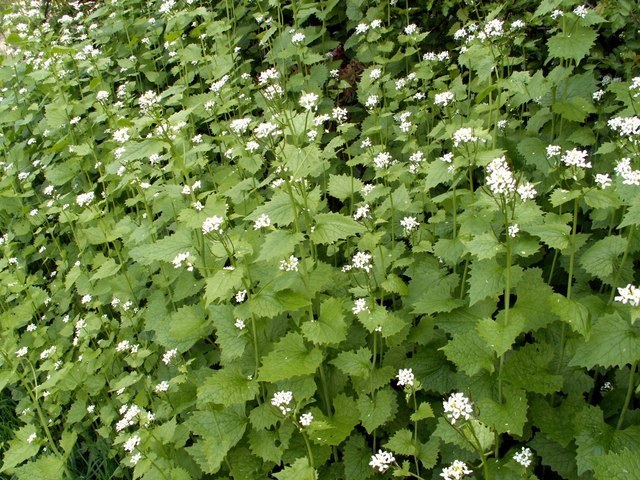
Key Identifying Features
Garlic mustard (Alliaria petiolata) is an invasive biennial in the mustard family. Its standout trait is the garlic or onion smell released when leaves or stems are crushed. Also look for:
- Four-petaled white flowers in small clusters (typical mustard-family bloom)
- Kidney-shaped, scalloped basal leaves in the first year
- Triangular, sharply toothed stem leaves in the second year
- Slender upright, four-sided seed pods (siliques)
First-year rosettes stay low; flowering plants reach 1-4 feet.
Leaves & Stems
First-year plants form a low rosette of round to kidney-shaped, scalloped (wavy-edged) leaves that stay green through winter. Second-year plants send up a stalk with alternate, triangular to heart-shaped leaves with coarse, sharp teeth. The leaves and stems, when crushed, give off an unmistakable garlic odor — the single best confirming feature. Stems are usually unbranched to sparsely branched. The plant has a slender white taproot often with an S- or L-shaped crook near the top.
Flowers & Fruit
Flowers are small, white, with four petals arranged in a cross (the classic mustard/Brassicaceae pattern), clustered at the top of the stem in spring. They mature into long, slender, four-sided erect seed pods (siliques) that stand upright along the stalk and split to release small black seeds. A single plant can produce hundreds to thousands of seeds.
How to Tell It Apart from Look-Alikes
- Violets and ground ivy: First-year garlic mustard rosettes resemble these, but only garlic mustard smells of garlic when crushed and has scalloped kidney-shaped leaves without a square stem.
- Creeping Charlie (ground ivy): Square stems and minty (not garlic) smell.
- Fringecups / saxifrages: Lack the four-petaled white mustard flower and garlic odor.
- Other white mustards: Share the four-petaled flower but lack the strong garlic smell and the triangular toothed stem leaves.
The garlic odor plus four-petaled white flowers plus triangular toothed leaves is diagnostic.
Where You'll Find It
Garlic mustard is a serious invasive in shaded woodlands, forest edges, trail sides, floodplains, and shady yards, especially across the eastern and midwestern U.S. and Europe. It tolerates deep shade, forms dense stands that crowd out native wildflowers, and releases chemicals that suppress beneficial soil fungi.
Quick ID Checklist
- Garlic smell when leaves/stems are crushed
- First-year kidney-shaped scalloped rosette
- Second-year triangular, sharply toothed stem leaves
- Four-petaled white flowers in clusters
- Slender upright four-sided seed pods
- White taproot with an S-shaped crook
If a shade-loving plant with four-petaled white flowers smells distinctly of garlic when you crush a leaf, it is garlic mustard.
Frequently asked questions
What is the surest way to identify garlic mustard?
Crush a leaf or stem and smell it. A distinct garlic or onion odor, combined with four-petaled white flowers and triangular, sharply toothed leaves, confirms garlic mustard. The smell fades on older or dried foliage, so test fresh growth.
Why is garlic mustard considered so invasive?
It tolerates deep shade, produces thousands of seeds, stays green through winter, and releases chemicals that suppress soil fungi many native plants depend on, allowing it to form dense stands that displace native woodland wildflowers.
How do I tell first-year garlic mustard from violets or ground ivy?
All three form low rosettes of rounded, scalloped leaves, but only garlic mustard smells strongly of garlic when crushed. Ground ivy has square stems and a minty smell, and violets have no garlic odor and produce purple five-petaled flowers.