
Garlic Identification Guide
Identify garlic by its flat strap-like leaves, papery-skinned segmented bulb of cloves, and unmistakable pungent sulfur smell. Covers how to separate it from onions and leeks.
Read the full Garlic encyclopedia entry →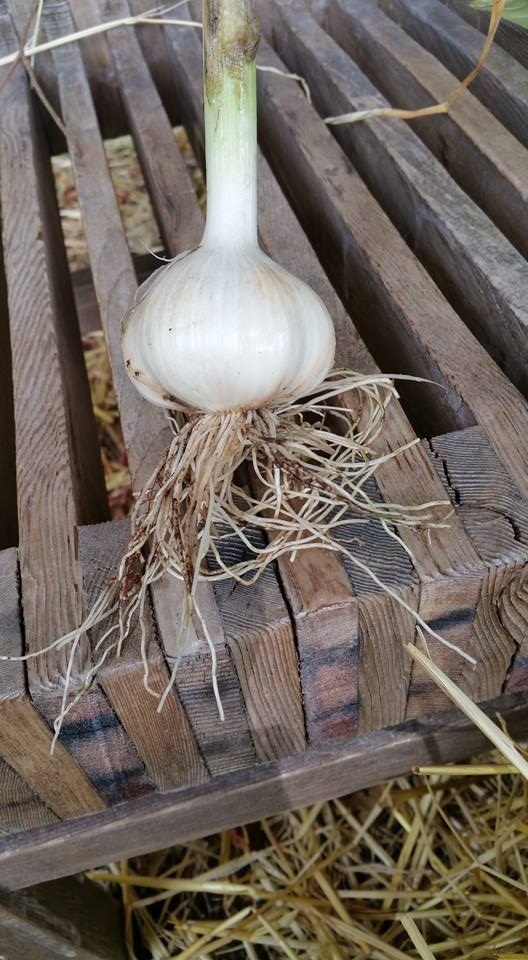
Key Identifying Features
Garlic (Allium sativum) is a bulb-forming perennial in the onion family (Amaryllidaceae, Allium genus). Its defining traits are a bulb divided into wedge-shaped cloves wrapped in white-to-purplish papery skin, flat, folded, strap-shaped leaves, and a powerful pungent sulfurous garlic odor when any part is bruised. The smell alone separates it from nearly all non-allium plants.
Leaves & Stems
- Leaves are flat, linear, and keeled (folded lengthwise like a shallow V), not hollow and round.
- They grow 30-60 cm long, grayish-green, arising in two ranks from a central stalk.
- Hardneck garlic sends up a stiff central flower stalk called a scape that curls in a loop before straightening.
- Softneck garlic has no woody central stalk, allowing the leaves to be braided.
Flowers & Fruit
- The scape ends in a spathe-covered cluster that opens to small bulbils (mini aerial cloves) mixed with sterile pinkish-white flowers.
- Garlic rarely sets true seed; it reproduces mainly by cloves and bulbils.
How to Tell It Apart from Look-Alikes
- Onion (Allium cepa) has rounded, hollow, tubular leaves and a single layered bulb (no separate cloves).
- Leek (Allium porrum) has broad flat leaves but forms a thick stem, not a clove cluster.
- Wild garlic / ramsons (Allium ursinum) has broad flat leaves and a garlic smell but a single small bulb and white star flowers.
- Lily-of-the-valley and death camas have similar strap leaves but lack any garlic/onion smell entirely. The pungent odor is the key distinction: no allium smell means it is not garlic.
Where You'll Find It
Garlic is cultivated globally in gardens and farms, planted in autumn for a summer crop. It prefers full sun and rich, well-drained soil. It is not truly wild but occasionally persists at old garden sites.
Quick ID Checklist
- Bulb splits into several papery-skinned cloves
- Flat, folded strap leaves (not hollow tubes)
- Strong sulfurous garlic smell when crushed
- Hardneck types show a coiling flower scape
- Flower head bears bulbils, rarely true seed
Frequently asked questions
What is the difference between garlic and onion leaves?
Garlic leaves are flat and folded into a shallow V, while onion leaves are round and hollow like tubes. Garlic bulbs also split into cloves; onions form a single layered bulb.
Why does my garlic have a curling stalk?
That curling stalk is the scape, produced by hardneck garlic varieties. It bears a cluster of tiny aerial bulbils and is often removed to direct energy into the bulb.
Does garlic produce seeds?
Garlic rarely sets viable true seed. It reproduces mainly through underground cloves and the small aerial bulbils formed in the flower head.