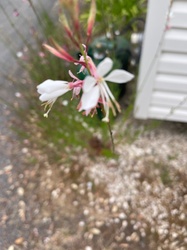
Gaura Identification Guide
Recognize Gaura (Oenothera lindheimeri) by its airy wands of butterfly-like four-petaled flowers dancing on wiry stems.
Read the full Gaura encyclopedia entry →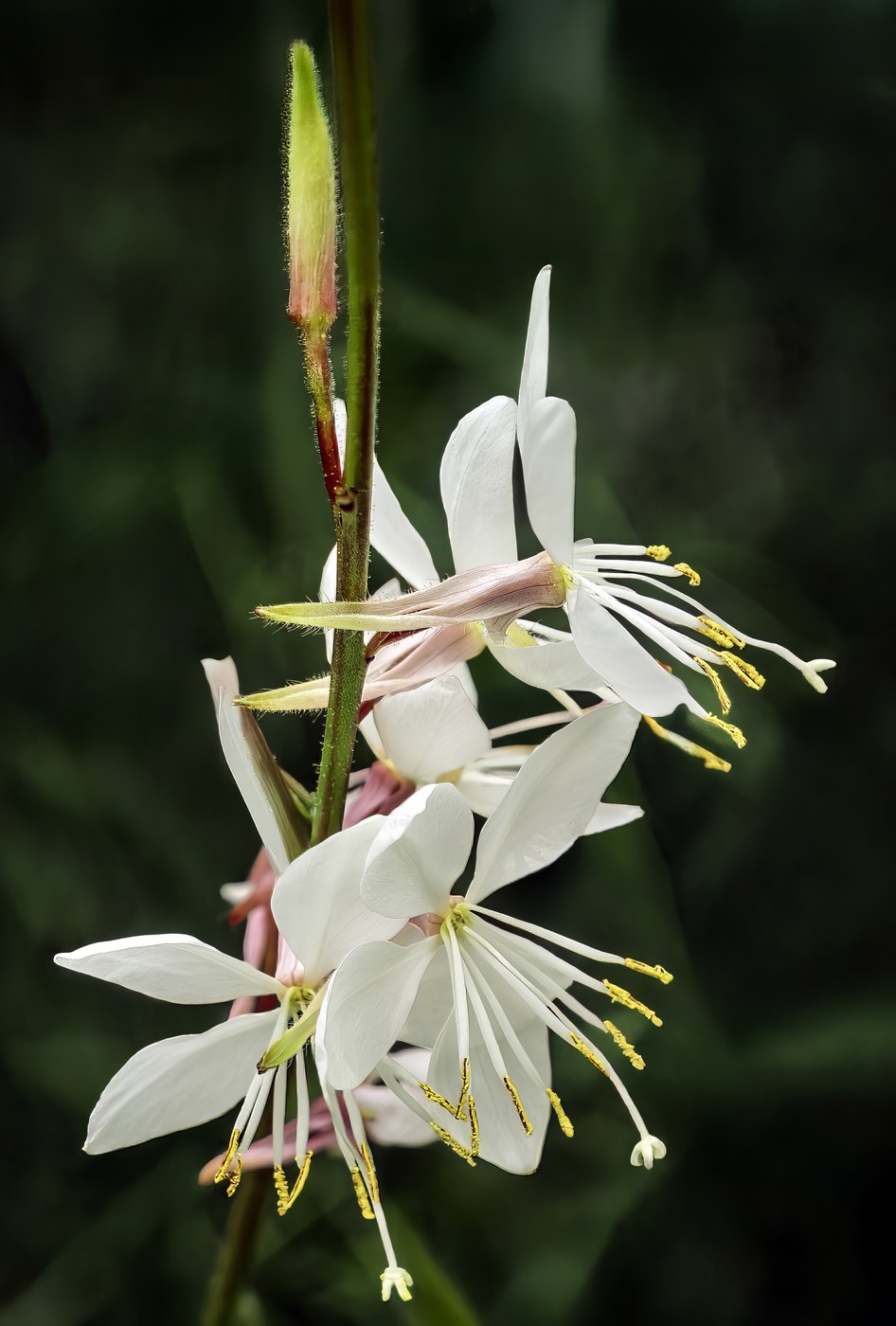
Key Identifying Features
Gaura (Oenothera lindheimeri, formerly Gaura lindheimeri), also called whirling butterflies or wand flower, is an airy, long-blooming perennial. Look for:
- Delicate four-petaled flowers that flutter on thin, wiry stems like a cloud of small butterflies
- Flowers in white to pink, with long, prominent stamens
- A loose, open, fountain-like habit 2-4 ft tall
- Narrow, willow-like leaves, sometimes spotted maroon
Leaves & Stems
Leaves are narrow, lance- to spoon-shaped (lanceolate to spatulate), 1-3 in long, with smooth or slightly toothed edges, and arranged alternately. Foliage is often gray-green and sometimes flecked with reddish-maroon spots. Stems are slender, wiry, branching, and somewhat lax, giving the whole plant an airy, see-through quality that sways in the slightest breeze.
Flowers & Fruit
From late spring through frost, gaura produces a long succession of flowers along slender spike-like racemes. Each flower is about 1 in across with four spoon-shaped petals all angled to the upper side, plus eight long, drooping stamens and a cross-shaped stigma, creating a butterfly silhouette. Buds and petals open white and often age to pink, so a single wand shows mixed shades. Only a few flowers open at once along each stem. Fruits are small, hard, nut-like capsules.
How to Tell It Apart from Look-Alikes
- Evening primrose (other Oenothera) — related, but most have larger, cup-shaped four-petaled flowers, often yellow, on stouter plants.
- Fireweed / willowherb (Epilobium) — also has willow-like leaves and pink four-petaled flowers, but they're held in denser spikes and the plant is more upright/leafy.
- Cosmos — airy too, but flowers are daisy-like with many petals, not four.
- Verbena bonariensis — airy and wiry, but tiny clustered purple flowers in flat heads, not single butterfly blooms.
The four-petaled, butterfly-shaped flowers fluttering on bare wiry wands identify gaura.
Where You'll Find It
Native to Texas and the south-central United States, found in prairies, open fields, and roadsides on well-drained soil in full sun. It's heat- and drought-tolerant and hugely popular as a long-blooming border and container plant worldwide. Look for its hovering white-pink blooms all summer.
Quick ID Checklist
- Airy, fountain-shaped plant 2-4 ft tall
- Slender, wiry, swaying stems
- Narrow willow-like leaves, sometimes maroon-spotted
- Four-petaled butterfly-like flowers, white aging to pink
- Long drooping stamens
- Sunny, well-drained habitat
If small four-petaled blooms seem to hover like butterflies above thin swaying stems, you've found gaura.
Frequently asked questions
Why is gaura called 'whirling butterflies'?
Its four-petaled flowers, angled upward with long stamens, resemble small butterflies, and they flutter on thin wiry stems in the breeze, creating a dancing effect.
Is gaura the same as evening primrose?
It's now classified within Oenothera, the evening primrose genus, but gaura has smaller, butterfly-shaped flowers on wiry, airy stems rather than large cup-shaped blooms.
Why are my gaura flowers both white and pink?
The flowers typically open white and age to pink, so a single flowering stem often shows a mix of both shades at once.
Where is gaura native to?
The south-central United States, especially Texas and Louisiana, where it grows in prairies and open fields in full sun.
Gaura identified by the community
Recent Gaura specimens identified with Plant Identifier.