
Ginkgo Biloba Identification Guide
How to identify Ginkgo biloba (maidenhair tree) by its one-of-a-kind fan-shaped, often two-lobed leaves with forking parallel veins and its strong-smelling fleshy seeds.
Read the full Ginkgo Biloba encyclopedia entry →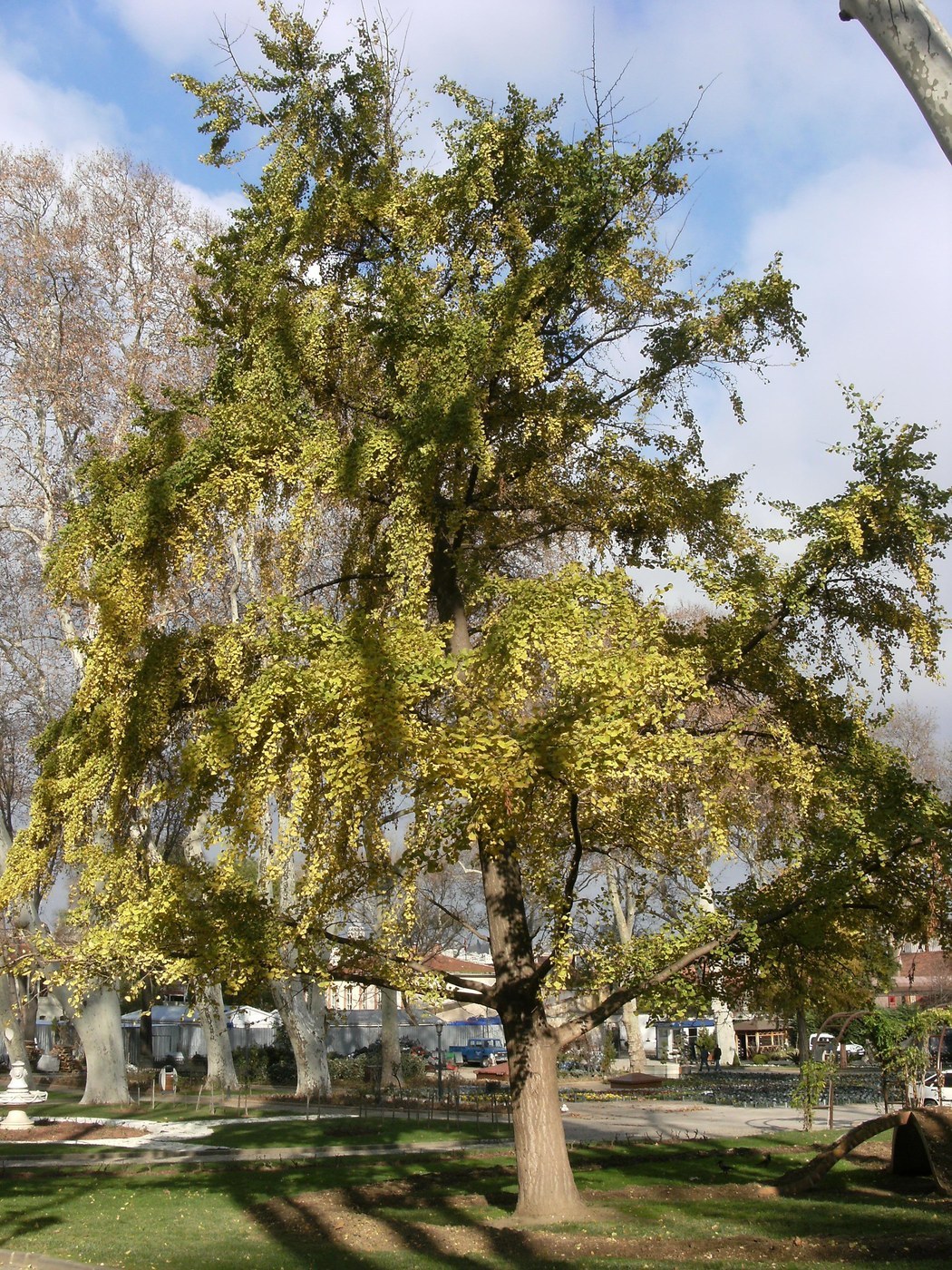
Key Identifying Features
Ginkgo (Ginkgo biloba), the maidenhair tree, is a living fossil with no close living relatives, and its leaf is unmistakable: a fan-shaped (flabellate) blade, leathery and bright green, usually with a notch or split in the middle dividing it into two lobes (the biloba of the name). The veins are equally distinctive — they fork repeatedly (dichotomous) and run parallel to the leaf edge, with no central midrib and no net-veining, a feature found in no other broadleaf tree.
- Fan-shaped leaf, often notched into two lobes
- Forking parallel veins, no midrib, no net
- Leaves clustered on short, stubby spur shoots
- Brilliant uniform golden-yellow fall color
Leaves & Stems
Leaves are 2-4 inches wide, fan-shaped on a long slender stalk, leathery, and bright to deep green. The margin is smooth or wavy; the characteristic central cleft is most pronounced on long-shoot leaves. Foliage is borne in two ways: scattered along new long shoots, and in tufts of 3-5 leaves at the tips of woody spur shoots (short shoots) along older branches — a diagnostic arrangement. In autumn the whole tree turns a clear, vivid yellow and often drops its leaves within a day or two.
Twigs bear obvious knobby spur shoots. The tree is large (50-80+ feet), with deeply furrowed gray-brown bark and a habit that is conical when young, broadening with age.
Flowers & Fruit
Ginkgo is a gymnosperm and dioecious — separate male and female trees. Males produce small, catkin-like pollen cones in spring. Females bear ovules that develop into plum-like, fleshy seeds about 1 inch across, green ripening to yellow-orange. When the fleshy coat rots it smells strongly rancid (like vomit or rotten butter) due to butyric acid — a memorable ID clue.
How to Tell It Apart from Look-Alikes
- Maidenhair fern: shares the leaf texture/shape resemblance (hence the common name) but is a fern, not a tree.
- No other tree has fan-shaped, forking-veined leaves on spur shoots — there are essentially no true botanical look-alikes.
- Maple, sweetgum, etc. all have netted veins and a midrib, immediately separating them.
If the leaf is a notched green fan with forking parallel veins, it is ginkgo — full stop.
Where You'll Find It
Ginkgo is native to China but survives in the wild only in small relict populations; it is now planted worldwide as a tough, pollution-tolerant street and park tree. Cities favor it for its pest resistance and beauty — but usually plant male trees only, since female seeds make a foul mess on sidewalks. Look for it lining urban streets, in campuses, parks, and temple grounds.
Quick ID Checklist
- Fan-shaped leaf, often split into two lobes
- Forking, parallel veins; no midrib, no netting
- Leaves in tufts on short spur shoots
- Uniform golden-yellow fall color, dropping all at once
- Female trees bear strong-smelling fleshy seeds
- Common as a planted urban street/park tree
Frequently asked questions
What makes a ginkgo leaf unique?
Its fan shape, frequent central notch dividing it into two lobes, and especially its veins, which fork repeatedly and run parallel with no midrib and no net pattern — found in no other broadleaf tree.
Why do some ginkgo trees smell so strong?
Only female trees produce the fleshy seeds, whose rotting outer coat releases butyric acid and smells rancid. Cities therefore usually plant only male, seedless ginkgos, and the odor is a useful field clue.
Is ginkgo a conifer or a broadleaf tree?
Neither exactly. It is a gymnosperm (a seed plant related to conifers) but with broad, deciduous, fan-shaped leaves — a unique living fossil with no close living relatives.
Why is it called the maidenhair tree?
Because its fan-shaped, forking-veined leaves resemble the leaflets of the maidenhair fern (Adiantum).