
Ginkgo Identification Guide
How to identify the ginkgo (Ginkgo biloba) by its unmistakable fan-shaped leaves, distinctive branching, and strong-smelling fleshy seeds.
Read the full Ginkgo encyclopedia entry →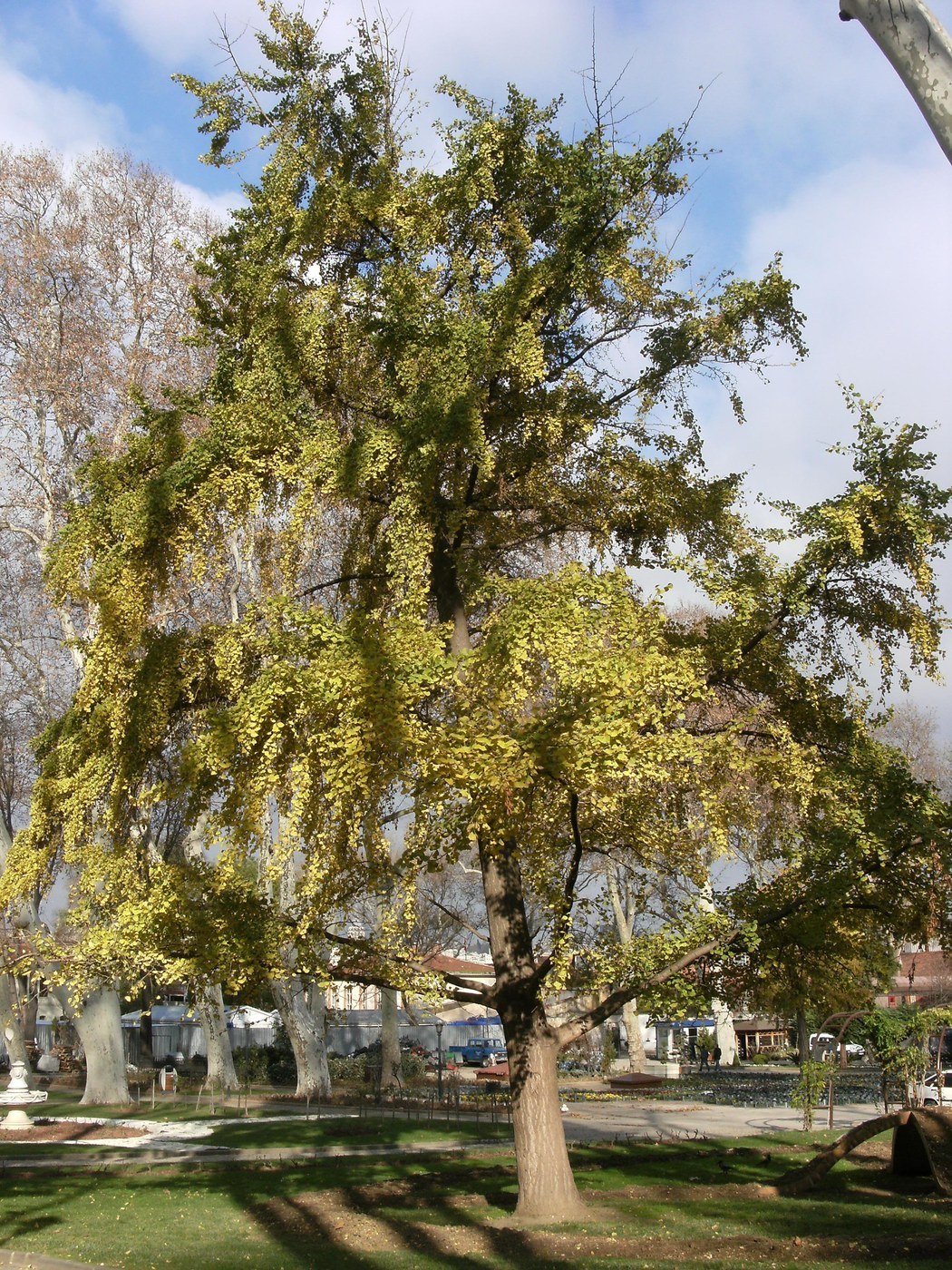
Key Identifying Features
The ginkgo (Ginkgo biloba), or maidenhair tree, is one of the most recognizable trees on Earth because no other tree shares its fan-shaped, parallel-veined leaves. It is a living fossil — the sole survivor of an ancient lineage. Look for:
- Fan- or wedge-shaped leaves with a notch dividing them into two lobes (biloba).
- Dichotomous (forking) veins that radiate out with no central midrib.
- Leaves borne in clusters on short, knobby spur shoots.
- A tall, often pyramidal-when-young to broad-crowned tree, reaching 20–35 m.
Leaves & Stems
Each leaf is 5–10 cm wide, leathery, and bright to medium green, turning a uniform brilliant golden-yellow in autumn before dropping — often all at once over a day or two. The hallmark is the venation: veins fork repeatedly (dichotomous) and run parallel to the leaf edge, with no central midrib — unlike any flowering tree. Leaves grow both singly on long shoots and in tufts on stubby spur shoots along older branches. Bark is gray-brown, becoming deeply furrowed with age.
Flowers & Fruit
Ginkgo is a gymnosperm, so it has no true flowers or fruit. Trees are dioecious (separate male and female). Male trees bear small pollen catkins in spring. Female trees produce naked ovules that develop into plum-like seeds about 2–3 cm, with a tan-orange fleshy outer coat (sarcotesta). When ripe and fallen, this flesh smells strongly of rancid butter or vomit (butyric acid) — a notorious giveaway.
How to Tell It Apart from Look-Alikes
Ginkgo is hard to confuse once you note the leaf. Still:
- Maidenhair fern (Adiantum): shares the fan-leaflet look that inspired the common name, but it's a low fern, not a tree.
- Some Tulip tree (Liriodendron) leaves are vaguely fan-like but have a clear midrib and net-like veins, and are larger with squared lobes.
- No other broadleaf tree has the forking parallel veins with no midrib — this is the single best diagnostic.
Where You'll Find It
Wild ginkgo is essentially extinct, but it is planted worldwide as a tough, pollution-tolerant street and park tree. Cities favor male clones to avoid the smelly seeds. Look for it lining urban streets, on campuses, and in temple and botanical gardens, especially across East Asia, Europe, and North America.
Quick ID Checklist
- Fan- or wedge-shaped leaves, often notched into two lobes
- Veins fork repeatedly, run parallel, no central midrib
- Leaves clustered on short knobby spur shoots
- Uniform golden-yellow autumn color, dropping en masse
- Female trees with strong-smelling orange-tan fleshy seeds
The fan leaf with forking veins seals the identification.
Frequently asked questions
What makes ginkgo leaves unique?
Their fan shape combined with dichotomous (forking) parallel veins and no central midrib is found in no other tree. Most ginkgo leaves also have a central notch splitting them into two lobes.
Why do some ginkgo trees smell so strong?
Only female trees produce seeds. The fleshy outer coat contains butyric acid, which smells like rancid butter when the seeds fall and decay. Cities plant male trees to avoid this, and the odor is a handy field clue.
Does ginkgo have flowers or fruit?
No. Ginkgo is a gymnosperm, so it produces pollen cones on males and naked seeds on females rather than true flowers or fruit. The seeds only resemble fruit because of their fleshy coat.
When is ginkgo easiest to identify?
In autumn, when the whole tree turns vivid golden-yellow and drops its leaves over a short period, it's striking and unmistakable. The fan leaf identifies it any time during the growing season.