Ginseng Identification Guide
Recognize ginseng by its whorl of palmately compound five-leaflet leaves, central cluster of greenish flowers, bright red berries, and forked aromatic root. Includes how to age plants by prongs.
Read the full Ginseng encyclopedia entry →Key Identifying Features
Ginseng (Panax species, notably American Panax quinquefolius and Asian Panax ginseng) is a slow-growing woodland perennial in the ivy family (Araliaceae). Its hallmark is a whorl of palmately compound leaves, each typically with five toothed leaflets, atop a single stem, with a central cluster of small greenish flowers that ripen to a tight bunch of bright red berries. The prized root is forked and aromatic.
Leaves & Stems
- A single smooth stem (15-50 cm) bears a whorl of 1-4 compound leaves ("prongs") at the top.
- Each leaf is palmately compound, usually with 5 leaflets (two smaller lower, three larger upper).
- Leaflets are oval to obovate, pointed-tipped, with finely toothed (serrated) margins.
- The number of prongs indicates age: a single prong is young; three to four prongs signal a mature plant several years old.
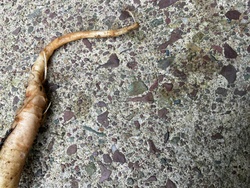
- The root is pale tan, fleshy, often forked or man-shaped, with a sweet earthy aroma.
Flowers & Fruit
- A small rounded umbel of inconspicuous greenish-white flowers rises from the center where the leaf stalks meet.
- Flowers ripen into a tight cluster of bright red (sometimes red-and-yellow) berries in late summer.
- Each berry contains two seeds.
How to Tell It Apart from Look-Alikes
- Virginia creeper has five leaflets but is a climbing vine with tendrils, not a single-stemmed herb.
- Wild sarsaparilla (Aralia nudicaulis) has compound leaves and a similar habitat but its leaflets are in threes/fives on separate divisions and flowers form three round clusters.
- Dwarf ginseng (Panax trifolius) has only three stalkless leaflets and white flowers with a round yellowish berry.
- The palmate 5-leaflet whorl with a central red berry cluster confirms true ginseng.
Where You'll Find It
Ginseng grows in rich, shaded, moist hardwood forests with deep leaf litter, often on cool north- or east-facing slopes. American ginseng is found in eastern North America; Asian ginseng in northeastern Asia. It is slow-growing and increasingly protected from over-harvest.
Quick ID Checklist
- Whorl of palmately compound leaves, usually 5 leaflets each
- Central umbel of greenish flowers → bright red berry cluster
- Prong count indicates age (3-4 = mature)
- Forked aromatic tan root
- Found in rich shaded hardwood forest
Frequently asked questions
How can I tell how old a ginseng plant is?
Count the prongs (compound leaves): a single prong is a young plant, two indicates a few years, and three to four prongs signal a mature plant several years old and ready to reproduce.
What do ginseng berries look like?
Mature plants form a tight central cluster of bright red berries in late summer, each containing two seeds, rising from where the leaf stalks meet the stem.
How do I distinguish ginseng from Virginia creeper?
Both can show five leaflets, but Virginia creeper is a climbing vine with tendrils, while ginseng is a single low herb with a whorl of palmate leaves and a central berry cluster.
Where does wild ginseng grow?
It favors rich, moist, shaded hardwood forests with deep leaf litter, typically on cool north- or east-facing slopes, and grows slowly over many years.
Ginseng identified by the community
Recent Ginseng specimens identified with Plant Identifier.