
Goatsbeard Identification Guide
How to recognize Aruncus dioicus, a tall woodland perennial with airy cream-white plumes that resembles a giant astilbe.
Read the full Goatsbeard encyclopedia entry →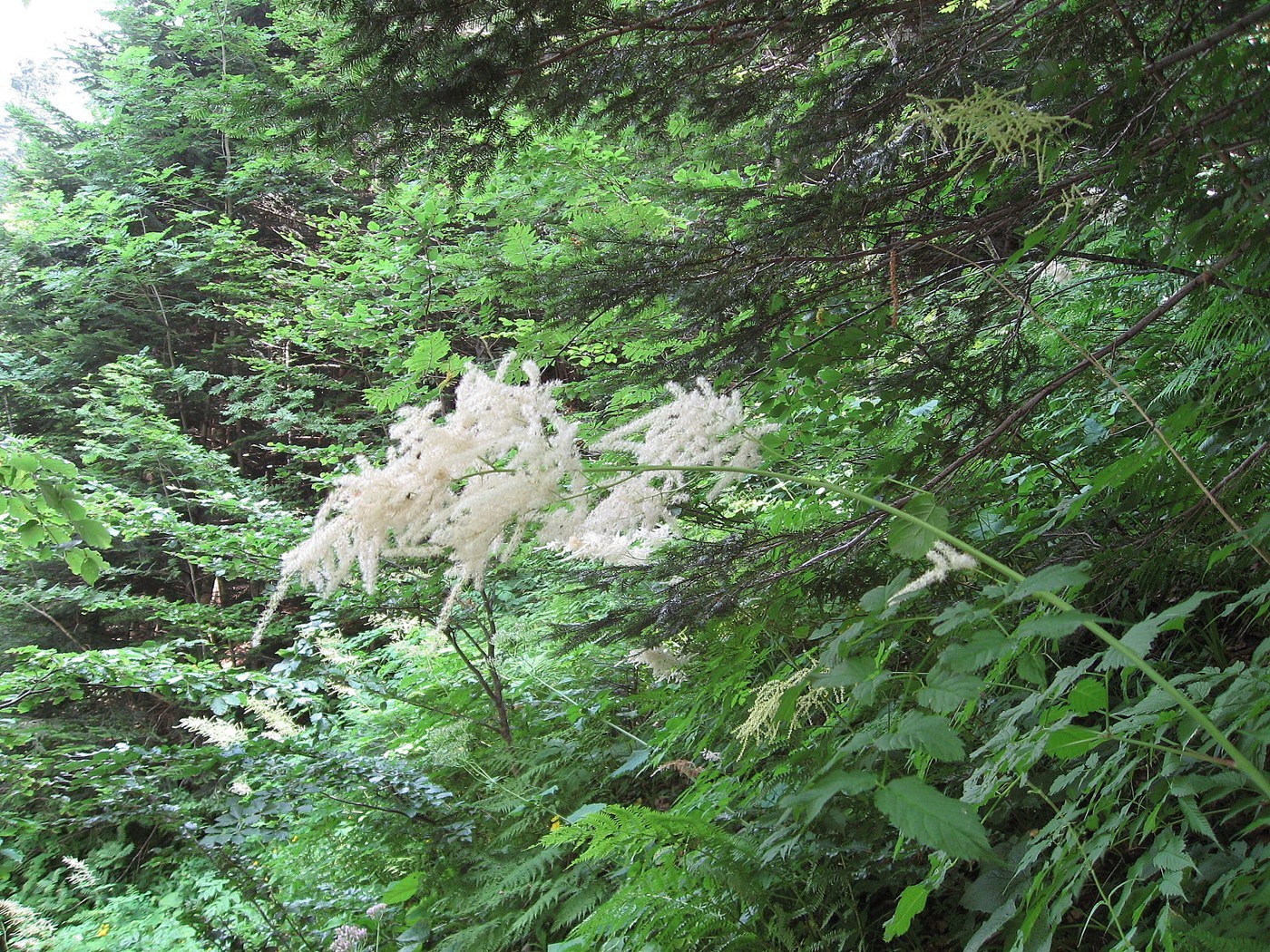
Key Identifying Features
Goatsbeard (Aruncus dioicus) is a large, clump-forming perennial of moist woodlands across the Northern Hemisphere. Look for:
- Tall, branching plumes of tiny creamy-white flowers held well above the foliage in early summer
- Large, compound (twice- or thrice-divided) leaves with toothed, pointed leaflets
- A shrubby, mounded habit reaching 4-6 ft tall and nearly as wide
- Separate male and female plants (dioecious) — male plumes are showier and fluffier
The overall look is that of a supersized astilbe, but goatsbeard is woodier and much larger.
Leaves & Stems
Leaves are alternate and 2-3 times pinnately compound, meaning each leaf divides into many leaflets. Individual leaflets are ovate, doubly serrate (toothed), and taper to a sharp point, typically 2-4 in long. The foliage is fresh green and forms a dense, fern-like mound. Stems are stout, branching, and unarmed — no thorns or hairs of note. There is no leaf rosette at the base; growth emerges as upright leafy canes.
Flowers & Fruit
Flowering occurs in late spring to early summer. The inflorescence is a large, feathery panicle of branched spikes, 6-20 in long, made of countless tiny 5-petaled flowers about 1/8 in across. Color is cream to white. Because plants are dioecious:
- Male flowers have prominent stamens, giving fuller, brighter plumes
- Female flowers are slightly greener and produce small dry follicles that turn brown and persist into autumn
How to Tell It Apart from Look-Alikes
- Astilbe — much smaller (1-3 ft), grows from a crown of finer ferny leaves, and comes in pink/red as well as white; goatsbeard is far larger and only cream-white.
- Meadowsweet (Filipendula) — has fragrant, fluffier flat-topped clusters and lobed (not fully compound) leaves.
- False goatsbeard (Astilbe biternata) — very similar but has a terminal 3-lobed leaflet and is native to the southern Appalachians.
- Salsify (Tragopogon), also called goatsbeard, is completely different — a yellow dandelion-like flower; don't confuse the names.
Where You'll Find It
Goatsbeard favors moist, rich, partly shaded woodland edges, stream banks, and ravines. In gardens it's grown as a bold specimen for shade. It is hardy and widespread in temperate North America, Europe, and Asia. Look for it blooming at woodland margins in June.
Quick ID Checklist
- 4-6 ft tall, shrub-like mound
- Large twice/thrice-compound leaves with sharply toothed, pointed leaflets
- Big creamy-white feathery plumes in early summer
- Separate male (fluffy) and female (seed-bearing) plants
- Moist, shady habitat
If you find a giant astilbe-like plant towering in damp shade with airy white plumes, you've almost certainly found goatsbeard.
Frequently asked questions
Is goatsbeard the same as astilbe?
No. They look similar and are sometimes confused, but goatsbeard (Aruncus) is much larger (4-6 ft) and only comes in cream-white, while astilbe is smaller and available in pinks and reds.
Why do some goatsbeard plants set seed and others don't?
Goatsbeard is dioecious — plants are either male or female. Only female plants form the small brown follicles; male plants have showier, fluffier plumes but no seed.
Is the yellow 'goatsbeard' I see in fields the same plant?
No. That is salsify (Tragopogon), a dandelion-relative with yellow flowers and a giant seed puff. It shares the common name but is unrelated to Aruncus.
Where is the best place to look for goatsbeard?
Moist, rich, partly shaded spots — woodland edges, ravines, and stream banks — where it blooms in late spring to early summer.