Goji Berry Identification Guide
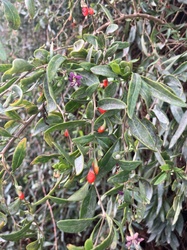
Identify the goji berry (Lycium barbarum) by its arching thorny stems, narrow leaves, purple star flowers, and bright red-orange ellipsoidal berries.
Read the full Goji Berry encyclopedia entry →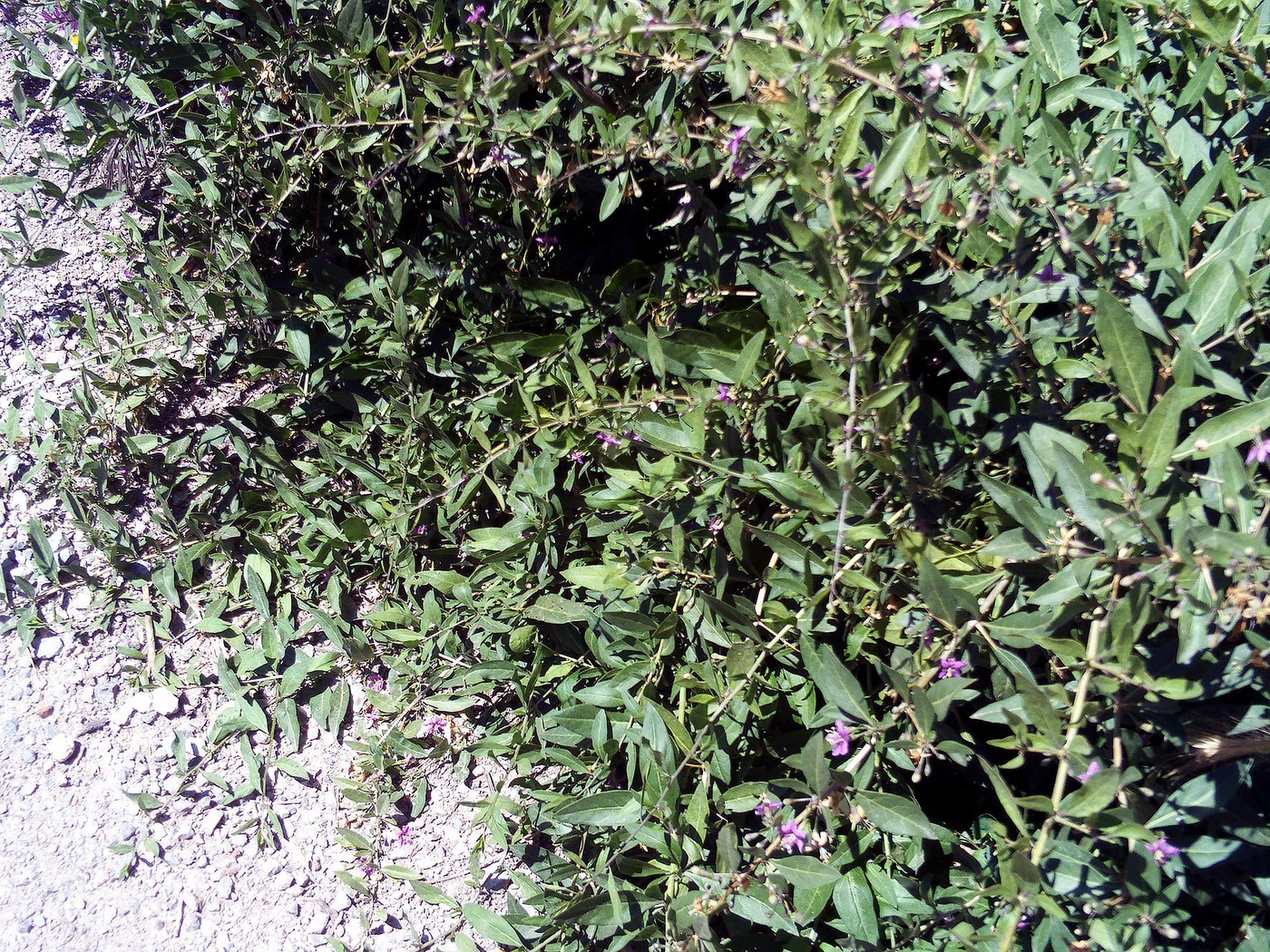
Key Identifying Features
The goji berry, or wolfberry (Lycium barbarum, and the related L. chinense), is a deciduous, sprawling, somewhat thorny shrub in the nightshade family (Solanaceae). It grows 1-3 m (3-10 ft) tall with long, arching, vine-like branches that often droop to the ground. Diagnostic features are the lance-shaped grayish-green leaves, small purple trumpet flowers, and shiny bright orange-red elongated berries.
Leaves & Stems
- Leaves are narrowly lanceolate to ovate, 2-8 cm long, soft, slightly fleshy, and gray-green, often appearing in small clusters along the stem.
- Stems are slender, gray-tan, flexible and arching, sometimes bearing small spines at leaf nodes.
- The plant suckers and sprawls, forming thickets if unpruned.
Flowers & Fruit
- Flowers are small (1-2 cm), funnel- to star-shaped, with five lobes, lavender to purple fading toward white, with conspicuous yellow stamens.
- They appear in late spring through summer, singly or in small clusters in the leaf axils.
- Fruit is a bright orange-red, glossy ellipsoidal berry, 1-2 cm long, slightly tapered like a tiny rugby ball, containing many small yellow seeds.
- Berries ripen from summer into autumn and dry to a wrinkled red raisin-like form.
How to Tell It Apart from Look-Alikes
- Other nightshades (Solanum spp., bittersweet): many have round berries; goji's berry is distinctly elongated/oval.
- Barberry (Berberis): also has red oblong berries and spines, but barberry has simple yellow flowers and small spoon-shaped leaves with spiny clusters, and woody, grooved stems.
- Boxthorn relatives: other Lycium species look similar; L. barbarum has longer, narrower leaves and larger fruit than the rounder-leaved L. chinense.
- Other red-berried nightshade vines have round berries on non-thorny stems, unlike goji's oval berries on arching, sometimes thorny branches.
Where You'll Find It
Native to China and the Himalayan region, goji is now grown worldwide in temperate gardens, orchards, and as a hedge. It tolerates poor, alkaline, even saline soils and full sun, and naturalizes along roadsides, fence lines, and disturbed ground in some areas. Its arching habit and tolerance of drought make it common in dry-climate home gardens.
Quick ID Checklist
- Sprawling shrub with long arching, sometimes thorny stems
- Gray-green, soft, lance-shaped leaves often clustered
- Small purple 5-lobed funnel flowers with yellow stamens
- Glossy orange-red oval berries with many seeds
- Nightshade family; tolerates dry, poor soil
Frequently asked questions
What does a goji berry plant look like?
It is a sprawling deciduous shrub with long, arching, sometimes thorny branches, soft gray-green lance-shaped leaves, small purple funnel-shaped flowers, and bright orange-red oval berries.
What features best distinguish the goji plant?
Goji berries are distinctly elongated/oval and bright orange-red, growing on a thorny arching shrub with purple star flowers. The oval berry shape and the arching, sometimes spiny stems are the most reliable visual clues to the plant.
When do goji berries ripen?
Flowers appear from late spring through summer and the bright red berries ripen from mid-summer into autumn, often over a long staggered season.
What plant family does goji belong to?
Goji is a member of the nightshade family (Solanaceae), the same group as tomatoes and peppers, shown by its five-lobed purple star flowers and berry fruit.
Goji Berry identified by the community
Recent Goji Berry specimens identified with Plant Identifier.