
Golden Chain Tree Identification Guide
Identify the golden chain tree (Laburnum) by its long hanging chains of bright yellow pea flowers, clover-like trifoliate leaves, and flat bean-like pods.
Read the full Golden Chain Tree encyclopedia entry →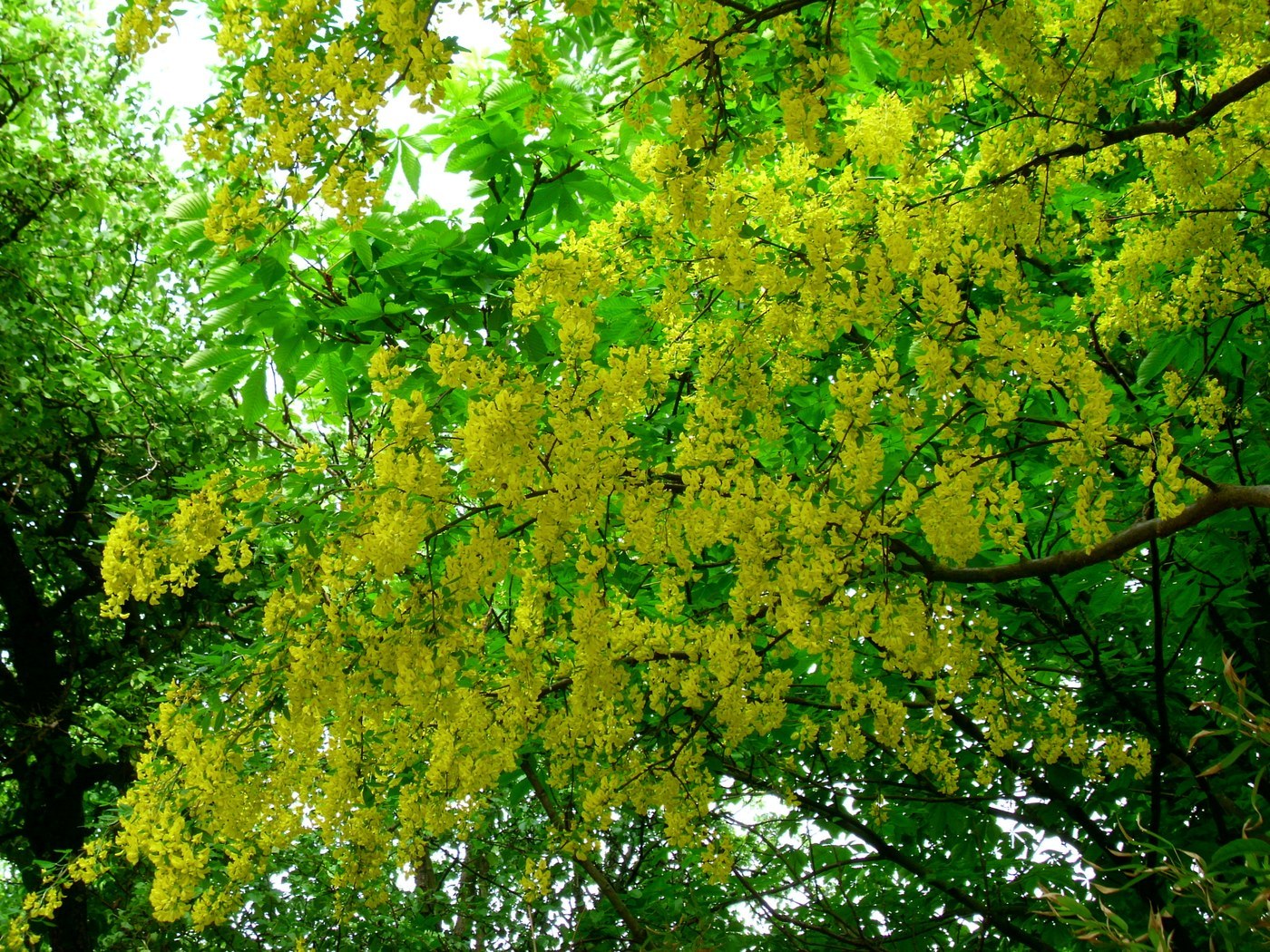
Key Identifying Features
The golden chain tree (Laburnum spp.) is a small deciduous tree in the legume family, grown for its dramatic spring display of long, dangling chains of golden-yellow flowers. In bloom it's unmistakable—curtains of yellow pea blossoms hanging beneath the foliage.
- Size & form: Small, 15–25 ft, with an upright then spreading, often vase-shaped crown.
- Bark: Smooth, greenish-brown to gray, sometimes with shallow fissures in age.
- Flowers: Vivid golden-yellow pea blossoms in long hanging chains.
Leaves & Stems
Leaves are trifoliate—three leaflets per leaf, like a large clover or bean leaf—and alternate on the stem. Each leaflet is oval, 1–3 inches long, smooth-edged, dull green above and often silky-hairy and grayish beneath. The clover-like three-part leaf is a strong clue distinguishing Laburnum from other yellow-flowering trees.
Flowers & Fruit
- Flowers (late spring): Classic pea-shaped (papilionaceous) flowers in pendulous chains (racemes) 6–24 inches long, vivid golden yellow. The hybrid Laburnum × watereri 'Vossii' has especially long, dense chains and is the most planted form.
- Fruit: Flat, bean-like pods that ripen brown and contain hard dark seeds. The pods strongly resemble pea or bean pods—a useful identification feature.
How to Tell It Apart from Look-Alikes
- Golden rain tree (Koelreuteria): Confusingly similar common name, but it has compound feathery leaves, upright flower clusters, and papery lantern-shaped pods—quite different.
- Mimosa / silk tree (Albizia): Feathery bipinnate leaves and pink powderpuff flowers.
- Wisteria: Also hangs in chains, but flowers are blue-purple and it's a woody vine.
- The combination of trifoliate clover-like leaves + hanging yellow pea-flower chains + bean pods points firmly to Laburnum.
Where You'll Find It
Native to the mountains of southern/central Europe, the golden chain tree is widely planted as an ornamental in cool-temperate gardens—the UK, northern Europe, the Pacific Northwest, and the northern U.S. (USDA 5–7). It dislikes hot, humid summers and is famously trained over arched laburnum walks/tunnels.
Quick ID Checklist
- Small tree, 15–25 ft, vase-shaped
- Trifoliate (3-leaflet) clover-like leaves, hairy beneath
- Long hanging chains of yellow pea flowers in late spring
- Flat bean-like pods
- Cool-climate ornamental
Frequently asked questions
What's the difference between a golden chain tree and a golden rain tree?
Despite the similar names they're unrelated. Golden chain (Laburnum) has trifoliate leaves and hanging yellow pea-flower chains, while golden rain tree (Koelreuteria) has large compound leaves and upright clusters followed by papery lantern pods.
Why won't my golden chain tree thrive in a hot climate?
Laburnum is adapted to cool European mountain conditions and struggles in hot, humid summers. It performs best in cool-temperate regions like the Pacific Northwest or northern Europe.
When does it bloom?
It blooms in late spring, typically May to early June, producing its signature curtains of golden flowers for a few weeks.
What features confirm a golden chain tree?
Look for the three-part, clover-like trifoliate leaves with silky-haired undersides, the long pendulous chains of yellow pea-shaped flowers, and the flat bean-like pods. Together these confirm Laburnum.