
Goldenseal Identification Guide
How to identify goldenseal (Hydrastis canadensis) by its pair of palmate maple-like leaves, single greenish flower, and bright yellow rhizome.
Read the full Goldenseal encyclopedia entry →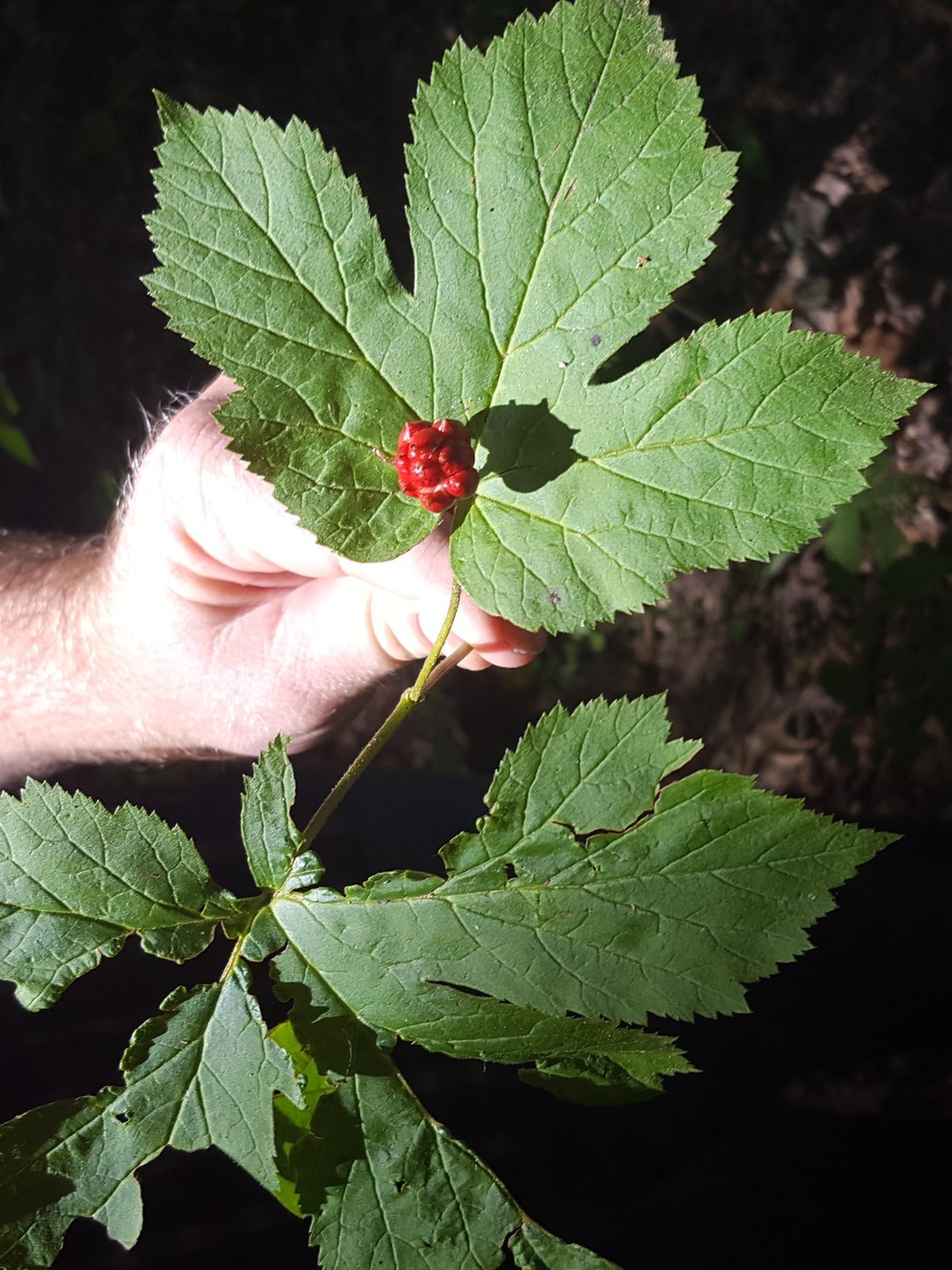
Key Identifying Features
Goldenseal (Hydrastis canadensis) is a small woodland perennial of eastern North America, prized and now uncommon due to overharvest. Key signs:
- A short, hairy single stem about 15–35 cm tall.
- Typically two palmately lobed leaves near the top, looking like crinkled maple leaves.
- A bright yellow, knotty rhizome with a yellow interior — the source of the name.
- A solitary inconspicuous flower followed by a single red berry cluster.
Leaves & Stems
A flowering plant produces a forked stem bearing two leaves; the upper is larger. Leaves are broad, rounded, and palmately 5–7 lobed with doubly serrated (toothed) margins and a wrinkled, deeply veined surface — much like a maple or thimbleweed leaf. Mature leaves can reach 20–30 cm wide. The stem and leaf veins are noticeably hairy. Non-flowering plants may have just one leaf. Snap or scratch the rhizome and you'll see a vivid bright yellow interior with a bitter taste — the single most reliable confirming feature.
Flowers & Fruit
In mid-to-late spring a single small flower opens above the leaves. It has no petals — instead a cluster of showy white-to-greenish stamens form a fuzzy pom-pom roughly 1 cm across; the three small greenish-white sepals quickly fall. By mid-summer the flower develops into a single raspberry-like cluster of bright red berries (each containing hard black seeds). The berries are not eaten.
How to Tell It Apart from Look-Alikes
- Wild geranium, mayapple, or thimbleweed (Anemone): have similar palmate or lobed leaves, but lack the bright yellow rhizome and the distinctive raspberry-like red berry.
- Mayapple (Podophyllum): bigger umbrella leaves and a single white flower, with a pale (not yellow) root.
- The yellow rhizome plus the two maple-like leaves plus a single red berry cluster is the diagnostic combination. Because goldenseal is rare and protected in places, observe rather than dig.
Where You'll Find It
Goldenseal grows in rich, moist, shady deciduous forests, often on north-facing slopes with leaf-litter soil. Its range centers on the eastern United States and southeastern Canada (Appalachians and Ohio Valley especially). It forms small patches via rhizome spread and is now scarce in the wild.
Quick ID Checklist
- Single hairy stem, 15–35 cm tall
- Two crinkled, maple-like palmately lobed leaves
- Solitary petalless flower with fuzzy white stamens (spring)
- Single raspberry-like cluster of red berries (summer)
- Bright yellow rhizome and yellow inner root
The yellow root plus maple-like leaf pair confirm goldenseal.
Frequently asked questions
Why is it called goldenseal?
The rhizome is bright yellow inside and out, and the scars left on it resemble old wax seals. The vivid yellow root is the plant's most distinctive identification feature.
What does goldenseal's flower look like?
It's a single, small, petalless flower made up of a fuzzy cluster of white-to-greenish stamens about a centimeter across, blooming in mid-to-late spring above the leaves.
How do I distinguish goldenseal from mayapple?
Mayapple has large umbrella-like leaves and a pale root, while goldenseal has two smaller maple-like leaves and a bright yellow rhizome. Goldenseal's red raspberry-like berry is also distinctive.
Is it okay to dig up goldenseal to identify it?
It's best not to. Goldenseal is threatened by overharvesting and protected in many areas. You can usually identify it confidently from the leaves, flower, and berry without disturbing the root.