
Grass Pink Orchid Identification Guide
How to recognize the grass pink orchid (Calopogon tuberosus) in bogs and wet meadows, including its unusual non-resupinate flower and grass-like leaf.
Read the full Grass Pink Orchid encyclopedia entry →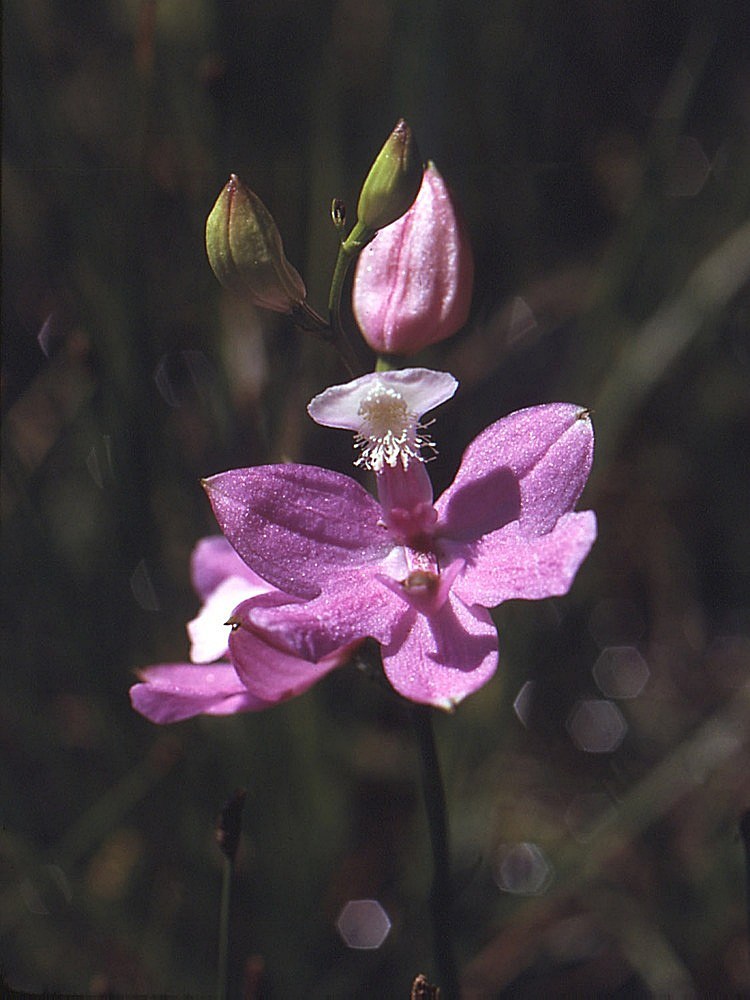
Key Identifying Features
The grass pink orchid (Calopogon tuberosus) is a native North American terrestrial orchid of bogs, fens, and wet meadows. Two features make it stand out:
- Magenta-pink flowers held on an open, branchless spike of 3-15 blooms
- An upside-down (non-resupinate) flower in which the lip sits at the top rather than the bottom
- A single, grass-like leaf rising from the base
This combination — a slender grassy orchid in standing-wet ground with the showy lip held aloft — is diagnostic.
Leaves & Stems
Most plants produce one (rarely two) narrow, pleated, grass-like leaf that emerges from a buried corm and clasps the base of the flowering stalk. The leaf is bright green, linear, and can reach 8-20 inches long but only about a half-inch wide, so a non-flowering plant looks almost exactly like surrounding sedges and grasses. The leafless flowering stem (scape) is smooth, round, and 1-3 feet tall.
Flowers & Fruit
Flowers bloom from the bottom of the spike upward over several weeks in late spring to mid-summer. Each is roughly 1-1.5 inches across with:
- Five spreading magenta-to-rose-pink tepals (sometimes white in rare forms)
- An upward-pointing lip crested with a tuft of golden-yellow, club-tipped bristly hairs that mimic pollen-bearing anthers
This yellow "false pollen" lures bees; when a bee lands, the hinged lip drops it onto the column. Fruit is a dry, ribbed, upright capsule releasing dust-like seed.
How to Tell It Apart from Look-Alikes
- Rose pogonia (Pogonia ophioglossoides) shares pink bog flowers but is resupinate (lip downward and bearded), has a leaf midway up the stem, and bears usually a single flower.
- Dragon's mouth (Arethusa bulbosa) is a smaller single-flowered bog orchid with the lip hanging downward and no grassy basal leaf at bloom time.
- Marsh grasses and sedges match the leaf but never produce the magenta orchid spike.
The upward-held, yellow-bearded lip is the surest separator — no other pink bog orchid carries the lip at the top.
Where You'll Find It
Look in acidic, sunny wetlands: sphagnum bogs, fens, wet pine savannas, seepage meadows, and pond margins across eastern and central North America. It needs constant moisture, full sun, and open ground, so it disappears as shrubs shade a site. Plants are easiest to spot when the magenta flowers rise above low sedges.
Quick ID Checklist
- Single grass-like basal leaf
- Leafless stem 1-3 ft tall
- Spike of 3-15 magenta-pink flowers, opening bottom to top
- Lip held at the TOP of the flower (non-resupinate)
- Tuft of golden-yellow bristles on the lip
- Growing in a sunny acidic bog or wet meadow
If all six match, you have a grass pink orchid. Because it is a protected wild orchid in many regions, photograph it in place and never dig it.
Frequently asked questions
Why does the grass pink orchid look upside down?
Its flower is non-resupinate, meaning the lip is held at the top instead of the bottom. The yellow bristles on that upper lip imitate pollen to attract bees.
How do I tell a non-flowering plant from grass?
You often can't with certainty — the single linear pleated leaf looks just like sedges. Wait for the magenta flower spike in early-to-mid summer to confirm.
Is it the same as rose pogonia?
No. Rose pogonia has the lip pointing downward with a fringed beard and usually one flower with a stem leaf, while grass pink holds its bristly lip upward on a leafless stalk.
Where does it grow?
In sunny, acidic, perpetually wet habitats such as sphagnum bogs, fens, and wet pine savannas, mainly in eastern and central North America.
Can I dig one up for my garden?
You should not. It is a protected native orchid in many areas and rarely survives transplanting because of its specialized bog requirements.