
Gray Pine Identification Guide
How to recognize Gray Pine (Pinus sabiniana) by its sparse blue-gray foliage, forked open crown, and massive heavy cones with sharp talon-like prongs.
Read the full Gray Pine encyclopedia entry →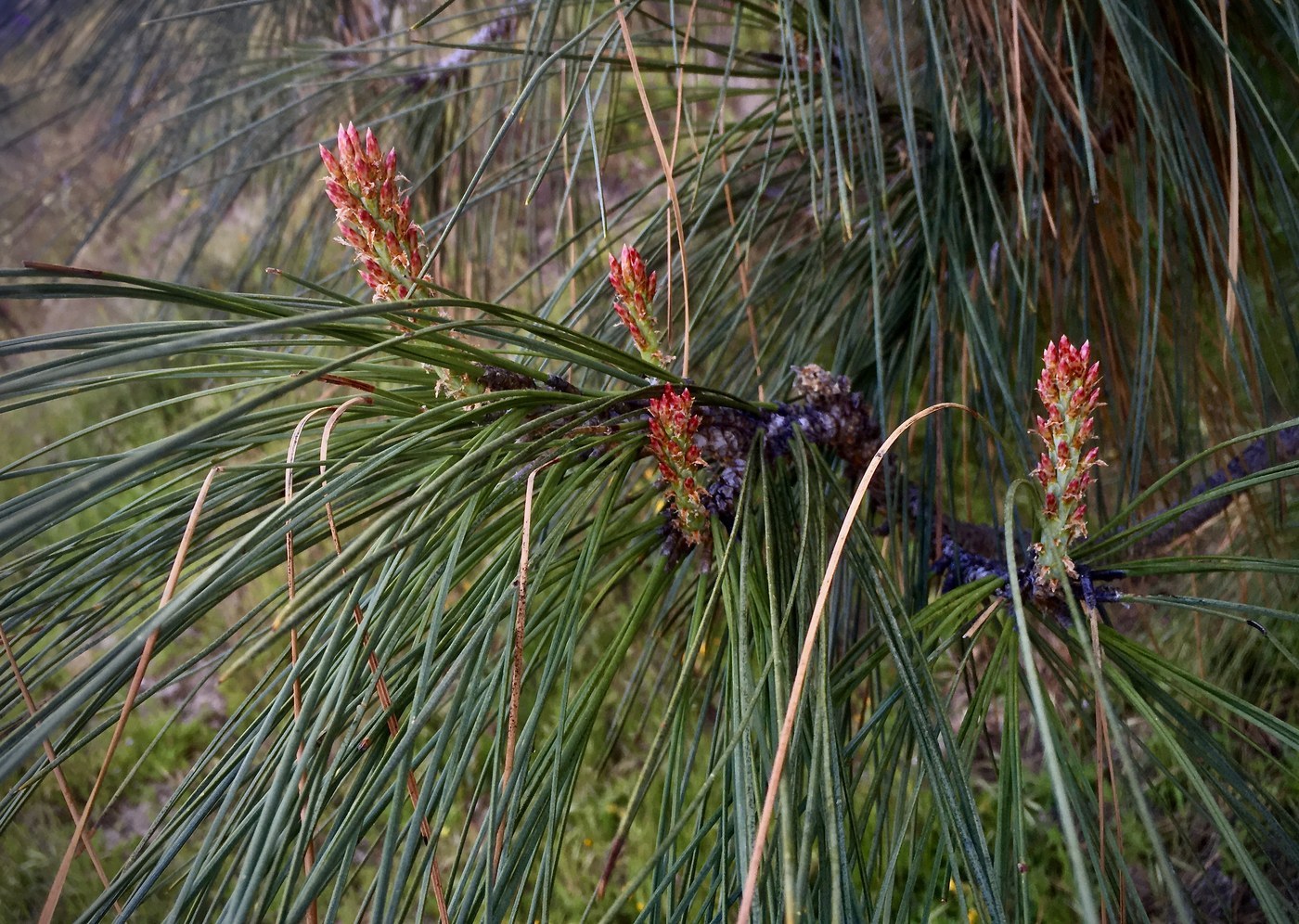
Key Identifying Features
Gray Pine (Pinus sabiniana), also called Foothill or Digger Pine, is one of the most distinctive pines of California's interior foothills. From a distance it looks wispy and almost ghostly, with a thin, airy crown that lets daylight pass straight through it — very different from the dense green of most pines.
- Sparse, drooping blue-gray to gray-green needles that give the whole tree a hazy appearance
- A trunk that typically forks into several leaning, crooked main stems well above the ground
- Enormous, heavy cones armed with sharp, hooked spines
- Medium height, usually 40–80 ft, with an open, irregular silhouette
Leaves & Stems
Needles are borne in bundles (fascicles) of three, each needle a long 8–13 inches, slender and drooping. Their distinctive pale gray-green to bluish color is the single best at-a-glance trait. The thin, sparse foliage clusters toward branch tips, leaving the gray, furrowed bark and forking limbs clearly visible. The bark is dark gray-brown with irregular ridges.
Flowers & Fruit
The cones are unmistakable. They are massive — 6 to 10 inches long, broad, and very heavy (up to 1–2 lbs), often described as the size of a small football. Each scale ends in a stout, sharply curved spine or claw. Cones take two years to mature, persist on the tree, and contain large, hard-shelled seeds eaten by wildlife. Pollen cones are small and yellow, appearing in spring.
How to Tell It Apart from Look-Alikes
- Coulter Pine has even larger, heavier cones but darker green (not gray) foliage and a straighter, single trunk; Coulter grows in southern California mountains while Gray Pine rings the Central Valley.
- Ponderosa Pine has dense, deep-green foliage, a straight trunk, and much smaller cones (3–6 in).
- Knobcone Pine has cones clustered tightly around the branches and pointing backward.
- The combination of gray, see-through crown + forked trunk + spiny football-sized cones is unique to Gray Pine.
Where You'll Find It
Gray Pine is essentially endemic to California (just into Oregon), encircling the Central Valley in the dry, hot foothills below the conifer belt, typically 500–4,000 ft. It thrives on poor, rocky, often serpentine soils and is a classic companion of blue oak and chaparral in oak-foothill woodland.
Quick ID Checklist
- Sparse, gray-blue, see-through crown
- Needles in 3s, 8–13 in, drooping
- Trunk often forked / leaning
- Huge spiny cones (6–10 in, very heavy)
- California interior foothills, hot dry sites
Frequently asked questions
Why does Gray Pine look so thin and see-through?
Its needles are sparse, long, and drooping with a pale gray-blue color, so the crown casts little shade and you can see the sky and trunk through it — a reliable field mark.
How can I tell Gray Pine from Coulter Pine?
Both have giant spiny cones, but Gray Pine has pale gray foliage and a forked, leaning trunk in California's foothills, while Coulter Pine has darker green needles and a straighter trunk in southern California mountains.
Are the cones dangerous to handle?
The cones are very heavy and the scales end in sharp, hooked spines, so handle them carefully — falling cones can be a real hazard beneath the tree.
Where does Gray Pine grow?
It grows in California's hot, dry interior foothills below the main conifer belt, typically 500-4,000 ft, on poor, rocky, often serpentine soils alongside blue oak and chaparral.