
Guava Tree Identification Guide
Identify the common guava (Psidium guajava) by its smooth peeling mottled bark, prominently veined opposite leaves, fluffy white flowers, and aromatic round fruit.
Read the full Guava Tree encyclopedia entry →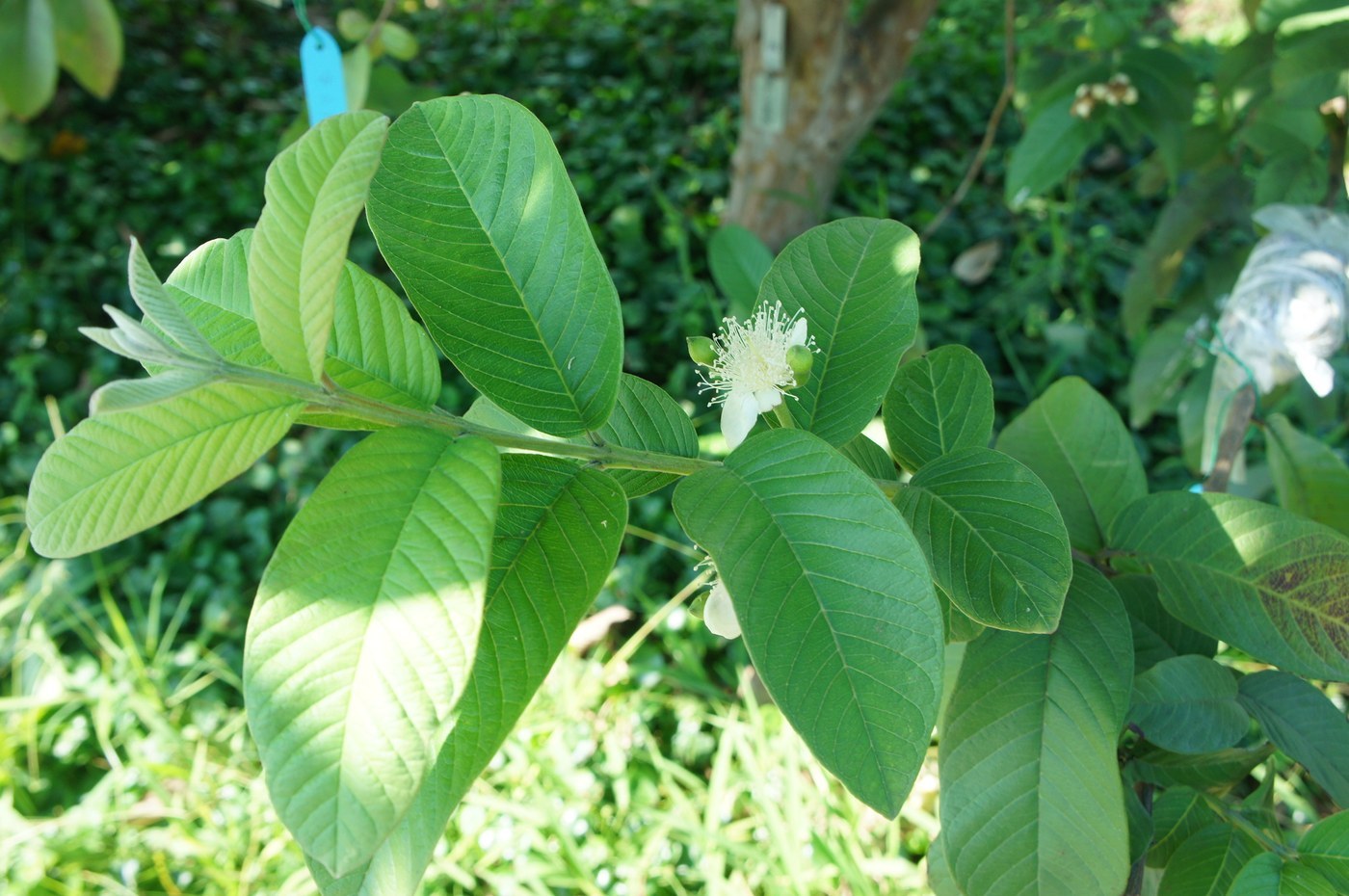
Key Identifying Features
The common guava (Psidium guajava) is a small evergreen to semi-deciduous tree or shrub, 3-10 m (10-33 ft) tall, in the myrtle family. The most reliable clues are its smooth, thin, mottled bark that flakes off to reveal greenish patches, its opposite, strongly veined leaves, showy white flowers with a brush of many stamens, and round-to-pear-shaped aromatic fruit with many small hard seeds.
Leaves & Stems
- Leaves are opposite, oblong to elliptical, 5-15 cm, dull green, with conspicuous parallel side veins that are sunken above and raised below.
- The underside is finely hairy; crushed leaves are aromatic.
- Bark is smooth, thin, copper-to-greenish-brown, and peels in flakes, often giving a mottled, almost camouflage look; young twigs are four-angled and downy.
Flowers & Fruit
- Flowers are white, about 2.5-3 cm, with four to five petals and a prominent pom-pom of numerous white stamens tipped with pale anthers.
- They are borne singly or in small clusters in the leaf axils.
- Fruit is a round to ovoid or pear-shaped berry, 4-12 cm, with thin yellow-green skin when ripe.
- Flesh is white, pink, yellow, or red, aromatic, packed with numerous small, very hard seeds.
How to Tell It Apart from Look-Alikes
- Strawberry guava (Psidium cattleianum): has smaller, glossier leaves and small dark-red round fruit; bark is reddish.
- Pineapple guava / feijoa (Acca sellowiana): has gray-green leaves with white undersides and red-and-white flowers; fruit is green and oval.
- Other myrtles: share the brush-like flowers, but guava's peeling mottled bark + strongly veined opposite leaves + seedy round fruit is distinctive.
Where You'll Find It
Native to tropical America, guava is now grown and naturalized throughout the tropics and subtropics worldwide, often becoming an invasive weed in pastures, roadsides, and forest edges. Look for it in home gardens, orchards, and disturbed wild areas. It tolerates a wide range of soils, full sun, and some drought, but is frost-sensitive.
Quick ID Checklist
- Smooth, thin, mottled bark that flakes off to greenish patches
- Opposite leaves with prominent sunken parallel veins
- Four-angled downy young twigs
- White flowers with a pom-pom of many stamens
- Round/pear-shaped aromatic fruit full of small hard seeds
Frequently asked questions
What is the easiest way to identify a guava tree?
Check the bark and leaves: guava has smooth, thin, mottled bark that peels in flakes to reveal greenish patches, and opposite leaves with strongly sunken parallel side veins. Together these are very distinctive.
What do guava flowers look like?
They are white, about 2.5-3 cm, with four to five petals and a showy central brush of many long white stamens, giving a fluffy pom-pom appearance typical of the myrtle family.
How do I tell common guava from strawberry guava?
Common guava has larger, dull, prominently veined leaves and larger yellow-green fruit, while strawberry guava has smaller, glossy leaves, reddish bark, and small dark-red round fruit.
Why are there so many hard seeds in guava fruit?
Guava fruit naturally contains numerous small, very hard seeds embedded in the central pulp. This abundance of hard seeds is normal and is one feature that helps confirm the fruit's identity.