
Heather Identification Guide
Identify heather by its low evergreen shrub form, tiny scale-like or needle leaves, and dense spikes of small bell or urn-shaped flowers.
Read the full Heather encyclopedia entry →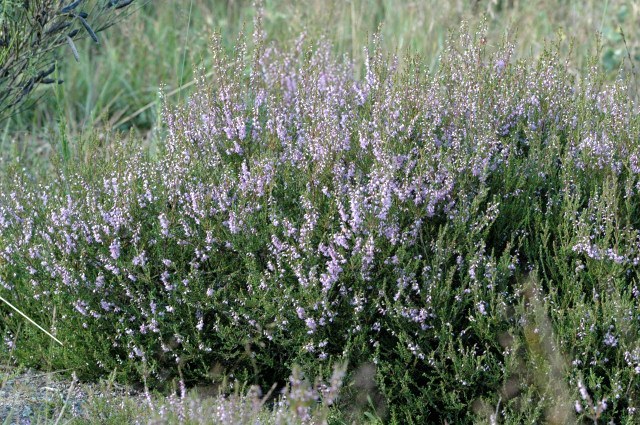
Key Identifying Features
Heather refers to low, woody, evergreen shrubs — true heather (Calluna vulgaris) and the closely related heaths (Erica) — recognized by their dense, mat-forming growth, tiny crowded leaves, and masses of small bell- or urn-shaped flowers along the stems. They cover open ground in a low, springy carpet.
- Low, spreading evergreen shrub (usually under 60 cm)
- Very small, scale-like or needle-like leaves packed along wiry stems
- Dense spikes of tiny bell/urn flowers, often pink-purple
- Woody, much-branched, twiggy base
Leaves & Stems
Leaves are minute — in Calluna they are tiny overlapping scales pressed flat against the stem in opposite rows, giving the shoots a knobbly, cord-like texture; in Erica heaths they are short needle-like leaves in whorls of 3–4. Both are evergreen, dark to grey-green, sometimes flushing bronze, gold, or red in cold or sun. Stems are wiry, woody, and densely branched, forming a tight low mound or carpet. The whole plant is tough and springy underfoot.
Flowers & Fruit
Flowers are small but numerous, lining the upper stems in spikes or clusters. Calluna flowers are tiny, bell-shaped, with the colored sepals as showy as the petals, in pink, purple, mauve, or white, blooming late summer into autumn. Erica (heath) flowers are urn- or tube-shaped and slightly larger, and various species bloom from winter through summer, so heaths and heathers together can flower nearly year-round. After bloom, tiny dry capsules form. The flowers are highly attractive to bees.
How to Tell It Apart from Look-Alikes
- Calluna (heather) vs. Erica (heath): Calluna has flat scale-leaves and open bell flowers with prominent sepals, blooming late summer; Erica has needle leaves in whorls and deeper urn-shaped flowers, often blooming winter/spring.
- Thyme / other low subshrubs: Thyme has flat aromatic leaves and two-lipped flowers, not bells, and lacks the wiry evergreen heath texture.
- Crowberry / bilberry: Share moorland habitat but produce berries and have broader leaves.
The low evergreen mat + tiny crowded leaves + spikes of bell/urn flowers confirm heather.
Where You'll Find It
Heather dominates moorland, heathland, bogs, and acidic open hillsides, especially in the UK and northern Europe, painting whole landscapes purple in late summer. In gardens it is grown in rockeries, borders, and ground-cover beds, requiring acidic, free-draining soil and full sun. Erica heaths tolerate a slightly wider range and provide winter color.
Quick ID Checklist
- Low, spreading evergreen woody shrub
- Tiny scale-like or needle leaves densely packed
- Spikes of small bell- or urn-shaped flowers
- Pink, purple, mauve, or white blooms
- Wiry, twiggy, much-branched stems
- Acidic moorland or heathland setting
Frequently asked questions
What's the difference between heather and heath?
True heather (Calluna vulgaris) has flat, scale-like leaves pressed to the stem and open bell flowers with showy sepals, blooming in late summer. Heaths (Erica) have needle leaves in whorls and deeper urn-shaped flowers, often blooming in winter or spring.
How do I recognize heather when it's not flowering?
By the growth form: a low, springy, evergreen woody mat of wiry branches covered in tiny scale- or needle-like leaves, typically on acidic, open moorland or in a rock garden.
Why does heather turn the hills purple?
Calluna vulgaris blooms en masse in late summer, covering moorland in tiny pink-purple flowers. Whole landscapes can appear purple because the plant forms continuous low carpets.
What soil tells me I'm looking at heather habitat?
Heather strongly favors acidic, nutrient-poor, free-draining soils — heathland, moorland, and bog margins. If you see a purple-flowering low evergreen shrub on acidic open ground, it's very likely heather.