
Hebe Identification Guide
Identify hebe by its neat mounded evergreen form, opposite leaves arranged in tidy crossing pairs, and bottlebrush-like flower spikes.
Read the full Hebe encyclopedia entry →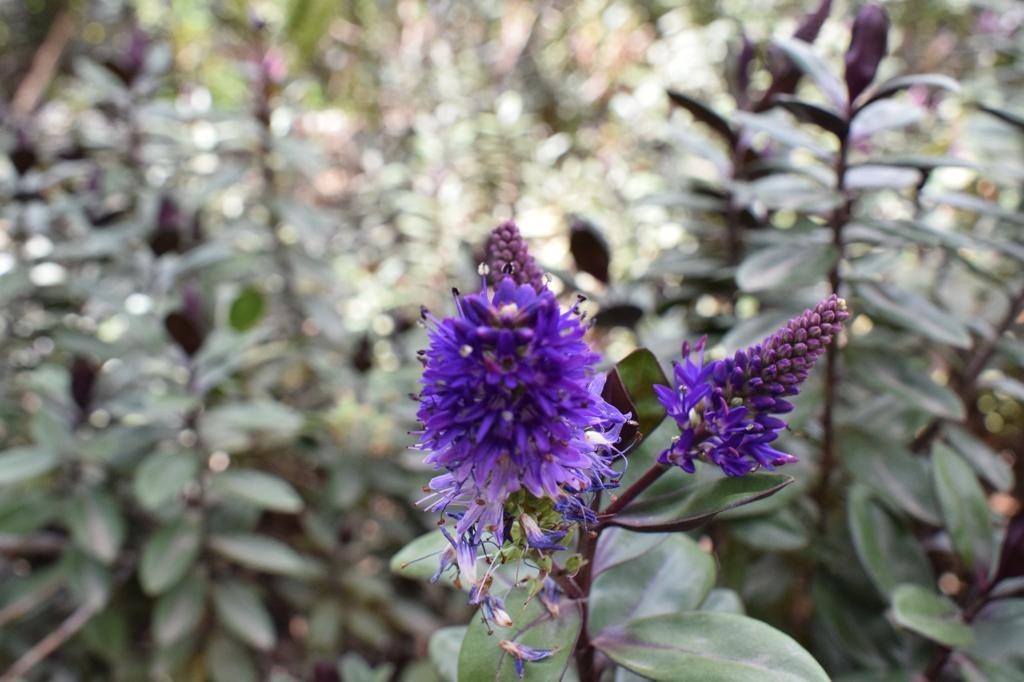
Key Identifying Features
Hebe (now botanically placed in Veronica) is a New Zealand-native evergreen shrub grown for its tidy rounded form and dense spikes of small flowers. The most reliable structural clue is its foliage arrangement: leaves are held in opposite pairs that each rotate 90° from the one below, creating neat four-ranked rows along the stem (a pattern called decussate).
- Compact, dome-shaped to mounding evergreen shrub, 1–5 ft
- Leaves in regular crossing pairs down the stems
- Flowers in dense cylindrical or bottlebrush spikes
- Blooms in white, pink, lavender, blue, or purple-magenta
Leaves & Stems
Leaves are opposite, simple, and usually smooth-edged (entire), ranging from tiny scale-like leaves in the conifer-mimicking "whipcord" hebes to broad glossy leaves 1–4 in long in the large-leaved types. Most are leathery, glossy, and often arranged so neatly they look braided or plaited along the stem. Many cultivars show attractive leaf coloring — gray-green, blue-green, or variegated cream margins, and some have a red or purple tint to new growth or leaf edges. Stems are smooth and often show distinct leaf-scar rings where old leaves dropped.
Flowers & Fruit
Flowers are small, 4-lobed, and tubular, each with two long protruding stamens that give the flower spikes a fuzzy, bottlebrush look. They are massed into dense racemes at the branch tips, blooming heavily in summer and often reblooming. Fruit is a small dry two-parted capsule. The two protruding stamens per tiny flower are a helpful confirming detail.
How to Tell It Apart from Look-Alikes
- Boxwood: similar neat opposite leaves but never produces showy flower spikes, and has a notched leaf tip.
- Whipcord hebes vs. dwarf conifers: whipcord hebes mimic cypress foliage, but if it flowers with bottlebrush spikes it's a hebe, not a conifer.
- Veronica (herbaceous speedwells): closely related and now the same genus, but those are soft-stemmed perennials, not woody evergreen mounds.
- Daphne: fragrant tubular flowers but in flat clusters, not dense spikes, and leaves not so rigidly four-ranked.
The decussate (cross-paired) glossy leaves + dome habit + bottlebrush flower spikes combination is diagnostic.
Where You'll Find It
A favorite in coastal, mild-winter, and maritime gardens (UK, New Zealand, US Pacific Coast). Hebes tolerate wind, salt spray, and poor soil but dislike hard frost and waterlogging. You'll see them as low hedges, container plants, and front-of-border mounds, often chosen for their neat self-shaping habit.
Quick ID Checklist
- Compact, dome-shaped evergreen shrub
- Glossy opposite leaves in neat crossing pairs
- Foliage often gray-, blue-green, or variegated
- Dense bottlebrush flower spikes
- Tiny 4-lobed flowers with two protruding stamens
- White/pink/blue/purple blooms in summer
- Mild coastal garden setting
If you find a tidy little evergreen dome with leaves stacked in crisp crossing pairs and fuzzy bottlebrush flower spikes, it's a hebe.
Frequently asked questions
Why is hebe sometimes labeled Veronica?
Botanists have reclassified the genus Hebe into Veronica, so nurseries and references increasingly use the name Veronica. Both names refer to the same New Zealand-native evergreen shrubs; gardeners still widely use 'hebe' as the common name.
What are whipcord hebes?
Whipcord hebes are species with tiny scale-like leaves pressed tight against the stems, making them look like dwarf cypress conifers. The giveaway that they're hebes is their bottlebrush flower spikes, which conifers never produce.
How do I distinguish hebe from boxwood when neither is flowering?
Both have neat opposite leaves, but boxwood leaves have a small notch at the tip and a distinctive pungent smell, while hebe leaves are usually smooth-tipped, glossier, and arranged in very precise four-ranked crossing pairs, often with colored margins.
Are hebes frost hardy?
Most large-leaved hebes are only moderately hardy and can be damaged by hard frost, which is why they thrive in mild coastal and maritime climates. Small-leaved and whipcord types tend to be tougher and more cold-tolerant.