
Hen And Chicks Identification Guide
How to recognize Hen and Chicks (Sempervivum) by its tight rosettes and the cluster of offset 'chicks' that ring the parent plant.
Read the full Hen And Chicks encyclopedia entry →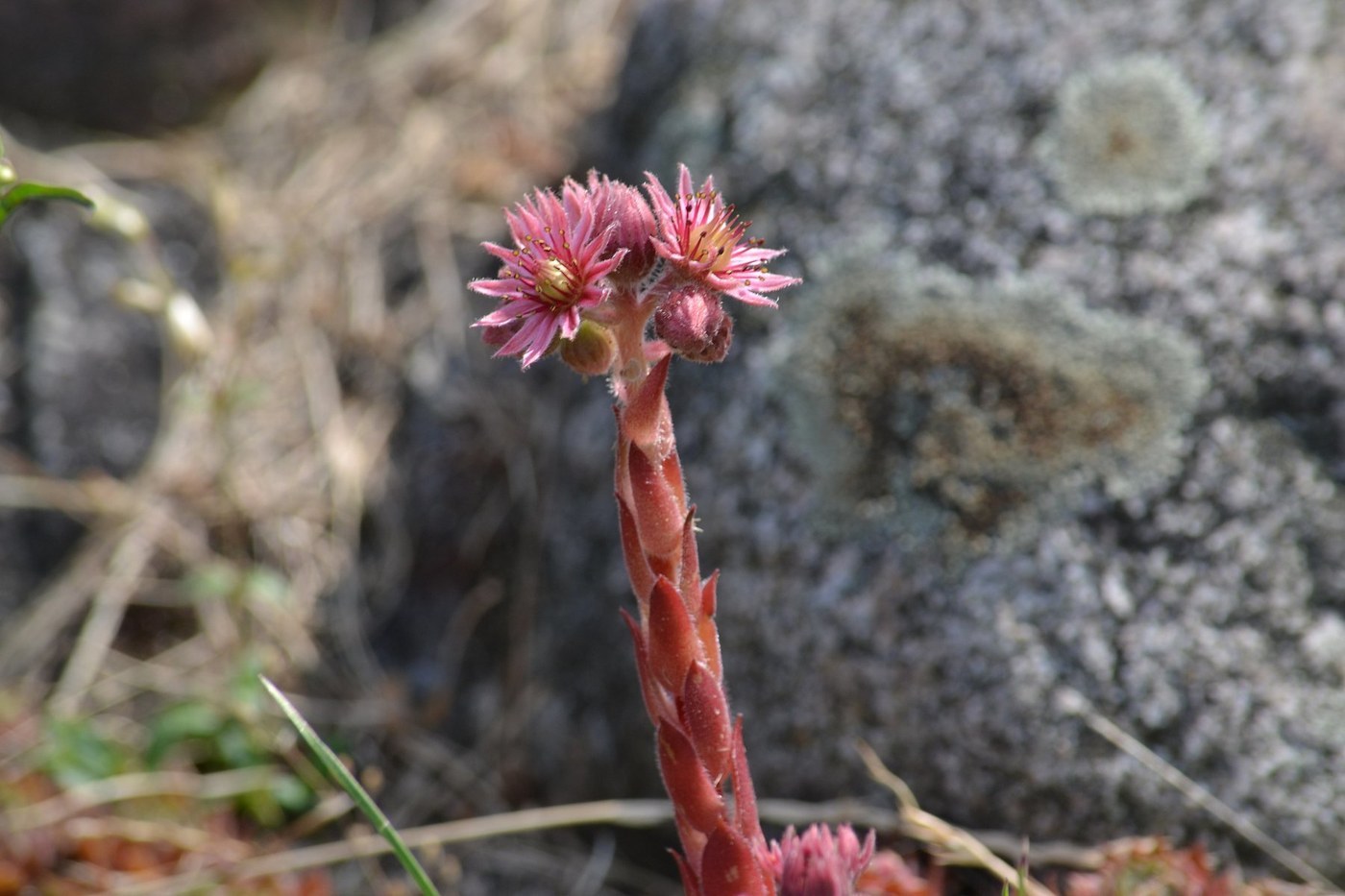
Key Identifying Features
Hen and Chicks (genus Sempervivum) is a hardy, cold-tolerant succulent named for its growth habit: a central "hen" rosette surrounded by many smaller offset "chick" rosettes connected by thin stolons.
- Flattened, symmetrical rosettes typically 1–4 in (3–10 cm) across
- Numerous offsets clustered tightly around the parent
- Fleshy, pointed leaves arranged in a geometric spiral
- Forms low, mat-like ground cover that spreads over time
Leaves & Stems
The leaves are thick, fleshy, and lance-shaped, tapering to a sharp tip that often carries a small reddish or brownish point. Color ranges from blue-green to apple-green, frequently blushed red, purple, or bronze, especially in cold or bright conditions. Many varieties have fine cobweb-like hairs webbing across the rosette (the "cobweb" types). Stems are essentially absent on the rosette itself; the plant hugs the ground, sending out short horizontal runners to produce chicks.
Flowers & Fruit
Hen and Chicks is monocarpic — a rosette flowers once, then dies. When mature, the hen pushes up a thick, leafy flower stalk 4–12 in (10–30 cm) tall, opening into a cluster of star-shaped, pink, red, or yellowish flowers with many pointed petals. After blooming, that rosette withers, but the surrounding chicks live on, so the colony persists.
How to Tell It Apart from Look-Alikes
- Echeveria: also rosette-forming but generally larger, with broader, softer leaves and offsets on longer stems; Echeveria is frost-tender, Sempervivum is frost-hardy.
- Jovibarba: very similar, but its chicks detach and roll away as loose balls, and flowers are bell-shaped and yellow.
- Aeonium: rosettes sit atop tall woody stems rather than flat on the ground.
The combination of flat ground-hugging rosettes, abundant tightly-clustered chicks, and pointed-tip leaves is the giveaway.
Where You'll Find It
Native to mountains of Europe, it's grown worldwide in rock gardens, alpine troughs, green roofs, and container gardens. It thrives in poor, gritty, well-drained soil and full sun, tolerating freezing temperatures down to USDA zone 3–4. Look for it spilling over walls and crevices where little else grows.
Quick ID Checklist
- Flat, symmetrical rosette hugging the ground
- Ring of small offset "chicks" around a central "hen"
- Thick, pointed, often red-tipped leaves
- Sometimes cobwebbed with fine white hairs
- Cold-hardy, evergreen, mat-forming
- Tall leafy flower spike that kills the rosette after bloom
Frequently asked questions
Why do my Hen and Chicks have webbing on them?
Cobweb varieties (Sempervivum arachnoideum and hybrids) naturally produce fine white hairs that stretch across the rosette like a spider web. It's a normal identifying trait, not pests or disease.
How is Hen and Chicks different from Echeveria?
Both form rosettes, but Sempervivum is frost-hardy, ground-hugging, and pups into tight clusters of chicks, while Echeveria is frost-tender with larger, softer leaves and offsets on stalks.
Is my plant dying because the center sent up a tall stalk?
No, that's flowering. The rosette that blooms is monocarpic and will die afterward, but the surrounding chicks survive and keep the colony going.
Why do the leaves turn red or purple?
Cold temperatures and strong sun stress the plant into producing red and purple pigments. The color shift is normal and often most vivid in winter.