
Hollywood Juniper Identification Guide
How to identify Hollywood Juniper (Juniperus chinensis 'Torulosa') by its dramatic twisting, irregular upright form and rich green scale foliage. Covers its sculptural habit and look-alikes.
Read the full Hollywood Juniper encyclopedia entry →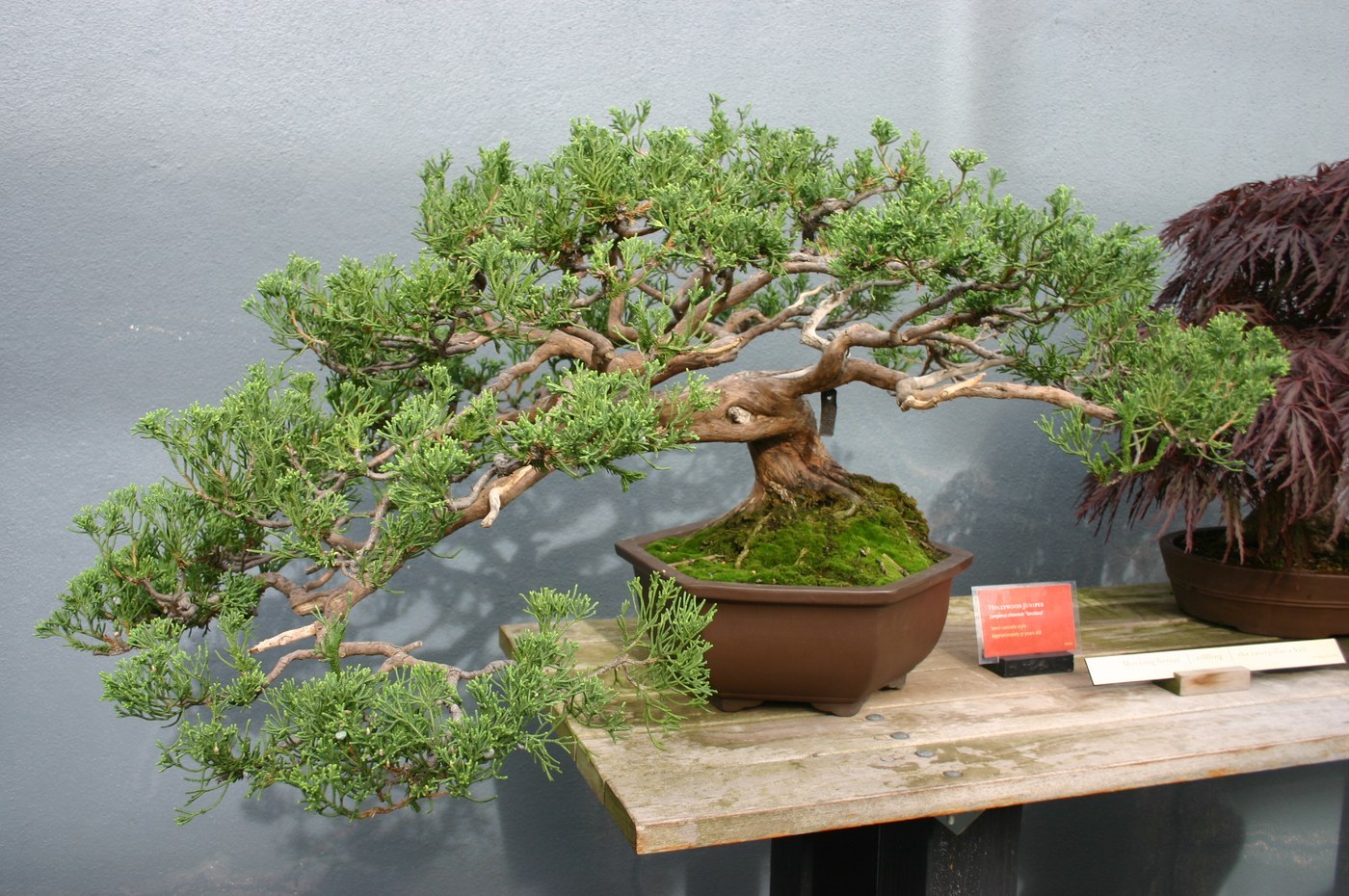
Key Identifying Features
Hollywood Juniper (Juniperus chinensis 'Torulosa', also sold as 'Kaizuka') is instantly recognized by its dramatic, irregularly twisting and contorted upright branches that give it a windswept, sculptural, almost bonsai-like silhouette. The foliage is rich deep green, scale-like, and held in dense tufted sprays along the curving limbs. It is grown for its bold architectural form.
Leaves & Stems
- Mature foliage scale-like, tightly packed, deep green to slightly blue-green, forming dense plume-like or tufted sprays.
- Vigorous or juvenile shoots may carry short awl-shaped (prickly) needles mixed in.
- Branches grow in a distinctive twisted, spiraling, irregularly ascending pattern — the signature trait — rather than straight or evenly spreading.
- Habit broadly upright and irregular, 10 to 15 feet tall, picturesque and uneven, often appearing to lean or swirl.
- Crushed foliage is aromatic and resinous.
Flowers & Fruit
- Often male (some clones), producing small pollen cones; female plants may bear small berry-like blue-glaucous cones of Juniperus chinensis.
- Fruiting is secondary to the foliage and form for which it is grown.
How to Tell It Apart from Look-Alikes
- Other Chinese juniper cultivars (e.g., 'Spartan', 'Hetzii') are denser and more regular; Hollywood Juniper's claim to fame is its irregular, twisting, open form.
- Italian cypress is tall, narrow, and uniformly columnar with no twisting.
- Rocky Mountain and other junipers have similar scale foliage but lack the deliberately contorted branch architecture.
- The swirling, contorted upright limbs with dense green tufts are the defining clue.
Where You'll Find It
A widely planted ornamental in warm-temperate and coastal landscapes — California, the South, and Mediterranean climates — used as a specimen accent, screen, or coastal plant, since it tolerates heat, drought, and salt. Native species Juniperus chinensis originates in East Asia; 'Torulosa' is a cultivated selection.
Quick ID Checklist
- Twisting, contorted, irregular upright branches
- Rich deep green scale foliage in dense tufted sprays
- Sculptural, windswept, bonsai-like silhouette (10 to 15 ft)
- Aromatic, resinous foliage when crushed
- Specimen plant in warm, coastal, or Mediterranean gardens
Frequently asked questions
What makes Hollywood Juniper recognizable?
Its branches grow in a dramatic twisting, contorted, irregularly upright pattern, creating a sculptural windswept look unlike the dense, even forms of most junipers.
Is the foliage prickly?
Mostly no. Mature foliage is soft, scale-like, deep green tufts, though some vigorous or juvenile shoots can carry short prickly awl-shaped needles.
How tall does it get?
Typically 10 to 15 feet tall with an irregular, picturesque upright habit, making it a popular specimen accent plant.
How do I tell it from Italian cypress?
Italian cypress is a tall, narrow, perfectly columnar tree, while Hollywood Juniper is shorter with deliberately twisting, swirling branches and a more open, irregular shape.