
Hydrangea Tree Identification Guide
How to recognize the tree-form panicle hydrangea (Hydrangea paniculata), including its cone-shaped flower clusters, single trunk, and seasonal color shifts.
Read the full Hydrangea Tree encyclopedia entry →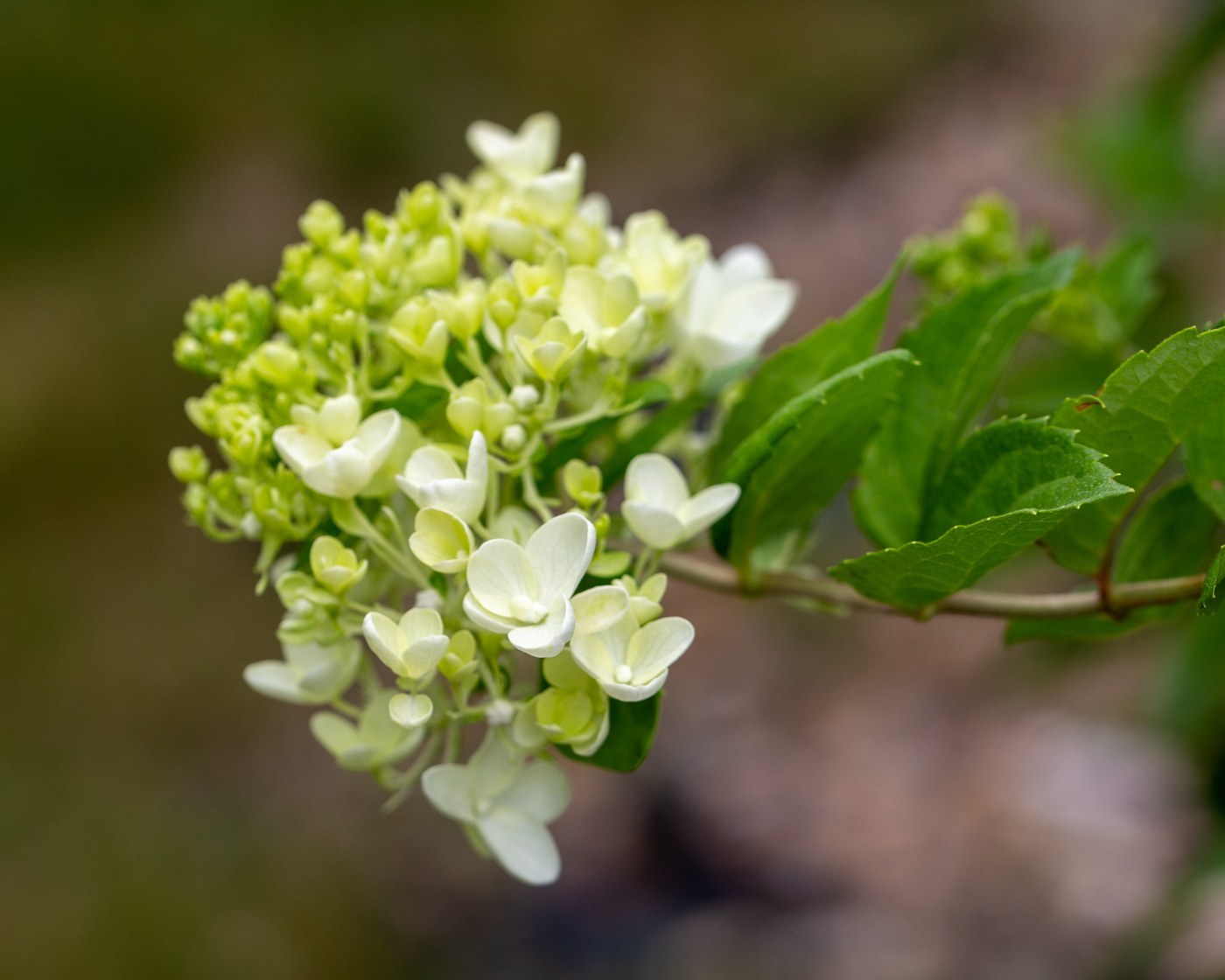
Key Identifying Features
The "Hydrangea Tree" is not a botanical species but a tree-form (standard) Hydrangea paniculata trained to a single trunk topped by a rounded canopy. The most reliable giveaway is the combination of a woody, upright single stem about 3-5 ft tall and the large, cone-shaped (panicle) flower heads that point upward and outward rather than forming a ball.
- Single bare trunk with a grafted or pruned head of branches
- Elongated, pyramidal flower panicles 6-15 in long, not rounded mophead clusters
- Flowers open creamy white and age to pink, rose, or burgundy in late summer
- Blooms on new wood, so it flowers reliably every year
Leaves & Stems
Leaves are opposite or in whorls of three, oval to egg-shaped, 3-6 in long, with pointed tips and finely serrated edges. The surface is dull medium-green and slightly rough with sunken veins, unlike the glossy leaves of bigleaf hydrangea. Stems are stiff and woody enough to hold the heavy flower heads upright, though tips may arch when blooms are wet. The trunk shows tan to gray-brown bark that can peel in thin strips on older specimens.
Flowers & Fruit
From mid-summer into fall, dense panicles carry a mix of showy sterile florets (four broad petal-like sepals) and tiny fertile flowers. As nights cool, the white florets blush pink to deep rose - a hallmark of cultivars like 'Limelight', 'Vanilla Strawberry', and 'Pinky Winky'. Spent heads dry to papery tan and persist through winter. There is no fleshy fruit; seeds are minute capsules.
How to Tell It Apart from Look-Alikes
- Bigleaf hydrangea (H. macrophylla): rounded mophead or flat lacecap blooms, glossy thick leaves, blue/pink color that shifts with soil pH; blooms on old wood.
- Smooth hydrangea (H. arborescens, e.g. 'Annabelle'): huge round white balls, heart-shaped thin leaves, usually shrubby not tree-form.
- Oakleaf hydrangea (H. quercifolia): deeply lobed oak-like leaves and conical white blooms - the leaf shape is the instant tell.
- Rose of Sharon or crape myrtle: also sold as standards, but they have single open flowers, not dense panicles of sepals.
The upright cone-shaped panicle plus serrated oval leaves plus single trunk together confirm a panicle hydrangea tree.
Where You'll Find It
It is a landscape and nursery plant, not wild. Look for it as a focal point in foundation plantings, containers, and formal beds across temperate gardens (USDA zones 3-8). It tolerates full sun better than most hydrangeas, so it often stands in open, sunny borders.
Quick ID Checklist
- Single woody trunk with a mounded head of branches
- Cone-shaped upright flower panicles, not round balls
- Flowers white aging to pink/burgundy
- Opposite, serrated, oval-pointed dull-green leaves
- Dried tan flower heads persisting into winter
- Grown in cultivated gardens, blooms mid-summer to fall
Frequently asked questions
Is the Hydrangea Tree a real species of tree?
No. It is Hydrangea paniculata, a shrub that nurseries train and prune into a single-trunk 'standard' so it looks like a small tree. The genetics are identical to the shrub form.
How can I tell a hydrangea tree from a bigleaf hydrangea?
Look at the flower shape and leaves. The tree form has elongated, cone-shaped upright panicles and dull, rough, serrated leaves. Bigleaf hydrangea has rounded mophead or flat lacecap blooms and thick glossy leaves.
Why do the flowers change from white to pink?
Panicle hydrangea florets naturally age from creamy white to pink, rose, or burgundy as nights cool in late summer. This is a pigment change with maturity, not a soil-pH effect like the blue/pink of bigleaf hydrangeas.
When does it bloom?
From mid-summer through fall. Because it flowers on new wood, it blooms dependably every year even after a hard winter or spring pruning.
Hydrangea Tree identified by the community
Recent Hydrangea Tree specimens identified with Plant Identifier.
