
Indian Hawthorn Identification Guide
Identify Indian Hawthorn (Rhaphiolepis) by its rounded evergreen form, leathery toothed leaves, clusters of white-to-pink spring flowers, and blue-black berries.
Read the full Indian Hawthorn encyclopedia entry →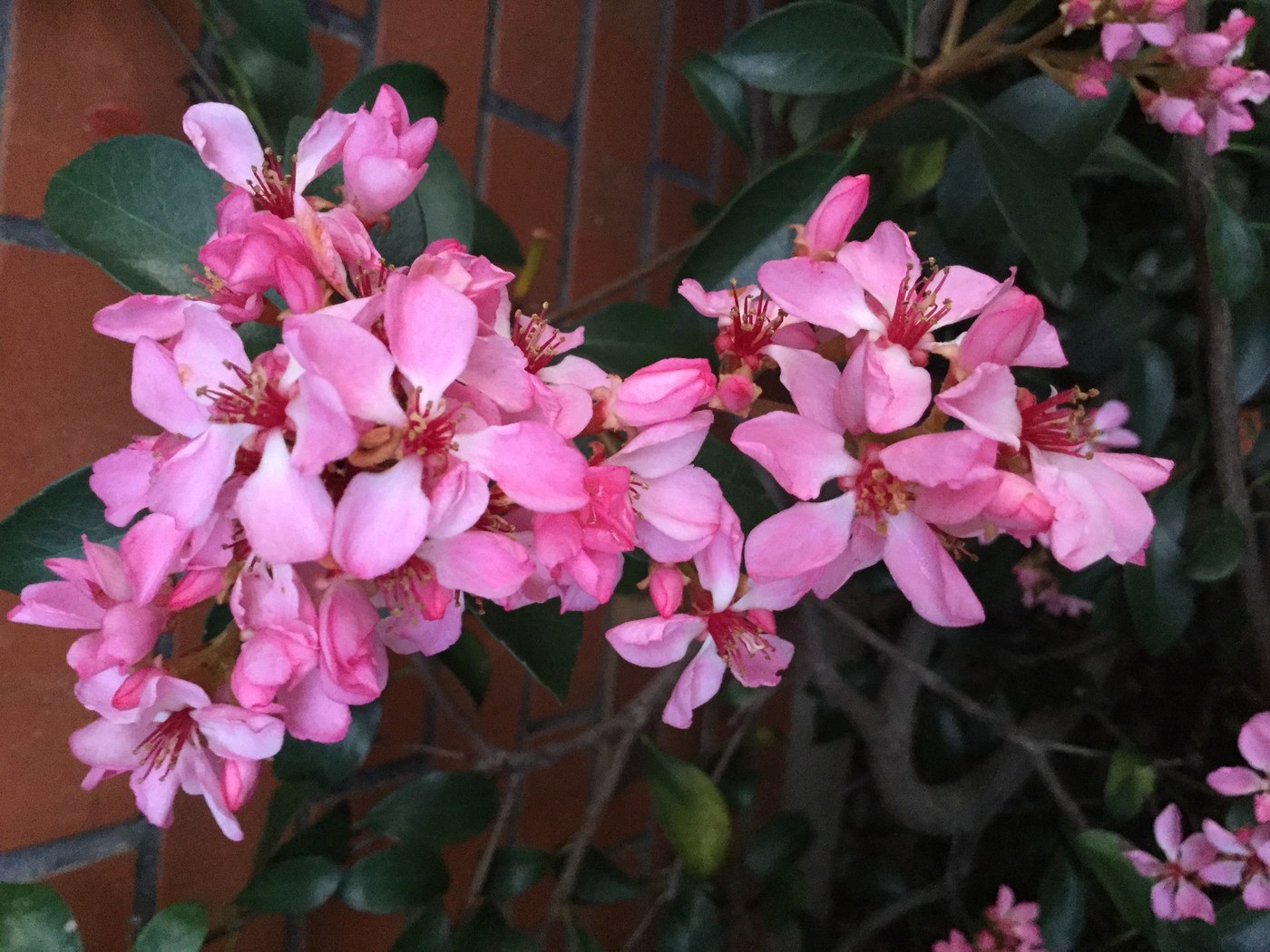
Key Identifying Features
Indian Hawthorn (Rhaphiolepis indica and hybrids) is a compact, evergreen shrub in the rose family (Rosaceae). It is recognized by its dense, rounded, mounded habit, thick leathery dark-green leaves clustered at branch tips, upright clusters of fragrant white-to-pink five-petaled flowers in spring, and later dusty blue-black berries. Despite the name, it is not a true hawthorn and has no thorns.
- Rounded, mounded evergreen shrub, usually 2–5 ft tall (some to 6+ ft)
- Leathery, dark-green toothed leaves crowded toward the stem tips
- Upright clusters (panicles) of white or pink flowers in spring
- Blue-black berries in summer to fall; thornless
Leaves & Stems
Leaves are alternate, simple, oval to oblong, 2–3 in long, thick and leathery with a glossy dark-green upper surface and finely toothed (sometimes nearly smooth) margins, often clustered toward the branch ends. New growth and cool-weather foliage frequently flush bronze or reddish-purple. Stems are stiff and the overall plant is dense and compact. Young twigs may be slightly woolly.
Flowers & Fruit
Flowers appear in erect terminal clusters (panicles) in spring, each flower about ½ in across with five rounded petals, white to pink, lightly fragrant, with pink stamens — typical rose-family blossoms. They are followed by small, round, blue-black to purplish berries (pomes) about ¼ in across, often with a waxy bloom, that persist into fall and attract birds.
How to Tell It Apart from Look-Alikes
- True hawthorn (Crataegus): Deciduous, with thorns and lobed leaves; Indian Hawthorn is evergreen, thornless, with unlobed toothed leaves.
- Photinia: A larger relative with bright red new growth and larger leaves; Indian Hawthorn is more compact with smaller, denser foliage.
- Cherry laurel: Has smooth-edged leaves and flowers in elongated spikes, not rounded panicles, and larger black fruit.
The compact evergreen mound + leathery toothed leaves clustered at tips + upright white/pink flower panicles + blue-black berries (no thorns) is diagnostic.
Where You'll Find It
Native to southern China and Southeast Asia; extremely common in warm-climate landscaping (USDA zones 8–11) as foundation shrubs, low hedges, parking-lot and mass plantings. It tolerates heat, salt, and coastal conditions and prefers full sun and well-drained soil.
Quick ID Checklist
- Compact, rounded evergreen shrub, thornless
- Leathery, dark-green, finely toothed leaves clustered at branch tips
- Bronze/reddish new growth
- Upright clusters of white-to-pink 5-petaled flowers in spring
- Blue-black waxy berries afterward
- Common in warm-climate foundation and mass plantings
Frequently asked questions
Does Indian Hawthorn have thorns?
No. Despite its name, Indian Hawthorn (Rhaphiolepis) is thornless, unlike true hawthorns (Crataegus), which bear sharp thorns.
What are the dark berries on Indian Hawthorn?
After flowering it produces small, round, blue-black to purplish pomes with a waxy coating that persist into fall and are eaten by birds.
Why does my Indian Hawthorn have reddish leaves?
New growth and cool-season foliage often flush bronze or reddish-purple, which is normal and can help confirm the plant's identity.
How do I tell Indian Hawthorn from photinia?
Both are evergreen rose-family shrubs, but photinia is larger with bigger leaves and vivid red new growth, while Indian Hawthorn is more compact with smaller, denser, dark-green foliage.