
Indian Paintbrush Identification Guide
Learn to recognize Indian Paintbrush (Castilleja) by its brush-tipped, brightly colored bracts and its half-parasitic habit. This guide covers the key features that separate it from other wildflowers.
Read the full Indian Paintbrush encyclopedia entry →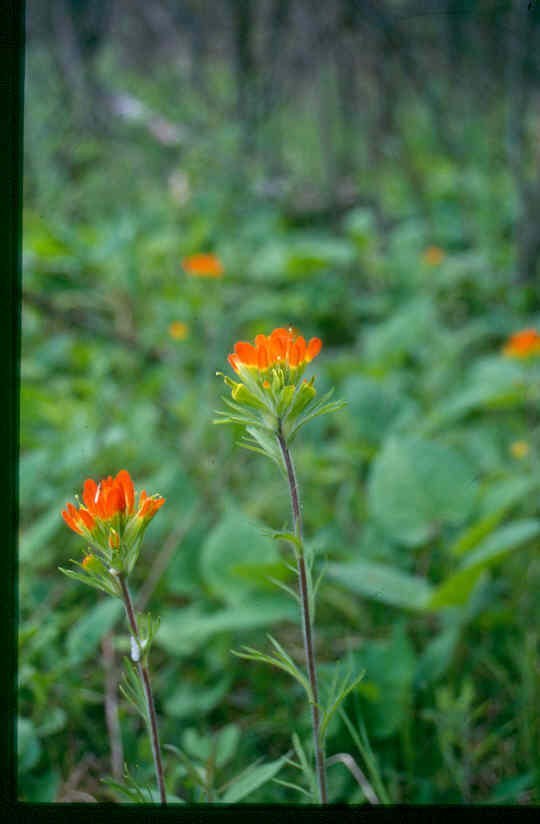
Key Identifying Features
Indian Paintbrush (genus Castilleja) is instantly recognizable for its clusters of flame-colored bracts that look as if they were dipped in paint. The true flowers are small and greenish and almost hidden; the showy color comes from modified leaves (bracts) and sepals, not petals. Plants typically stand 6 to 24 inches (15 to 60 cm) tall and grow in upright, leafy clumps.
- Brush-tipped flower spikes colored scarlet, orange, red, yellow, or pink
- Color comes from bracts, often three-lobed or fringed at the tips
- A hemiparasite: roots tap into neighboring plants for water and nutrients
- Hairy, often unbranched stems
Leaves & Stems
The stems are slender, usually hairy, and frequently grow in small clusters from a woody base. Leaves are alternate, narrow, and lance-shaped to linear, sometimes with a few finger-like lobes near the top of the plant. Lower leaves are usually entire (smooth-edged) while upper leaves grade into the colorful bracts. Foliage is typically green to grayish-green and may feel slightly rough.
Flowers & Fruit
Look closely at a "flower" and you'll see the real bloom is a narrow, tubular greenish-yellow flower peeking out between the colorful bracts. The bracts and calyx provide nearly all the visible color. Flowering occurs mainly in spring through summer, peaking April to July depending on elevation and region. The fruit is a small two-chambered capsule containing numerous tiny seeds.
How to Tell It Apart from Look-Alikes
- Owl's clover (Castilleja / Orthocarpus): closely related and similar, but blooms are denser and often pink-purple with more visible petals.
- Scarlet gilia (Ipomopsis aggregata): has true trumpet-shaped red flowers with five spreading lobes, not brush-like bracts.
- Paintbrush vs. lousewort (Pedicularis): louseworts have fern-like, deeply dissected leaves and hooded flowers without the painted-brush appearance.
The single best clue is the brush-dipped look created by colorful bracts rather than large showy petals.
Where You'll Find It
Indian Paintbrush thrives in open meadows, prairies, mountain slopes, sagebrush flats, and roadsides, mostly across western North America, with some species in the East and Midwest. Because it is partly parasitic, it almost always grows intermingled with grasses or other plants rather than in bare soil. Castilleja linariifolia is the state flower of Wyoming.
Quick ID Checklist
- Spike topped with brush-like, brightly colored bracts
- Color from bracts, not petals; true flowers small and greenish
- Narrow, alternate leaves, sometimes lobed near top
- Hairy stems in clumps
- Growing among grasses in meadows or slopes
- Blooms spring to summer
Frequently asked questions
Why does Indian Paintbrush look like the tips are dipped in paint?
The vivid color comes from modified leaves called bracts and from the sepals, not from petals. The actual flowers are small, tubular, and greenish, so the brushy painted appearance is created by these colorful surrounding structures.
Is Indian Paintbrush a parasite?
Yes, it is a hemiparasite. It makes some of its own food through photosynthesis but also taps its roots into neighboring plants, especially grasses, to draw water and nutrients. This is why it is almost always found growing among other plants.
What colors can Indian Paintbrush be?
Most are scarlet to orange-red, but depending on the species you may also find yellow, pink, salmon, or even purple-tinged forms. Color alone does not identify the species, so check leaf shape and region too.
Can I transplant or grow Indian Paintbrush at home?
It is notoriously difficult because it needs a host plant to thrive. Seeds usually must be sown alongside compatible grasses or other host species, and digging wild plants rarely succeeds since the root connection is disturbed.