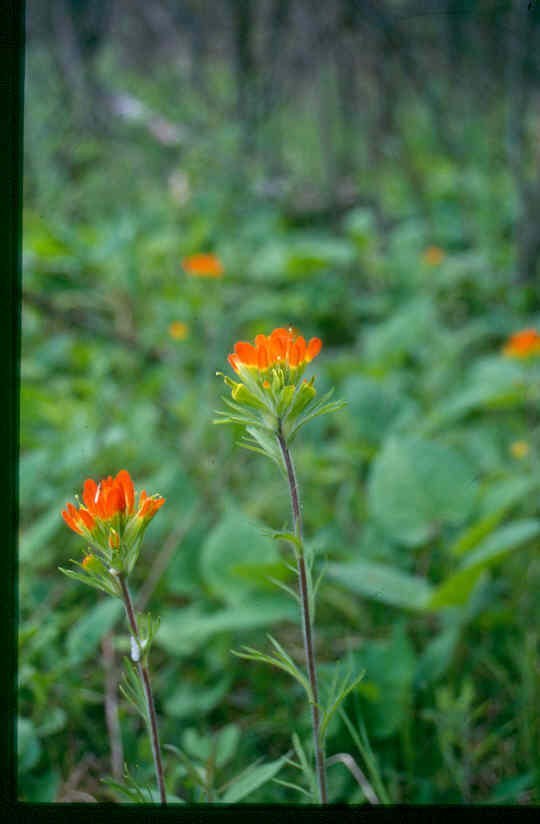
Indian Paintbrush
Castilleja coccinea
A vivid North American wildflower whose flame-colored display comes not from petals but from brightly tipped leaf-like bracts. It is a hemiparasite that taps the roots of neighboring plants, making it notoriously difficult to cultivate.
- Light
- Full sun
- Water
- Low to moderate; well-drained soil
- Difficulty
- Hard
Got a plant like this?
Identify any plant from a photo, free.
Overview
Indian paintbrush is the common name for the genus Castilleja, with roughly 200 species across the Americas. The brilliant red, orange, or yellow color that gives the plant its name comes from modified leaves called bracts, not from the inconspicuous greenish flowers tucked within them.
Most species are hemiparasitic: they photosynthesize on their own but attach specialized root structures (haustoria) to the roots of nearby grasses and forbs to draw water and nutrients. This dependence on host plants is the main reason paintbrushes resist ordinary garden cultivation.
The genus is celebrated across western North America, where Castilleja linariifolia serves as the state flower of Wyoming.
How to identify it
Look for upright stems topped by dense, brushy clusters in fiery colors.
- Bracts: Showy, three-lobed, tipped scarlet, orange, or yellow as if dipped in paint
- Flowers: Slender, tubular, greenish-yellow, largely hidden among the bracts
- Leaves: Narrow, often deeply lobed, alternate along the stem
- Size: Typically 8 to 24 inches (20 to 60 cm) tall
- Habit: Clumping, with single or branched flowering stems
Care & growing
Paintbrush is one of the most challenging native wildflowers to grow because of its parasitic habit.
- Light: Full sun is essential
- Water: Lean, well-drained soil; avoid overwatering and rich amended beds
- Host plants: Sow seed alongside a compatible host such as native bunchgrasses, blue grama, or Penstemon
- Soil: Sandy or gravelly, low-fertility soils mimic native conditions
- Propagation: From seed only; seeds often need cold stratification and benefit from being scattered directly into an established host stand
- Feeding: None needed; fertilizer favors competitors and weakens the plant
Habitat & origin
Castilleja species are native to the Americas, with the greatest diversity in western North America. Castilleja coccinea, the scarlet paintbrush, ranges across the eastern and central United States and southern Canada.
They grow in prairies, meadows, open woodlands, alpine slopes, and coastal bluffs. Because they depend on host roots, they are seen in established plant communities rather than disturbed bare ground.
They are rarely available as nursery transplants and are most often enjoyed in the wild or in carefully managed native seed plantings.
Frequently asked questions
Why is Indian paintbrush so hard to grow?
It is a hemiparasite that needs to attach to the roots of host plants for water and nutrients, so it rarely thrives when planted alone in garden soil.
Is the colorful part the flower?
No. The bright red or orange show comes from modified leaves called bracts; the true flowers are small, tubular, and greenish, hidden among them.
Can I transplant it from the wild?
Transplanting almost always fails because of its root connections to host plants, and digging wild natives is discouraged or illegal in many areas.
Indian Paintbrush guides
In-depth guides for identifying, growing, and caring for Indian Paintbrush.
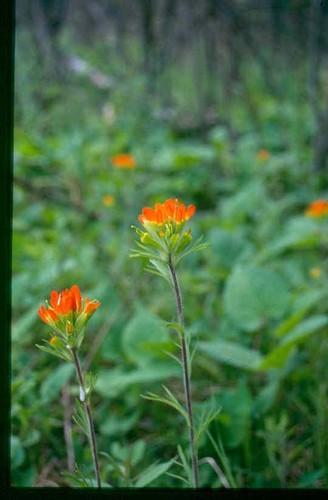
How to Care for Indian Paintbrush
Growing guide for Indian Paintbrush (Castilleja coccinea), a fiery wildflower prized for its scarlet bracts and challenging, host-dependent nature.
Indian Paintbrush Identification Guide
Learn to recognize Indian Paintbrush (Castilleja) by its brush-tipped, brightly colored bracts and its half-parasitic habit. This guide covers the key features that separate it from other wildflowers.