Indian Pipe Identification Guide
Identify Indian Pipe, a ghostly white parasitic woodland plant, by its waxy translucent stems, single nodding flower, and total lack of green.
Read the full Indian Pipe encyclopedia entry →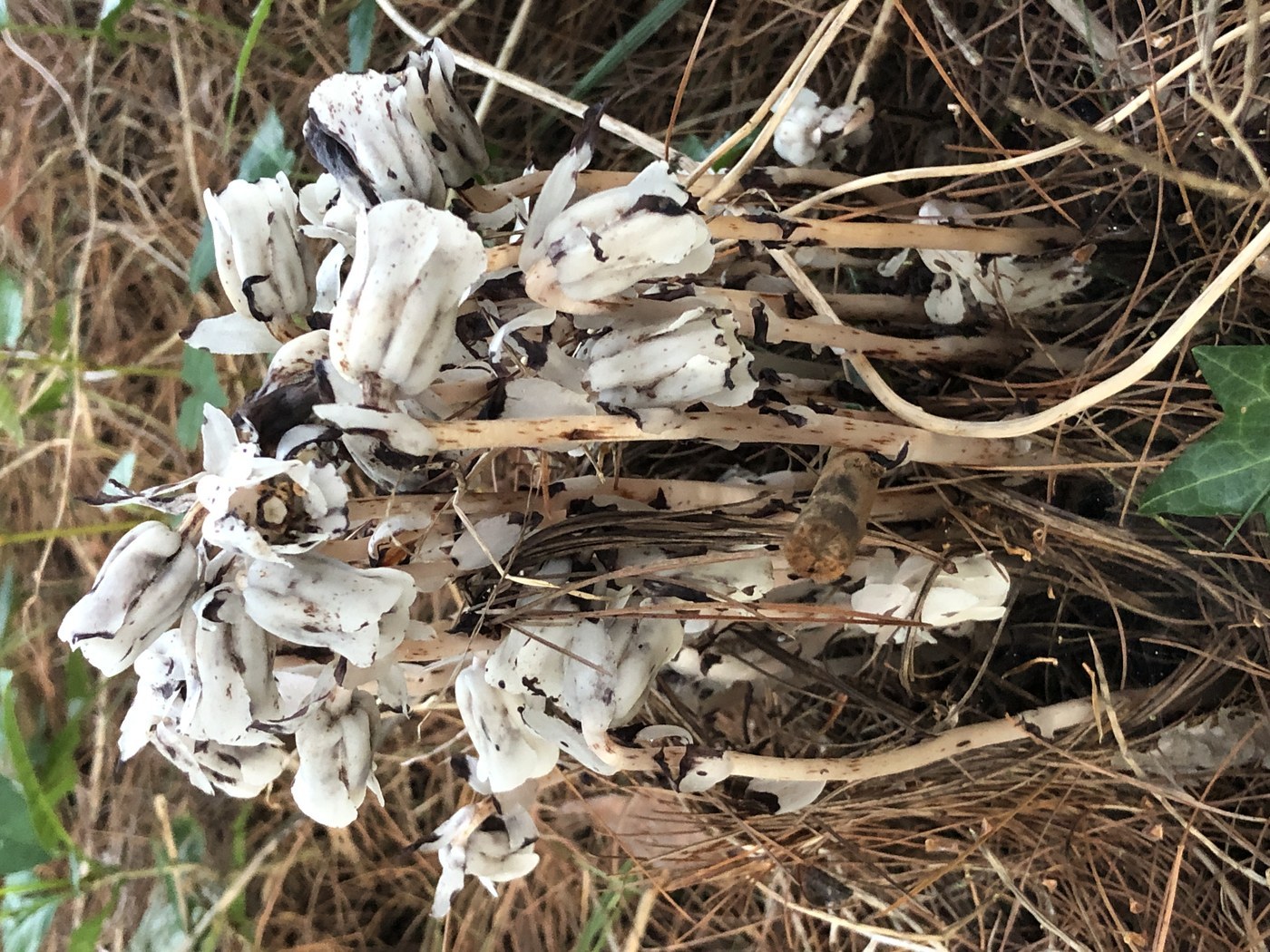
Key Identifying Features
Indian Pipe (Monotropa uniflora), also called Ghost Plant or Corpse Plant, is a strange, non-photosynthetic woodland plant that looks more like a fungus than a flower. Unmistakable traits:
- Entirely white, waxy, and translucent — no green anywhere because it lacks chlorophyll.
- A single, nodding (downward-facing) bell-shaped flower per stem (hence uniflora).
- Small, scale-like leaves pressed against the stem.
- Grows in small clusters, each stalk 5–25 cm (2–10 in) tall.
Leaves & Stems
Because it does not photosynthesize, Indian Pipe has no true green leaves; instead the stem bears tiny translucent white scales in place of leaves. The fleshy, smooth stems are waxy white, sometimes flushed with pink or black spots, and turn black as they age or are touched. The plant draws all its nourishment parasitically — it taps into mycorrhizal fungi connected to tree roots (it is a mycoheterotroph).
Flowers & Fruit
Flowering occurs summer into early autumn (June–September), often appearing after rain. Each stem nods at the tip so the single, urn- or bell-shaped flower points downward. After pollination, the flower turns upright and stiffens, and the stem dries to a hard, dark brown-black erect seed capsule that persists. This upright blackened capsule is a useful late-season ID clue.
How to Tell It Apart from Look-Alikes
- Pinesap (Monotropa/Hypopitys) is similar but yellow, tan, or reddish and has several flowers per stem, not one.
- Fungi (mushrooms) are sometimes confused at a glance, but Indian Pipe has an obvious flower with petals and stem scales.
- Other white woodland flowers are green-stemmed and leafy; nothing else is this uniformly waxy white with a single nodding flower.
Where You'll Find It
Indian Pipe grows in shady, moist, rich deciduous and coniferous forests with abundant leaf litter, across North America, Asia, and parts of South America. It needs the right host trees and mycorrhizal fungi to survive, so it appears sporadically and cannot be transplanted. Look in deep shade, often near beech, oak, or pine.
Quick ID Checklist
- Pure white, waxy, translucent — no green
- Single nodding bell flower per stem
- Scale-like leaves on the stem
- Turns black when bruised or aging
- Small clusters, 5–25 cm tall
- Shady, moist rich forest floor with leaf litter
Frequently asked questions
Is Indian Pipe a fungus?
No — it is a true flowering plant, but it lacks chlorophyll and gets its nutrients parasitically through mycorrhizal fungi connected to tree roots, which makes it resemble a fungus.
Why is it white instead of green?
Indian Pipe has no chlorophyll, so it doesn't make its own food by photosynthesis. Instead it steals carbon from trees via shared soil fungi, which is why it is ghostly white.
How is it different from Pinesap?
Indian Pipe is pure white with a single nodding flower per stem, while Pinesap (its close relative) is yellow to reddish and carries several flowers per stem.
Can I transplant Indian Pipe to my garden?
No. It depends on a specific network of host trees and mycorrhizal fungi, so it cannot be cultivated or successfully moved — enjoy it where it grows.
Indian Pipe identified by the community
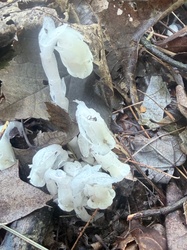
Recent Indian Pipe specimens identified with Plant Identifier.