Indian Pipe
Monotropa uniflora
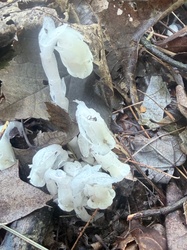
A ghostly white, leafless woodland plant that lacks chlorophyll and survives by parasitizing fungi, appearing as eerie translucent stems on the forest floor.
- Light
- Deep shade
- Water
- Naturally moist forest floor
- Difficulty
- Hard
Got a plant like this?
Identify any plant from a photo, free.
Overview
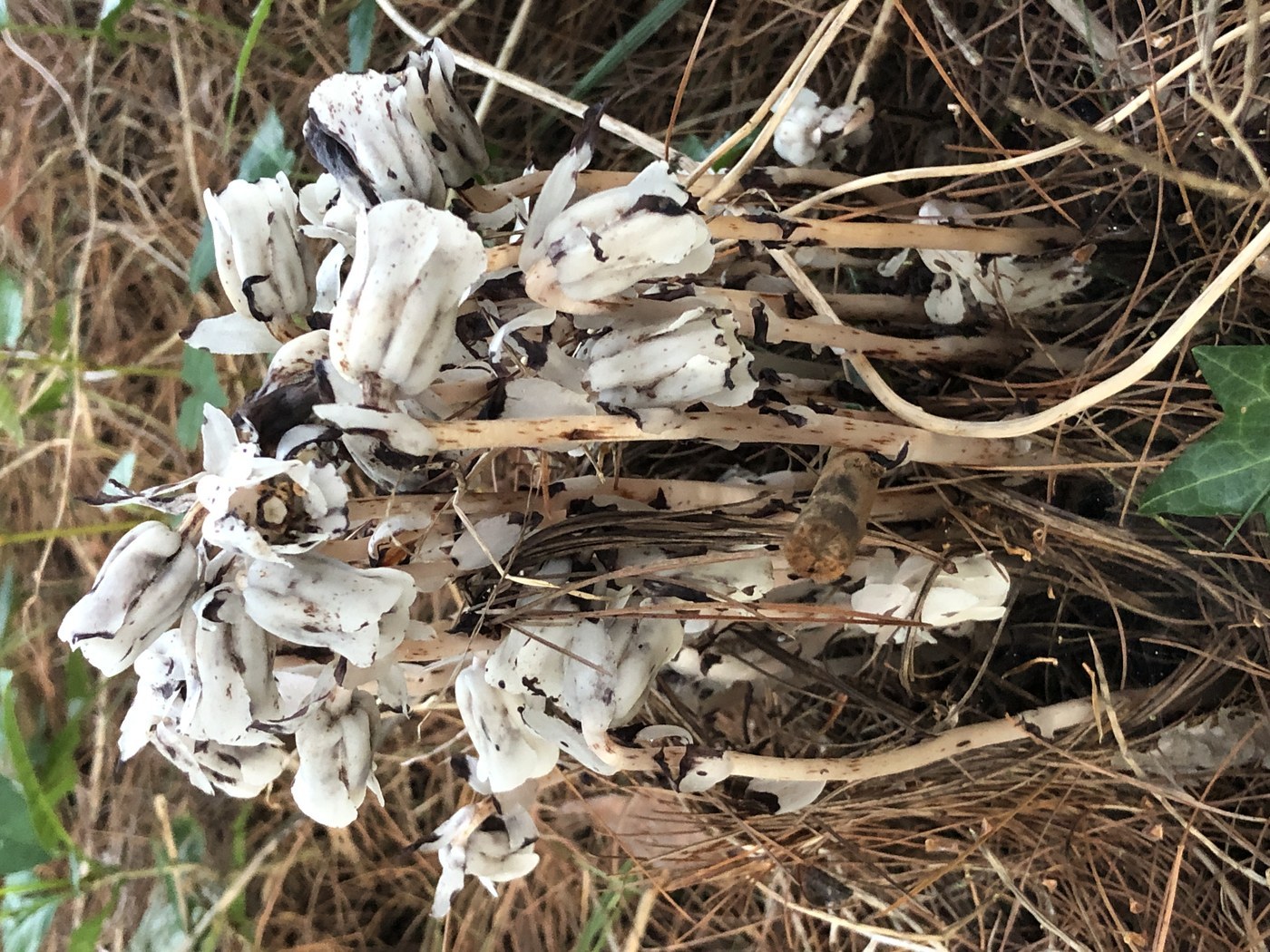
Indian pipe is one of the most curious plants in the temperate world: a waxy, ghostly white herb that contains no chlorophyll at all. Unable to photosynthesize, it cannot make its own food and instead taps into underground fungi that are themselves linked to tree roots — a parasitic strategy called mycoheterotrophy.
Its single nodding flower and translucent stem give it a phantom-like appearance, earning names like ghost plant and corpse plant. It blackens when bruised or as it ages. Because it depends entirely on a specific fungal-tree network, it cannot be transplanted or cultivated and should be left undisturbed in the wild.
How to identify it
- Color: Entirely waxy white (occasionally pinkish); turns black with age or bruising.
- Flowers: A single, nodding, bell-shaped flower per stem, becoming upright as it matures into a seed capsule.
- Leaves: Reduced to small, scale-like bracts on the stem — no true green leaves.
- Height: Typically 10-30 cm.
- Habit: Clustered, fleshy, leafless stems emerging from rich forest leaf litter; no green tissue anywhere.
Care & growing
Light: Deep shade — it needs no light for food, growing in dark forest understory.
Water: Found in the consistently moist, humus-rich forest floor.
Soil: Requires rich woodland soil hosting the specific mycorrhizal fungi it parasitizes.
Cultivation: Essentially impossible to cultivate or transplant because it depends on an intact fungus-tree relationship.
Conservation: Admire it in place; digging or picking kills it and serves no purpose.
Habitat & origin
Native to temperate North America and parts of Asia (and naturalized variably elsewhere), it grows in shaded, moist, mature forests with deep leaf litter, often beneath beech, oak, or pine.
It only appears where its host fungi and associated trees coexist, frequently emerging after rain in summer and fall. It is never "grown" in gardens.
Frequently asked questions
Why is Indian pipe white instead of green?
It lacks chlorophyll entirely. Rather than photosynthesizing, it steals nutrients from soil fungi that are connected to tree roots, so it needs no green pigment or sunlight.
Can I grow it in my garden?
No. It depends on a precise relationship with specific fungi and trees, so it cannot be transplanted or cultivated and will die if dug up.
Is it a fungus?
No, it is a true flowering plant (in the heath family), but it behaves like a parasite on fungi, which is why it superficially resembles one.
Why does it turn black?
Its tissues blacken when bruised, picked, or as the plant naturally ages and sets seed.
Indian Pipe guides
In-depth guides for identifying, growing, and caring for Indian Pipe.
How to Care for Indian Pipe
Indian Pipe is a ghostly woodland plant that cannot be cultivated; the focus is protecting it in the wild.
Indian Pipe Identification Guide
Identify Indian Pipe, a ghostly white parasitic woodland plant, by its waxy translucent stems, single nodding flower, and total lack of green.
Indian Pipe identified by the community
Real specimens identified with Plant Identifier.