
Jabuticaba Identification Guide
Identify jabuticaba (Plinia cauliflora) by its peeling mottled bark, small glossy leaves, and the remarkable habit of producing grape-like purple-black fruit directly on the trunk and main branches.
Read the full Jabuticaba encyclopedia entry →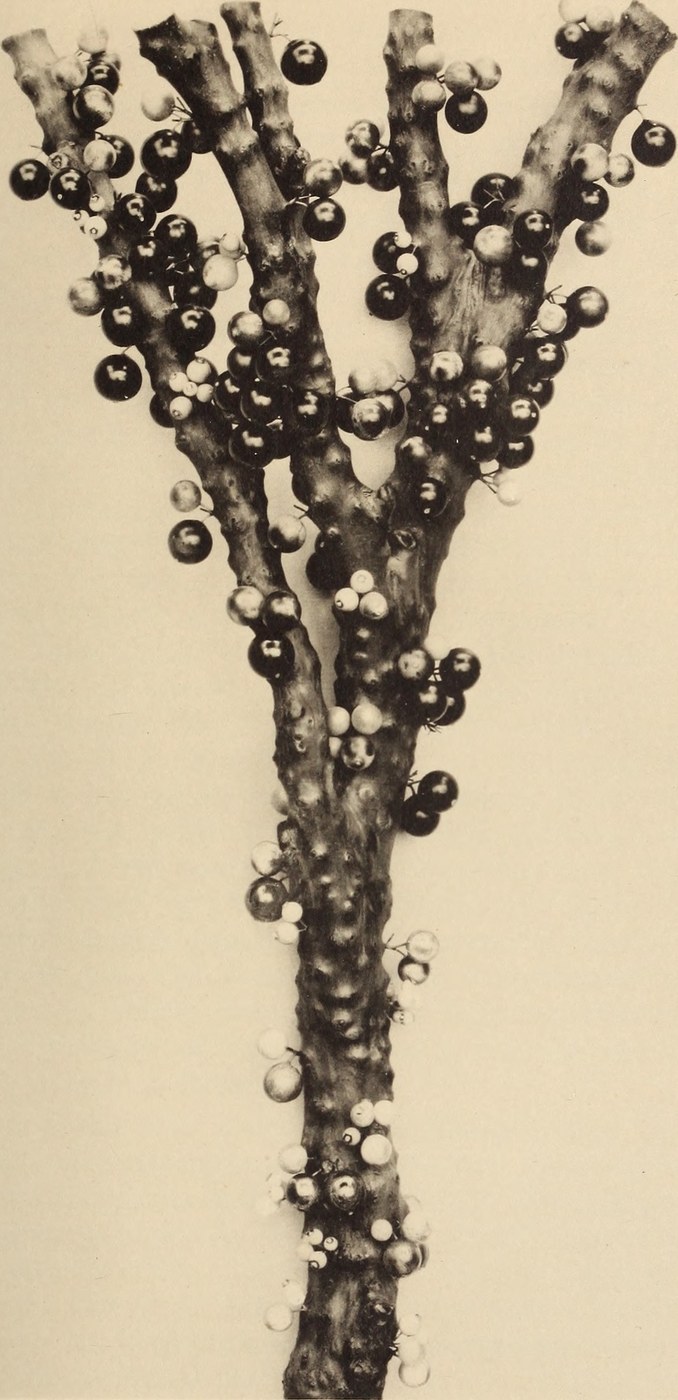
Key Identifying Features
Jabuticaba (Plinia cauliflora, formerly Myrciaria cauliflora) is a slow-growing evergreen tree in the myrtle family, typically 10–40 feet tall with a dense, bushy, multi-stemmed habit. Its most unforgettable trait is cauliflory: the round purple-black fruits grow straight out of the trunk and large limbs, often coating the bark like grapes glued to the wood. Combined with smooth, peeling, mottled bark, this makes the tree easy to recognize even out of season.
- Fruit borne directly on the trunk and branches
- Flaky, mottled tan-to-pinkish bark (like guava or crape myrtle)
- Small, glossy, opposite leaves on fine twigs
Leaves & Stems
Leaves are opposite, simple, and small, generally 1–4 inches long, lance-shaped to elliptic, with a glossy dark green mature surface. Like many myrtles, the foliage is dotted with tiny translucent oil glands visible when held to light, and crushed leaves may be faintly aromatic. New growth emerges a salmon-pink to bronze color, a striking feature that flushes several times a year. Twigs are slender. The bark is thin, smooth, and continually exfoliates in patches, leaving a mottled mosaic of gray, tan, beige, and pinkish tones over a sinuous, often leaning trunk.
Flowers & Fruit
Flowers appear directly on the trunk and woody branches in dense clusters, each a small white pom-pom of many fine stamens (typical Myrtaceae "powder-puff" flower) with four tiny petals. Flowering can occur in flushes, sometimes covering the trunk in fuzzy white blossoms. The fruit is a round berry, 0.5–1.5 inches across, ripening from green to glossy maroon-purple to black, with a tough but thin skin and translucent whitish, gelatinous pulp surrounding 1–4 seeds. The trunk-borne, grape-cluster appearance is unmistakable.
How to Tell It Apart from Look-Alikes
- True grapes look similar in fruit but grow on a climbing vine, not on a tree trunk.
- Guava (Psidium) shares the peeling mottled bark and oil-gland leaves but bears fruit at the branch tips, not on the trunk, and has larger leaves.
- Other Plinia/Myrciaria species also fruit on wood; jabuticaba is distinguished by its larger size, dense crown, and round black trunk-borne berries.
The combination of cauliflorous purple fruit + powder-puff white flowers + exfoliating mottled bark is diagnostic.
Where You'll Find It
Native to southeastern Brazil, jabuticaba is grown as a fruit and ornamental tree in subtropical and tropical regions, including Brazil, the southern U.S. (Florida, California), and Southeast Asia. It tolerates light frost when mature but prefers warm, humid conditions. Look for it in dooryard gardens, botanical collections, and orchards, often grown for its novelty fruit.
Quick ID Checklist
- Fruit and flowers growing directly on the trunk/branches (cauliflory)
- Smooth, peeling, mottled multicolored bark
- Small, opposite, glossy leaves with oil-gland dots
- Pinkish-bronze new growth
- White powder-puff flowers
- Round purple-black grape-like berries
Frequently asked questions
Why does jabuticaba fruit grow on the trunk?
Jabuticaba exhibits cauliflory, producing flowers and fruit directly from old wood on the trunk and main branches rather than at the twig tips. This makes it instantly recognizable.
How do I tell jabuticaba apart from a guava tree?
Both have peeling mottled bark and oil-gland leaves, but guava bears fruit at the ends of branches and has larger leaves, whereas jabuticaba's round black fruit clings to the trunk.
What color is the new growth?
New leaf flushes emerge a salmon-pink to bronze color before turning glossy green, a helpful seasonal identification clue.