
Japanese Stiltgrass Identification Guide
How to recognize Japanese stiltgrass (Microstegium vimineum), a sprawling invasive annual grass, by its silvery-striped leaves and reclining, bamboo-like stems.
Read the full Japanese Stiltgrass encyclopedia entry →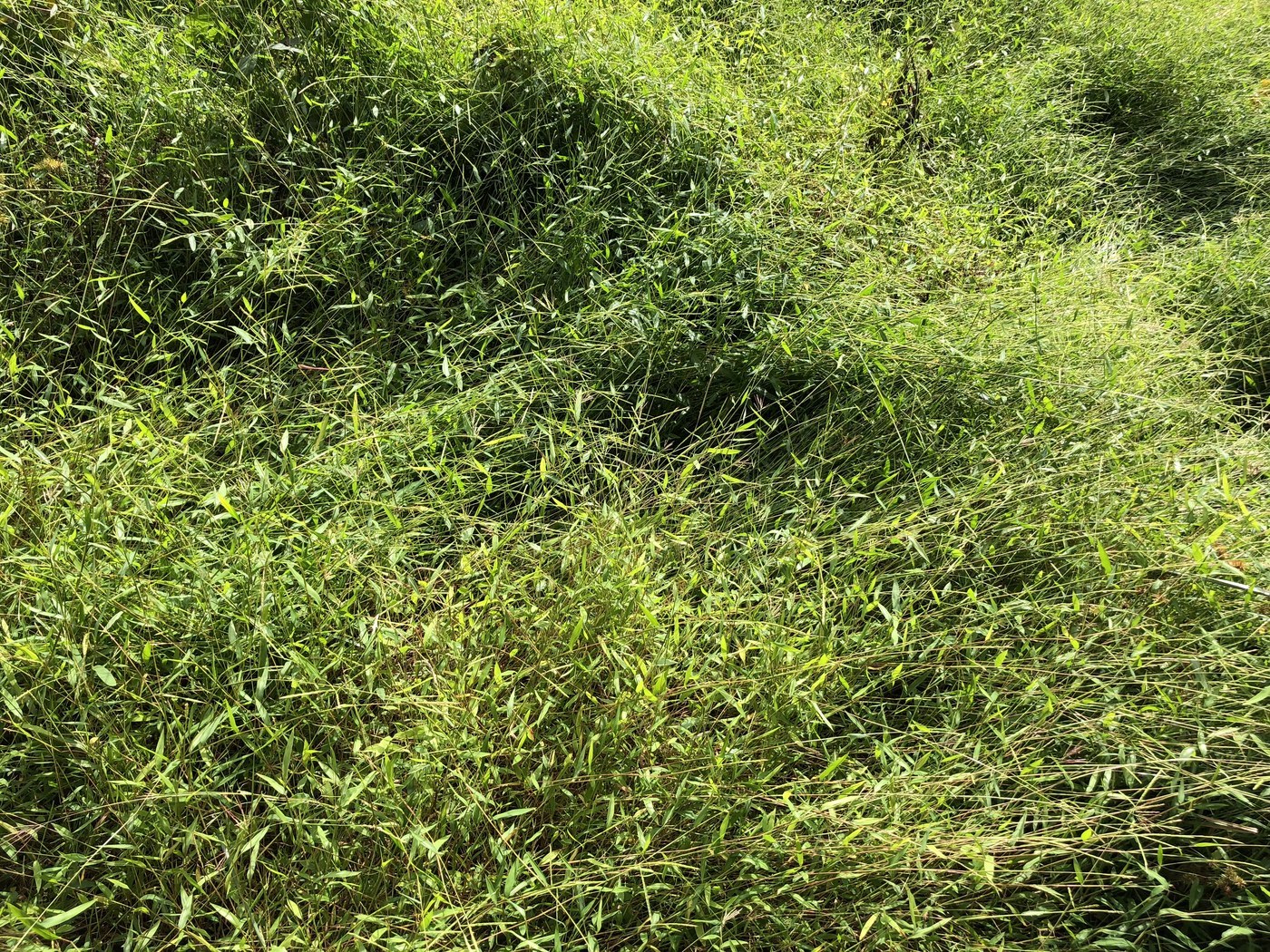
Key Identifying Features
Japanese stiltgrass (Microstegium vimineum) is a delicate, sprawling annual grass that forms dense mats in shaded, moist ground. The single most reliable clue is a shiny, off-center silvery midrib stripe running down each leaf blade. The plant has a pale, flimsy look compared with most lawn grasses, and large infestations create a soft, lawn-of-the-forest appearance.
- Sprawling, reclining stems that root at lower nodes (the "stilts")
- Pale green, lance-shaped leaves with a silvery streak slightly off the center line
- Annual habit: dies back to straw-colored stems after frost, persisting as visible dead mats
- Thrives in shade where few other grasses do
Leaves & Stems
Leaves are short (2-3 inches long, about 1/3 inch wide), lance-shaped, and taper to a fine point. The asymmetrical glossy midrib is diagnostic and visible even at a glance. Blades attach loosely and feel thin and almost translucent.
Stems are slender, branching, and weakly upright, often sprawling along the ground and rooting where nodes touch soil. Plants reach 1-3 feet but usually flop, forming tangled mats. The pale, bamboo-like stems give it the alternate name "Nepalese browntop."
Flowers & Fruit
Flowering occurs in late summer to fall (August-October). Thin, delicate flower spikes (racemes) emerge from the upper leaf axils and stem tips, usually one to three slender spikes per cluster. Seeds are tiny and abundant; a single plant can produce 100-1,000 seeds that remain viable in the seed bank for years. Note that stiltgrass also produces hidden self-pollinating (cleistogamous) flowers along lower stems.
How to Tell It Apart from Look-Alikes
- Smartweeds (Persicaria): broadleaf, not a grass, with papery sheaths at the nodes; stiltgrass has true grass blades and the silver stripe.
- Whitegrass (Leersia virginica): similar habit and habitat but lacks the off-center silvery midrib and has rougher blades.
- Crabgrass: prefers sun, has wider spreading stems and finger-like seed heads; stiltgrass favors shade and has the offset silver line.
- Seedling bamboo grass look: the thin, jointed stems can fool people, but stiltgrass pulls up easily with shallow roots.
The combination of shade habitat + off-center silver stripe + easily uprooted sprawling stems is conclusive.
Where You'll Find It
Native to Asia, it is a major invader across the eastern and central U.S. Look for it along shaded trails, stream banks, floodplains, ditches, forest edges, and disturbed moist soils. It tolerates deep shade and often follows foot traffic, deer trails, and mowing equipment. It is rarely found in full-sun lawns.
Quick ID Checklist
- Annual grass forming soft, sprawling mats in shade
- Leaf blade with shiny silver midrib offset from center
- Short lance-shaped leaves, 2-3 inches long
- Stems reclining and rooting at lower nodes
- Thin flower spikes from leaf axils in late summer/fall
- Pulls up easily; shallow rooted; straw-colored dead mats in winter
Frequently asked questions
What is the easiest way to confirm Japanese stiltgrass?
Look at a leaf blade in good light: a glossy silvery midrib that runs slightly off-center (not down the exact middle) is the standout diagnostic trait, especially combined with its shade habitat.
Is Japanese stiltgrass an annual or perennial?
It is an annual. It germinates in spring, sprawls through summer, flowers in late summer to fall, then dies with frost, leaving straw-colored mats. It returns each year from a persistent seed bank.
Could I confuse it with crabgrass?
They look superficially similar, but crabgrass prefers sunny lawns and has finger-like seed heads, while stiltgrass favors shade, has shorter leaves, and shows the off-center silver stripe.
Why is it called stiltgrass?
Its sprawling stems prop themselves up and root at the lower nodes where they touch the soil, giving a stilted, layered appearance.