
Jewelweed Identification Guide
Identify Jewelweed by its dangling orange spurred flowers, translucent watery stems, and seed pods that burst when touched, plus its close link to wet, shady ground.
Read the full Jewelweed encyclopedia entry →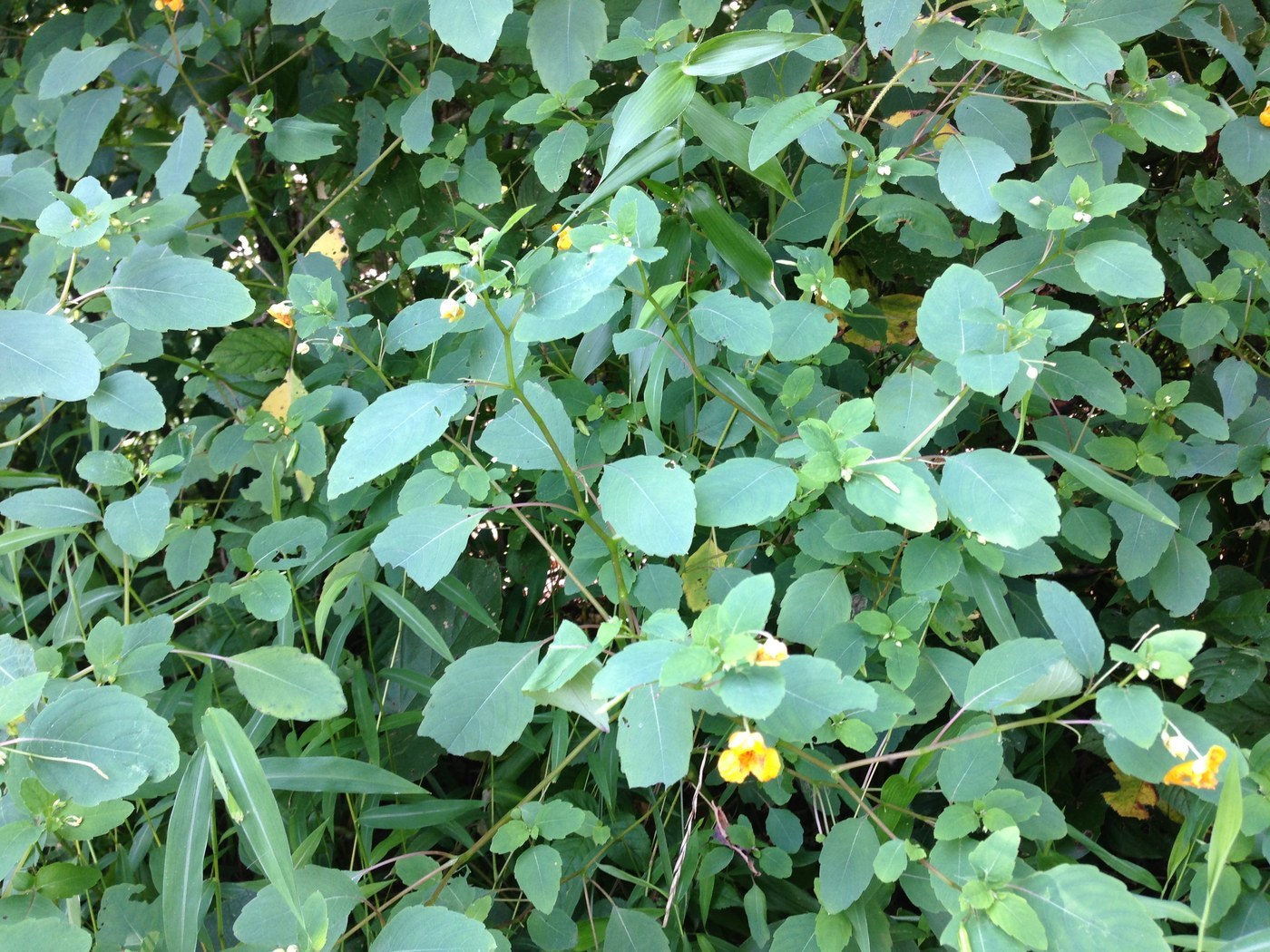
Key Identifying Features
Jewelweed, also called Spotted Touch-me-not (Impatiens capensis), is a native North American annual famous for its exploding seed pods. Watch for:
- Pendant orange flowers with reddish-brown spots, dangling on thin stalks
- A distinctive backward-curving nectar spur behind each flower
- Succulent, translucent, watery stems that snap easily and look almost glassy
- Leaves that show a silvery shine underwater ("jewel" effect) when submerged
- Plants 2-5 feet tall, often in dense stands in wet shade
Leaves & Stems
Leaves are oval to elliptical, 1-4 inches long, with rounded or shallowly scalloped, slightly toothed margins. They are alternate, soft, and a bit blue-green, on slender stalks. The defining trait is the stem: smooth, hollow, juicy, and semi-transparent, often with a swollen, knee-like look at the nodes. Crushed stems release a watery, mucilaginous sap.
Flowers & Fruit
The flowers are the showstopper: orange (sometimes pale yellow), about 1 inch long, trumpet-shaped, and hanging horizontally like tiny lanterns. Each has a hooked spur at the back holding nectar that attracts hummingbirds and bees. Blooming runs summer into early fall (July-September). The fruit is a plump green capsule that, when ripe, explodes at the lightest touch, flinging seeds several feet, hence "touch-me-not." Testing a ripe pod with a fingertip is itself a near-certain ID confirmation.
How to Tell It Apart from Look-Alikes
- Pale Jewelweed (Impatiens pallida): nearly identical structure but yellow flowers with fewer or no spots and a shorter, more downward-bent spur. The two often grow together.
- Garden Impatiens / Touch-me-nots: cultivated relatives with flat, non-spurred or differently shaped flowers and usually upright blooms.
- Other wetland herbs lack the combination of translucent juicy stems + spurred dangling flowers + exploding pods, which together are diagnostic.
Where You'll Find It
Jewelweed loves moist, shady, low ground: stream banks, ditch edges, seeps, floodplain woods, pond margins, and damp roadside swales. It frequently grows in large colonies, often alongside stinging nettle and poison ivy in the same damp habitats.
Quick ID Checklist
- Dangling orange (or yellow) spotted flowers with a curled spur
- Translucent, hollow, watery stems that snap easily
- Oval, scalloped-toothed alternate leaves
- Ripe seed pods explode when touched
- Wet, shady habitat, often in dense stands
- Blooms midsummer to early fall
Frequently asked questions
Why is it called touch-me-not?
Because the ripe seed capsules burst open explosively at the slightest touch, coiling back and scattering seeds several feet away. This is also a reliable way to confirm the plant's identity.
What is the difference between orange and yellow Jewelweed?
Spotted Jewelweed (Impatiens capensis) has orange spotted flowers, while Pale Jewelweed (Impatiens pallida) has yellow flowers with a shorter spur. They are structurally similar and sometimes grow side by side.
Is Jewelweed an annual or perennial?
Jewelweed is an annual that regrows each year from its abundant self-sown seeds, which is why it forms large recurring colonies in the same damp spots.