Jimsonweed Identification Guide
Identify jimsonweed (Datura stramonium), a rank-smelling poisonous annual with large white or violet trumpet flowers and spiny egg-shaped seed pods. Covers its jagged leaves, foul odor, and safety warnings.
Read the full Jimsonweed encyclopedia entry →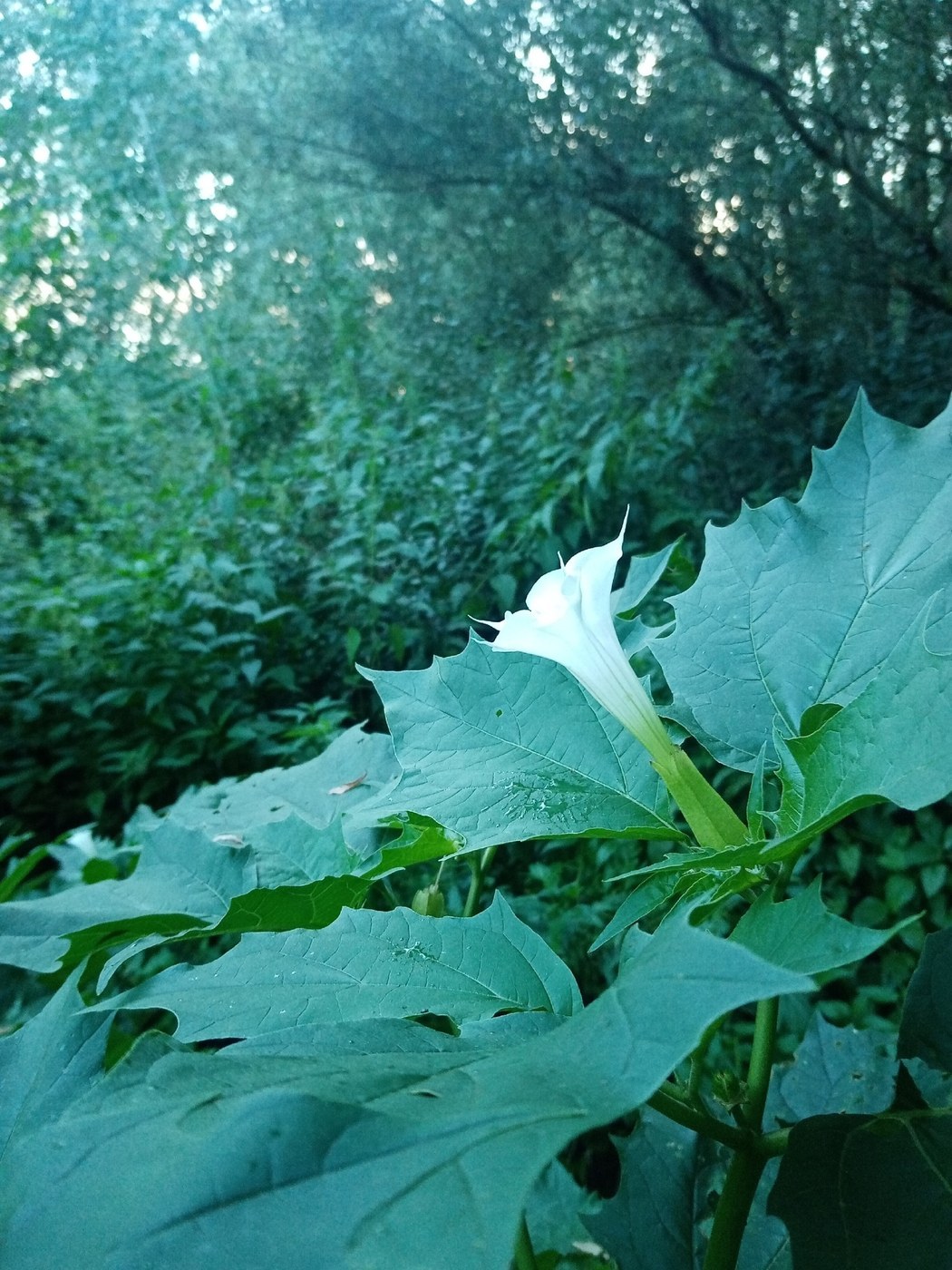
Key Identifying Features
Jimsonweed (Datura stramonium), also called thornapple, is a tall, bushy, strongly ill-smelling annual in the nightshade family and is highly poisonous. Recognize it by its large white to pale violet trumpet-shaped flowers, its spiny, egg-shaped seed capsules, and its big, coarsely toothed leaves with a rank odor when crushed.
- Stout, branching annual, often 2 to 5 feet tall
- Large trumpet flowers, 2.5 to 5 inches long, white or lavender
- Spiny (thorny) egg-shaped seed pods about the size of a walnut
- Large, jaggedly toothed, foul-smelling leaves
- Smooth stems often tinged purple
Leaves & Stems
Leaves are large (up to 8 inches), broadly oval, and coarsely and irregularly toothed or lobed, with pointed teeth giving a jagged, almost oak-like or maple-like outline. They are dark green, thin, and emit a rank, unpleasant smell when bruised. The stems are stout, smooth, hollow, and freely branching, frequently flushed purple, especially on the var. tatula form. The plant has a bushy, somewhat sprawling habit.
Flowers & Fruit
The flowers are erect, trumpet- or funnel-shaped, 2.5 to 5 inches long, with a long tube flaring into five (sometimes ten) shallow pointed lobes. They are typically white, sometimes washed with violet or pale purple, and open in the evening, often fragrant at dusk and pollinated by moths. Each flower develops into a hallmark hard, egg-shaped capsule densely covered in stiff spines, which splits into four parts to release numerous flat, dark seeds. Flowering and fruiting span summer into fall.
How to Tell It Apart from Look-Alikes
- Henbane (Hyoscyamus niger): Has dull yellow, purple-veined flowers and lidded urn capsules rather than white trumpets and spiny pods.
- Moonflower / ornamental Datura and Brugmansia: Brugmansia (angel's trumpet) has huge pendant (hanging) flowers on a woody shrub/tree, whereas jimsonweed's trumpets point upward on a herbaceous annual.
- Cocklebur: Has bur-like fruits but inconspicuous flowers and rough, non-trumpet leaves.
The pairing of upright white/violet trumpet flowers with spiny egg-shaped pods and a rank smell is diagnostic.
Where You'll Find It
Jimsonweed favors rich, disturbed soils in full sun: barnyards, feedlots, cultivated fields, gardens, roadsides, waste ground, and overgrazed pastures. Widely naturalized across North America and much of the world, it often appears where soil has been churned and fertilized.
Safety: All parts, especially the seeds, contain dangerous tropane alkaloids (atropine, scopolamine, hyoscyamine). Ingestion can cause severe poisoning or death. Never eat any part, keep it away from children and livestock, and wash hands after handling.
Quick ID Checklist
- Bushy annual, 2 to 5 ft, foul-smelling
- White or violet upright trumpet flowers, 2.5 to 5 in
- Spiny, egg-shaped seed pods (thornapples)
- Large, jaggedly toothed leaves
- Smooth, often purple-tinged hollow stems
- Highly poisonous; rich disturbed soils
Frequently asked questions
Is jimsonweed dangerous?
Yes. Every part, especially the seeds, contains potent tropane alkaloids that can cause severe poisoning or death. Do not eat any part and keep it away from children and livestock.
What is the spiny ball on jimsonweed?
That is the seed capsule, a hard, egg-shaped pod densely covered in stiff spines (hence the name thornapple). It splits open to release many dark seeds.
How do I tell jimsonweed from angel's trumpet (Brugmansia)?
Jimsonweed is a herbaceous annual with upward-pointing trumpet flowers, while Brugmansia is a woody shrub or small tree with large flowers that hang downward.
Why does jimsonweed smell bad?
The leaves release a rank, unpleasant odor when bruised or crushed, which together with the trumpet flowers and spiny pods helps confirm the plant's identity.
Jimsonweed identified by the community
Recent Jimsonweed specimens identified with Plant Identifier.