
Joe-Pye Weed Identification Guide
How to identify Joe-Pye weed (Eutrochium) by its towering height, whorls of large leaves around the stem, and big domed clusters of dusty mauve-pink late-summer flowers.
Read the full Joe-Pye Weed encyclopedia entry →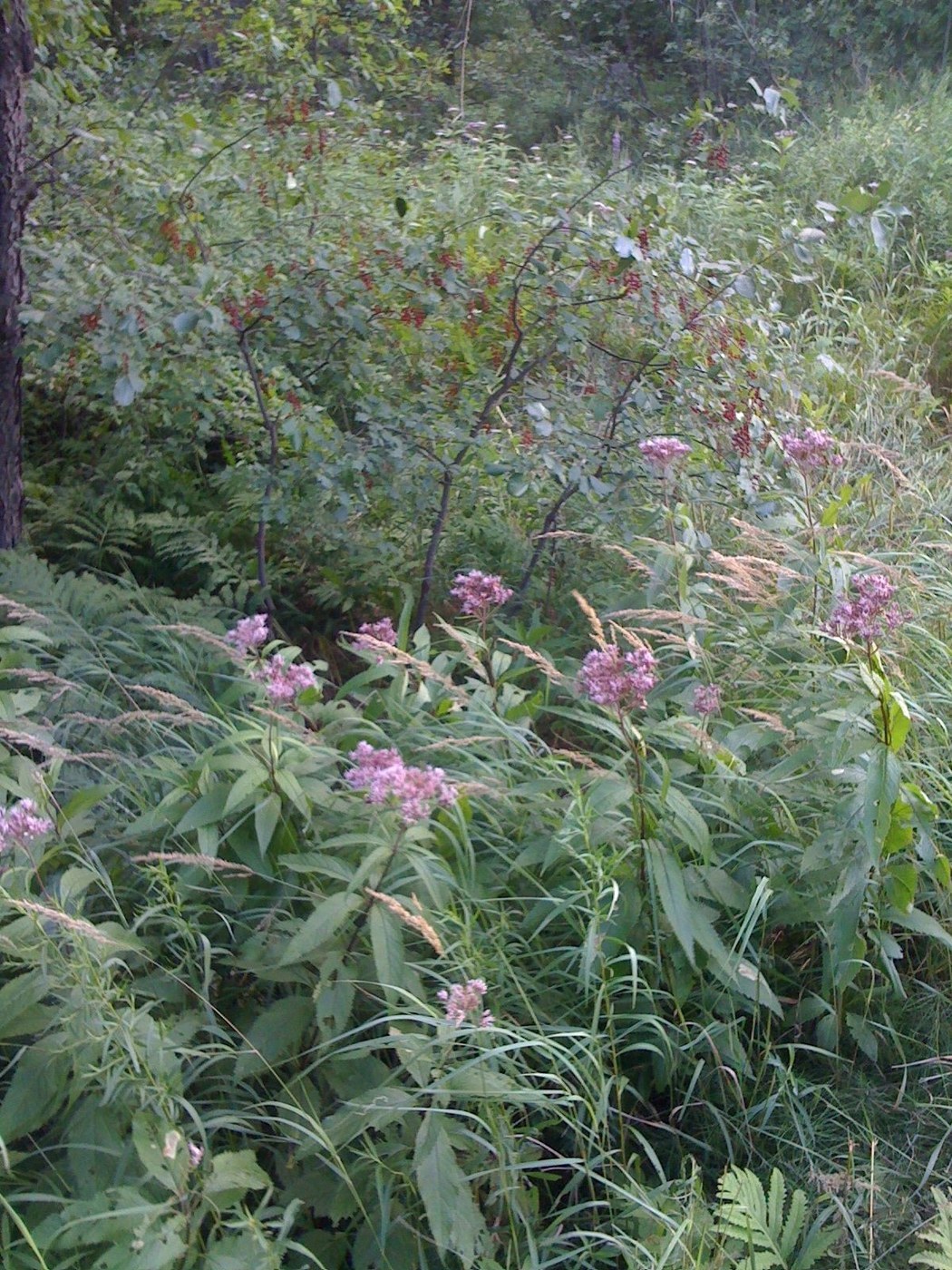
Key Identifying Features
Joe-Pye weed (Eutrochium, formerly Eupatorium) is a tall native North American perennial in the daisy family (Asteraceae). Two features make it stand out: its great height (often 1.5–3 m) and the whorls of 3–7 leaves arranged in rings around the stem. In late summer it is topped by large, domed to elongated clusters of tiny mauve-pink flowers that hum with pollinators.
- Tall, robust stems, often 1.5–3 m
- Leaves in whorls (rings) of 3–7 at each node
- Flat-topped to domed clusters of dusty rose to mauve-purple florets
- Coarse, vanilla-scented when leaves are crushed (in some species)
Leaves & Stems
The whorled leaf arrangement is the headline clue: at each stem node, several large leaves radiate like spokes. Leaves are lance- to ovate-shaped, coarsely toothed, prominently veined, and rough-textured, up to 20–30 cm long. Stems are stout and may be green, purple-spotted, or solidly purple depending on species (e.g., spotted Joe-Pye weed has purple-speckled stems). Stems are usually solid and unbranched until the flower head.
Flowers & Fruit
Flowers are in large terminal corymbs or rounded domes, each made of many small fuzzy florets (no ray petals — they are disc-flower heads), colored dusky pink, mauve, or rosy purple, occasionally creamy. Bloom time is mid-summer to early autumn. Fruit are tiny dry seeds (achenes) tipped with whitish hairs (pappus) that aid wind dispersal, giving faded heads a fluffy look.
How to Tell It Apart from Look-Alikes
- Boneset (Eupatorium perfoliatum): related, but has white flowers and opposite leaves fused around the stem, not whorled mauve.
- Ironweed (Vernonia): similar height and late bloom, but flowers are deep violet-purple and leaves are alternate, not whorled.
- Hemp agrimony (Eupatorium cannabinum): has opposite, divided leaves and dull pink flat heads; lacks the bold whorls.
- Milkweed: pink clustered flowers but with milky sap and paired leaves; Joe-Pye has no milky sap.
Where You'll Find It
Joe-Pye weed favors moist to wet ground: stream banks, wet meadows, ditches, pond edges, and damp thickets across eastern and central North America. It is widely planted in rain gardens, pollinator borders, and naturalistic plantings for its height and butterfly appeal.
Quick ID Checklist
- Tall (often 1.5–3 m) sturdy perennial
- Leaves in whorls of 3–7 around the stem
- Dusty mauve-pink domed flower clusters in late summer
- Coarsely toothed, veiny leaves; stems sometimes purple-spotted
- Grows in moist/wet ground; loved by butterflies
Frequently asked questions
What is the single best feature for identifying Joe-Pye weed?
The whorled leaves. Several large, toothed leaves radiate in a ring around the stem at each node, which combined with its great height and mauve-pink late-summer flowers makes it distinctive.
How do I separate Joe-Pye weed from ironweed?
Both are tall late-summer natives, but ironweed has alternate leaves and intense violet-purple flowers, while Joe-Pye weed has whorled leaves and softer dusty rose to mauve flowers.
Why are some Joe-Pye weed stems spotted purple?
Spotted Joe-Pye weed (Eutrochium maculatum) naturally has purple-speckled or solidly purple stems, a helpful trait for telling that species apart from green-stemmed relatives.
Does Joe-Pye weed grow in dry soil?
Generally no. It is a plant of moist to wet habitats like stream banks, ditches, and wet meadows, so finding a tall whorled-leaf perennial in damp ground is a strong clue.