
Joshua Tree Identification Guide
Identify the Joshua tree by its spiky evergreen dagger-like leaves, branching shaggy form, and creamy greenish flower clusters. Covers leaves, flowers, form, look-alikes, and Mojave habitat.
Read the full Joshua Tree encyclopedia entry →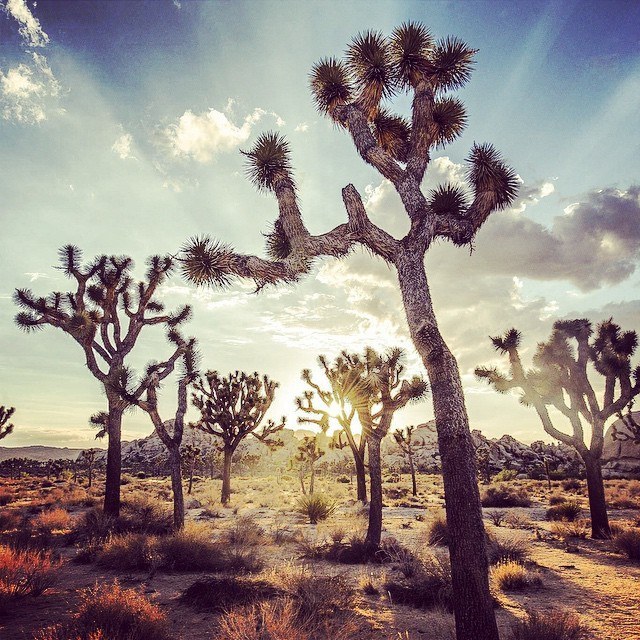
Key Identifying Features
The Joshua tree (Yucca brevifolia) is the iconic giant yucca of the Mojave Desert, not a true tree but an arborescent monocot. Recognize it by its clusters of stiff, sharp, dagger-like blue-green leaves at the tips of thick, often crooked branches, its shaggy 'skirt' of dead leaves, and a distinctive multi-armed silhouette. Mature plants reach 15-40 feet.
Leaves
- Leaves are stiff, narrow, dagger- or bayonet-shaped, 6-14 inches long, ending in a sharp spine.
- They are blue-green to gray-green, with finely toothed (minutely serrate) margins.
- Leaves cluster in dense spiral rosettes at the branch tips; older leaves bend down and persist as a brown, shaggy thatch along the trunk and limbs.
Form & Trunk
- The plant branches repeatedly into thick, irregular, often grotesquely angled arms — branching is typically triggered after each flowering or by damage.
- The trunk and limbs are covered in fibrous, reddish-brown bark of densely packed dead leaves.
- The overall shape is unmistakable: a stout, top-heavy, candelabra-like form.
Flowers & Fruit
- In spring (after wet winters), branch tips bear dense, upright, club-shaped clusters of creamy white to greenish, waxy, six-parted flowers.
- Flowers smell musty and are pollinated exclusively by the yucca moth.
- Fruits are greenish-brown, oval, spongy capsules that dry and drop.
How to Tell It Apart from Look-Alikes
- Mojave yucca (Yucca schidigera) has longer leaves with curling fibers along the margins, is usually shorter and less branched, and lacks the tall candelabra form.
- Banana yucca and soaptree yucca form ground-level rosettes or single stems, not the branched tree form.
- Ocotillo, sometimes confused at a distance, has whip-like spiny wands with small leaves and red flowers, not rosettes of daggers.
Where You'll Find It
The Joshua tree is essentially endemic to the Mojave Desert of California, Nevada, Arizona, and Utah, at elevations roughly 1,300-6,000 feet, especially on open desert flats and bajadas. Its range famously defines Joshua Tree National Park. Look for its branching silhouettes scattered across high desert.
Quick ID Checklist
- Stiff, sharp, dagger-like blue-green leaves in tip rosettes
- Branching, candelabra-like tree form
- Shaggy skirt of dead brown leaves on trunk and arms
- Spring clusters of creamy greenish waxy flowers
- Mojave Desert habitat
A branching desert giant tipped with spiky leaf rosettes and a shaggy trunk in the Mojave is the Joshua tree.
Frequently asked questions
Is the Joshua tree actually a tree?
No, it is a giant species of yucca, a woody monocot, that simply grows into a branched tree-like form; it lacks true wood and growth rings.
How do I tell a Joshua tree from Mojave yucca?
Joshua tree grows into a tall branched candelabra with short dagger leaves, while Mojave yucca is usually shorter, less branched, and has longer leaves with curling fibers along the edges.
Why are Joshua trees often branched in odd shapes?
Each time a stem flowers (or is damaged by frost or insects), it tends to split into new branches, producing the plant's irregular, grotesque, multi-armed silhouette.
Where do Joshua trees grow?
They are nearly endemic to the Mojave Desert of California, Nevada, Arizona, and Utah, growing on open high-desert flats and slopes roughly 1,300 to 6,000 feet in elevation.