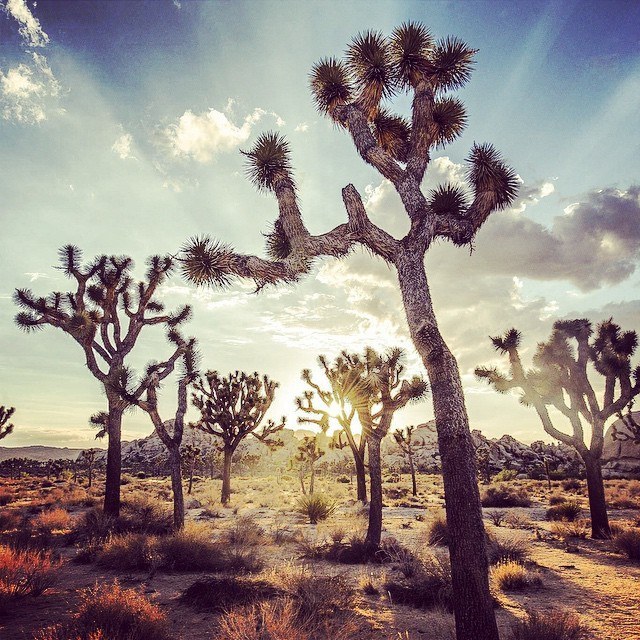
Joshua Tree
Yucca brevifolia
An iconic, slow-growing tree-sized yucca of the Mojave Desert, with spiky bayonet-like leaves and branched, shaggy arms that define the desert skyline.
- Light
- Full sun
- Water
- Very little; drought-tolerant
- Difficulty
- Moderate
Got a plant like this?
Identify any plant from a photo, free.
Overview
The Joshua tree is the signature plant of the Mojave Desert, a giant arborescent yucca that can live for well over a century and reach 40 feet tall. Despite its tree-like stature it is a monocot related to agaves and lilies, not a true tree, and it lacks growth rings.
Its twisted, branching silhouette — said to have reminded Mormon pioneers of the prophet Joshua raising his arms — is unmistakable. Growth is extremely slow, and the species depends on a remarkable, exclusive partnership with the yucca moth for pollination.
How to identify it
Bayonet leaves and branched arms are diagnostic:
- Leaves stiff, sharp, bayonet-like, 6-14 in long, blue-green, clustered in dense rosettes at branch tips; old dead leaves hang as a shaggy 'skirt' on the trunk
- Trunk and limbs thick, fibrous, and irregularly branched after each flowering or injury, giving the gnarled form
- Flowers creamy greenish-white, cup-shaped, in large dense clusters atop branches in spring (only after sufficient winter rain and cold)
- Fruit spongy, oval green capsules
- Size typically 15-40 ft tall, very slow-growing
Care & growing
A true desert plant needing heat, sun, and sharp drainage.
- Light: Full sun
- Water: Very little once established; rot-prone with excess moisture
- Soil: Fast-draining sandy or gravelly desert soil; never soggy
- Temperature: Hardy in USDA zones 6-10; needs hot days, cool nights, and a winter chill to bloom
- Feeding: Not needed
- Propagation: From seed (slow) or offsets and stem/rhizome cuttings; transplanting mature wild plants is difficult and often prohibited
Habitat & origin
Native and largely endemic to the Mojave Desert of the southwestern United States — parts of California, Nevada, Arizona, and Utah — typically at 2,000-6,000 ft elevation. It gives its name to Joshua Tree National Park.
It grows in open desert grassland and scrub, often in extensive stands. Climate change and habitat loss threaten its long-term range, making it a focus of conservation concern.
Frequently asked questions
Is the Joshua tree really a tree?
No — it is a giant yucca, a monocot related to agaves; it lacks true wood and annual growth rings.
How old can they get?
Many live 150 years or more, with some estimated at several centuries; their slow growth makes aging difficult.
Why does it branch in odd places?
It typically branches after flowering or when the growing tip is damaged, producing its characteristic gnarled arms.
How is it pollinated?
Almost exclusively by the yucca moth, which deliberately pollinates the flowers and lays eggs in them — a tight mutual dependence.
Joshua Tree guides
In-depth guides for identifying, growing, and caring for Joshua Tree.
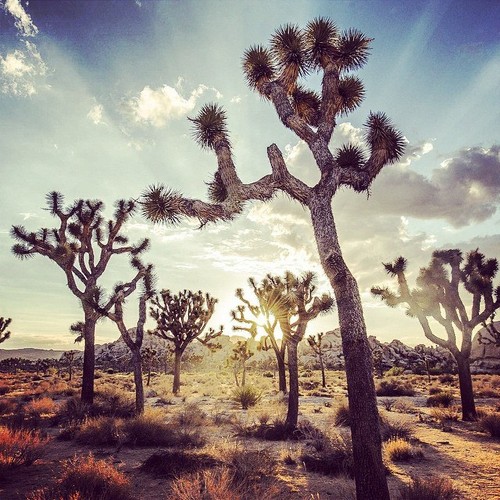
How to Care for Joshua Tree
Grow the iconic Joshua Tree (Yucca brevifolia) with blazing full sun, sharp-draining gritty soil, and very sparing water.
Joshua Tree Identification Guide
Identify the Joshua tree by its spiky evergreen dagger-like leaves, branching shaggy form, and creamy greenish flower clusters. Covers leaves, flowers, form, look-alikes, and Mojave habitat.