
Kentucky Coffeetree Identification Guide
Identify Kentucky coffeetree by its huge bipinnately compound leaves, thick reddish seed pods, and coarse winter silhouette. Covers leaves, pods, bark, look-alikes, and habitat.
Read the full Kentucky Coffeetree encyclopedia entry →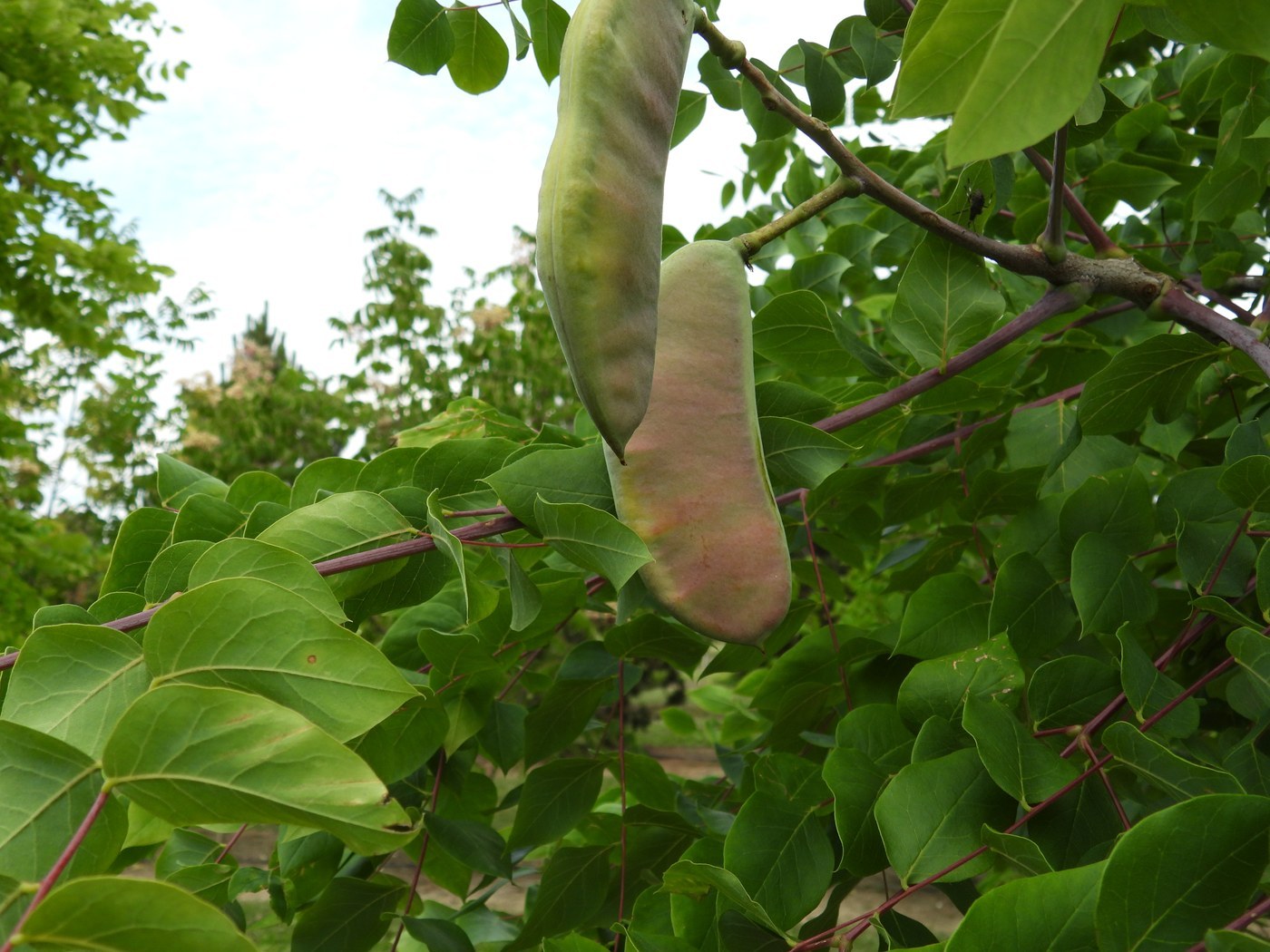
Key Identifying Features
Kentucky coffeetree (Gymnocladus dioicus) is a bold, coarse-textured legume tree with some of the largest compound leaves of any North American tree. It is unmistakable in winter for its stout, blunt, nearly twigless branches and in summer for its enormous doubly compound foliage. It grows 60-75 feet with an open, irregular crown.
Leaves & Stems
- Leaves are huge, bipinnately compound, often 1-3 feet long and up to 2 feet wide, divided into several side branches, each bearing many leaflets.
- Individual leaflets are oval, pointed, 1-3 inches long, with smooth margins.
- The lowest divisions of the leaf may have a single leaflet, while upper ones are fully compound.
- Leaves emerge late in spring (pinkish-bronze) and drop early; fall color is a soft yellow.
- Twigs are very stout, blunt-tipped, and coarse, with a salmon-colored pith and tiny sunken buds — giving a clubbed, almost dead look in winter.
Flowers & Fruit
- The tree is usually dioecious (separate male and female trees); greenish-white flowers appear in late spring.
- Female trees bear thick, flattened, leathery reddish-brown pods 5-10 inches long, containing a few large, hard, dark seeds embedded in sticky pulp.
- Pods persist into winter and are a strong ID clue.
Bark
Bark is dark gray-brown with hard, narrow, scaly ridges that curl outward at the edges, giving a rough, recurved-plate texture.
How to Tell It Apart from Look-Alikes
- Honeylocust (Gleditsia triacanthos) also has compound leaves and pods but has slender twigs (often branched thorns) and long twisted pods; coffeetree has no thorns and stout blunt twigs.
- Black walnut (Juglans nigra) has once-compound leaves with a chambered pith and round husked nuts, not flat pods.
- Ailanthus (tree-of-heaven) leaflets have a glandular tooth near the base and a foul smell.
Where You'll Find It
Native to the Midwest and central US, Kentucky coffeetree grows in rich bottomlands and floodplains but is uncommon in the wild. It is widely planted as a tough, pollution-tolerant street and park tree, often the seedless male clones. Look for its distinctive bare, stubby winter silhouette in parks and along avenues.
Quick ID Checklist
- Enormous bipinnately compound leaves up to 3 feet long
- Very stout, blunt, coarse twigs (clubbed winter look)
- Thick reddish-brown leathery pods with large hard seeds
- Scaly bark with recurved, curling ridges
- No thorns (unlike honeylocust)
Giant doubly compound leaves, chunky pods, and clubby thornless twigs make Kentucky coffeetree easy to confirm.
Frequently asked questions
Why is it called a coffeetree?
The common name comes from early settlers, who roasted its seeds as a coffee substitute. The name has stuck even though the tree is now grown mainly as an ornamental shade tree.
How do I tell it from honeylocust?
Kentucky coffeetree has very stout, blunt, thornless twigs and thick straight pods, while honeylocust has slender twigs, often branched thorns, and long twisted pods.
Why does the tree look almost dead in winter?
Its branches are unusually stout and sparingly twigged with tiny sunken buds, giving a coarse, clubbed silhouette that looks lifeless until late-emerging leaves appear.
Do all Kentucky coffeetrees make pods?
No, the species is dioecious; only female trees produce the large reddish pods, and many planted street trees are seedless male clones.