
Kerria Identification Guide
How to identify Japanese kerria (Kerria japonica), a graceful spring shrub with arching green stems and golden-yellow flowers.
Read the full Kerria encyclopedia entry →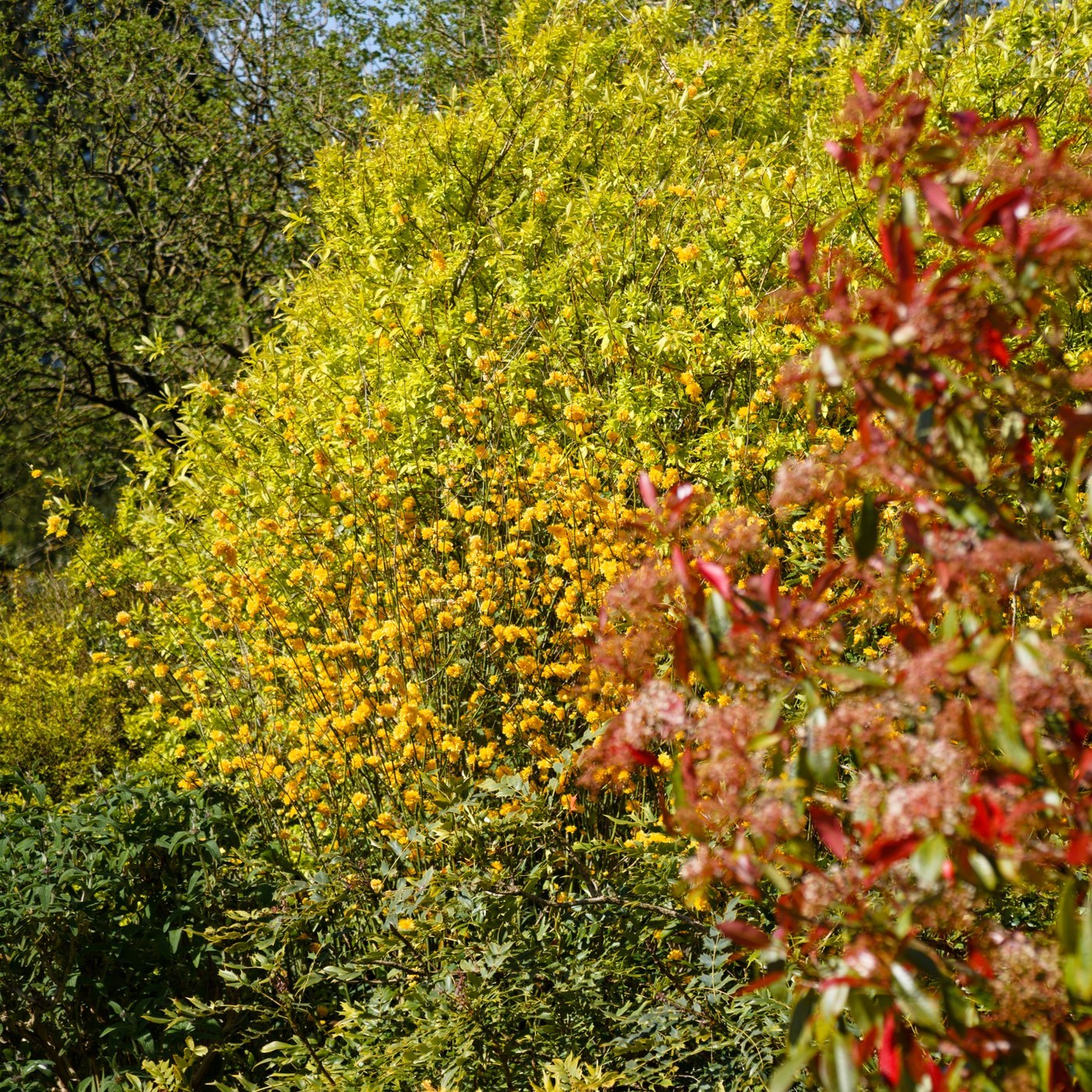
Key Identifying Features
Kerria (Kerria japonica), often called Japanese rose or Easter rose, is a deciduous shrub in the rose family prized for its early-spring bloom. Two traits make it easy to recognize: bright green, zigzag, arching stems that stay green all winter, and cheerful golden-yellow flowers in spring. The popular double-flowered form 'Pleniflora' has pompom-like blooms.
- Suckering, multi-stemmed shrub, 3-6 ft tall (taller when supported)
- Slender, bright green twigs that photosynthesize year-round
- Loose, fountain-like arching habit
Leaves & Stems
Leaves are alternate, bright green, oval to lance-shaped with a long-pointed tip, 1.5-4 inches long. The margins are sharply and doubly toothed (serrate), and the surface has prominent, deeply impressed veins giving a crinkled or pleated texture. Fall color is a pale yellow. The defining vegetative feature is the vivid green bark on slender, somewhat zigzagging stems; in winter the leafless green canes are a dead giveaway.
Flowers & Fruit
Kerria blooms heavily in mid to late spring, often with scattered repeat flowers into summer. The single form has flat, five-petaled, yellow-gold flowers about 1-1.75 inches across that look like small wild roses. The widely grown 'Pleniflora' bears fully double, ball-shaped golden flowers resembling tiny marigolds or pompoms. Fruit is rarely produced and inconspicuous.
How to Tell It Apart from Look-Alikes
- Forsythia: also early and yellow, but forsythia flowers are bell-shaped with four narrow petals on tan/brown stems, and bloom before leaves; kerria has rounded 5-petaled (or pompom) flowers and green stems.
- Yellow roses or potentilla: roses have thorns and compound leaves; shrubby potentilla has tiny pinnate leaflets. Kerria stems are thornless and green.
- Japanese rose confusion: Rosa rugosa is also nicknamed Japanese rose but is a thorny true rose, very different.
Where You'll Find It
Kerria is an ornamental garden shrub found in temperate landscapes worldwide (USDA zones 4-9). It thrives in partial shade, where flower color holds best, and tolerates a range of soils. It spreads by suckers, sometimes forming colonies along borders, foundations, and woodland edges. It is not a wild native in North America but may persist around old homesites.
Quick ID Checklist
- Bright green, arching, zigzag stems (green even in winter)
- Golden-yellow flowers in spring, single 5-petaled or double pompom
- Alternate, sharply double-toothed leaves with impressed veins
- Thornless, suckering, fountain-shaped habit
- Found in gardens and shaded borders, not wild woods
Frequently asked questions
How do I tell kerria from forsythia?
Both bloom yellow in spring, but forsythia has four-petaled bell-shaped flowers on brown stems and blooms on bare wood. Kerria has rounded five-petaled or pompom-shaped flowers and distinctive bright green stems.
Why are my kerria's stems green in winter?
Kerria has chlorophyll-rich green bark that photosynthesizes year-round, so the leafless canes stay vivid green through winter. This is one of the easiest ways to identify it out of season.
What is the difference between single and double kerria?
The single form has flat, five-petaled flowers like a small wild rose. The cultivar 'Pleniflora' has fully double, ball-shaped pompom flowers and is the most commonly planted form.
Is kerria invasive?
Kerria spreads by underground suckers and can form colonies, so it can be aggressive in a garden bed, but it is not considered a serious invasive species.