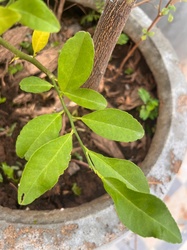
Key Lime Identification Guide
Identify the Key lime (Citrus aurantiifolia) by its thorny shrubby form, small aromatic leaves, white blossoms, and small, round, thin-skinned greenish-yellow fruit.
Read the full Key Lime encyclopedia entry →
Key Identifying Features
The Key lime (Citrus x aurantiifolia), also called Mexican or West Indian lime, is a small, spreading, densely thorny evergreen shrub or tree, typically 2-5 m (6-15 ft). It is identified by its small leaves, sharp spines, small white flowers, and tiny round-to-oval fruit that ripens from green to pale greenish-yellow, with very aromatic, acidic juice and seeds (unlike the seedless Persian lime).
Leaves & Stems
- Leaves are small (4-8 cm), elliptical, pale to medium green, with finely toothed margins and a narrowly winged petiole.
- Crushed foliage is intensely citrus-fragrant.
- Branches are slender, willowy, and armed with numerous short, stiff spines at the leaf axils.
Flowers & Fruit
- Flowers are small, white, fragrant, about 2-3 cm, borne singly or in small clusters, often flushing several times a year.
- Fruit is small (2.5-5 cm), round to oval, with a thin, smooth rind ripening green to greenish-yellow when fully ripe.
- The pulp is greenish-yellow, very juicy, highly acidic and aromatic, containing several small seeds.
How to Tell It Apart from Look-Alikes
- Persian/Tahiti lime (Citrus x latifolia): fruit is larger, oval, seedless, with a thicker rind; the tree is nearly thornless with larger leaves. Key lime is smaller, seedy, and very thorny.
- Lemon (Citrus limon): larger, oblong yellow fruit with a nipple and thick rind.
- Kaffir/makrut lime (Citrus hystrix): has distinctive double (figure-eight) leaves and bumpy fruit.
- The small thorny shrub + small seedy round green fruit + small fragrant leaves points to Key lime.
Where You'll Find It
Native to Southeast Asia, the Key lime is grown throughout the tropics and frost-free subtropics, famously in the Florida Keys, the Caribbean, Mexico, and India. Look for it in home gardens, dooryard plantings, and small orchards. It is frost-sensitive and thrives in full sun with well-drained, even rocky or sandy, soil.
Quick ID Checklist
- Small, densely thorny evergreen shrub/tree
- Small, fragrant, finely toothed leaves with narrowly winged stalks
- Small white fragrant blossoms, multiple flushes
- Small round-to-oval thin-skinned green-yellow fruit
- Seedy, highly acidic, aromatic pulp
Frequently asked questions
How do I tell a Key lime from a regular (Persian) lime?
Key limes are small, round, seedy, and grow on a very thorny shrub with small leaves, ripening to greenish-yellow. Persian limes are larger, oval, seedless, with thicker rinds on a nearly thornless tree.
Are ripe Key limes green or yellow?
Although usually picked and used green, Key limes actually ripen to a pale greenish-yellow. Fully ripe fruit is yellowish, juicier, and at peak aroma.
Why is my Key lime tree so thorny?
Sharp spines at the leaf axils are a natural feature of the Key lime and a useful identifier, distinguishing it from the largely thornless Persian lime.
Can Key limes grow in containers?
Yes, their modest size makes them suitable for large pots, which is common in regions too cold for them outdoors since they are quite frost-sensitive and need to be moved indoors in winter.
Key Lime identified by the community
Recent Key Lime specimens identified with Plant Identifier.