
Korean Fir Identification Guide
How to identify Korean fir (Abies koreana) by its short curled needles with vivid silver undersides and striking violet-blue upright cones. Covers needles, cones, bark, and look-alikes.
Read the full Korean Fir encyclopedia entry →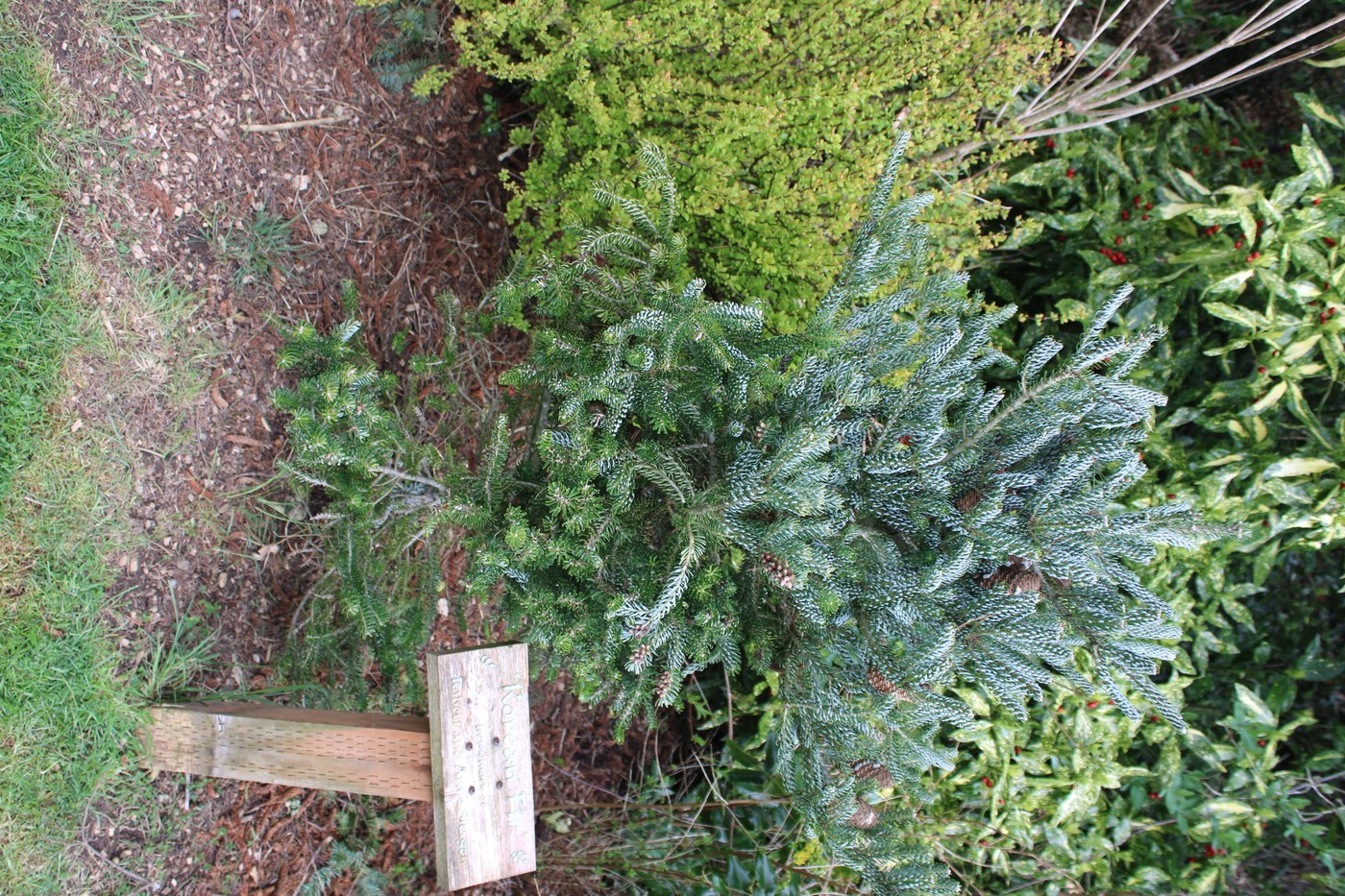
Key Identifying Features
Korean fir (Abies koreana) is a small, slow-growing fir famous for producing dramatic violet-blue, upright cones even on young, small trees. Combined with short needles that are bright silver-white underneath, this makes it one of the easier firs to recognize in gardens.
- Short needles (1–2 cm), often notched at the tip
- Brilliant silvery-white underside to each needle
- Needles curve upward, partly revealing their white undersides
- Purple-blue cones standing upright, appearing on small trees
Leaves & Stems
Needles are short, broad and somewhat crowded, dark glossy green above with two vivid chalk-white stomatal bands beneath. Because the needles twist and curve upward and outward, you constantly catch flashes of that silver underside—an excellent at-a-glance clue. Tips are typically rounded or slightly notched, not spiny. Shoots are pale buff to greyish and bear the round, flat leaf scars characteristic of firs. Winter buds are small and resinous. The bark is smooth and grey with resin blisters when young, becoming roughened with age.
Flowers & Fruit
The cones are the showpiece. They are upright, cylindrical, 4–7 cm long, and a striking violet-blue to purple when immature, ripening brown. Notably, Korean fir cones appear freely even on trees only a meter or two tall, which is unusual among firs. The bracts are often slightly exserted and reflexed. As with all firs, cones shatter on the branch and do not fall whole. Male cones are small and yellowish-red, clustered beneath the shoots in spring.
How to Tell It Apart from Look-Alikes
- Other firs: Few firs cone so young or so blue—abundant purple cones on a small tree strongly indicate Korean fir.
- Spanish fir (A. pinsapo): Needles radiate all around the shoot and are grey-blue, not silver-backed and upcurved.
- Balsam/Fraser fir: Longer, less crowded needles; cones less vividly purple; larger trees.
- Spruce (Picea): Sharp four-sided needles on pegs, hanging cones that fall whole.
Where You'll Find It
Native to high mountains of South Korea (including Jeju Island), growing in subalpine forest. Worldwide it is a hugely popular ornamental and dwarf conifer, with many named selections ('Silberlocke' with strongly upcurled silver needles, 'Horstmann's Silberlocke', compact 'Cis'). Look for it in rock gardens, borders, and as a specimen lawn tree.
Quick ID Checklist
- Short needles bright silver-white underneath
- Needles upcurved, flashing white undersides
- Tips rounded or notched (not spiny)
- Violet-blue upright cones, even on small trees
- Smooth grey bark; compact, slow habit
- Round flat leaf scars (true fir)
A small fir studded with purple-blue upright cones and silver-backed needles is almost certainly Korean fir.
Frequently asked questions
Why does Korean fir have such colorful cones?
Its immature upright cones are naturally violet-blue to purple, an ornamental trait that, combined with the cones appearing on very young trees, makes the species easy to identify.
What is the silver coloring on the needles?
Each needle has two broad chalk-white stomatal bands on its underside; because the needles curve upward you see these silver undersides constantly, a key field mark.
How is Korean fir different from a spruce?
Korean fir has soft, flat, notch-tipped needles with white undersides and upright cones that shatter on the tree, while spruces have sharp four-sided needles on woody pegs and hanging cones that fall whole.
Why is my small Korean fir already producing cones?
Unlike most firs, Korean fir cones freely even when only a meter or two tall, which is normal and one of its best identification clues.