
Lemon Myrtle Identification Guide
Identify lemon myrtle (Backhousia citriodora) by its glossy lance-shaped leaves with an intense lemon scent and fluffy creamy-white flower clusters.
Read the full Lemon Myrtle encyclopedia entry →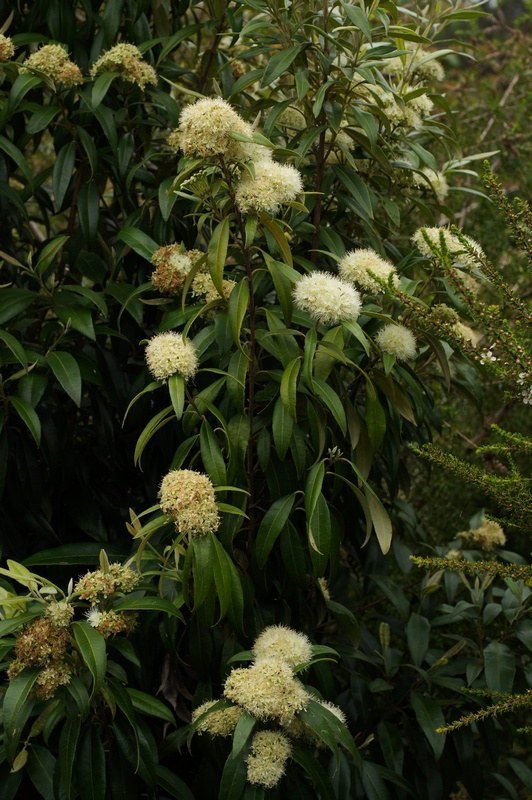
Key Identifying Features
Lemon myrtle (Backhousia citriodora) is an Australian rainforest tree in the myrtle family (Myrtaceae). The single most decisive test is scent: crush a leaf and it releases a powerful, pure lemon fragrance, stronger and cleaner than lemongrass, thanks to a very high citral content. Other marks:
- Glossy, lance-shaped evergreen leaves arranged in opposite pairs.
- Fluffy clusters of small creamy-white flowers with many protruding stamens.
- A shrub-to-small-tree habit, typically 3-8 m in cultivation (taller in the wild).
Leaves & Stems
Leaves are opposite, simple, and 3-12 cm long, narrowing to a pointed tip with a smooth (untoothed) margin. The upper surface is dark glossy green; new growth is often bronze to coppery. Hold a leaf to the light and you can see tiny translucent oil dots, typical of the myrtle family. Stems are slender and woody; bark on older trunks is brownish and fissured. The intense lemon aroma is present year-round.
Flowers & Fruit
Flowers appear mainly in summer to autumn, clustered at the branch tips in rounded creamy-white to cream sprays. Each tiny flower has small petals but a conspicuous tuft of white stamens, giving the whole cluster a soft, fluffy look. After flowering, small dry cup-shaped fruits (capsules) form, each holding fine seed; they persist on the tree as woody calyx cups.
How to Tell It Apart from Look-Alikes
- Lemon-scented tea tree (Leptospermum petersonii) is also lemon-scented but has much smaller, narrower leaves and open five-petalled flowers; its scent is more citronella-like.
- Lemon-scented gum (Corymbia citriodora) is a tall eucalypt with alternate leaves and shedding smooth bark, quite different in form.
- Bay laurel has glossy opposite-looking leaves but smells of bay, not lemon, and lacks the oil dots and fluffy stamen clusters.
The pairing of opposite glossy untoothed leaves, a pure lemon scent, oil dots, and fluffy stamen-rich cream flowers is unique to lemon myrtle.
Where You'll Find It
Native to subtropical and tropical rainforests of central and southeastern Queensland, Australia, lemon myrtle grows wild on rainforest margins and moist gullies. Worldwide it is widely cultivated as an ornamental plant in frost-free gardens, patio pots, and plantations.
Quick ID Checklist
- Intense, pure lemon scent from crushed leaves
- Opposite, glossy, lance-shaped untoothed leaves
- Tiny translucent oil dots visible against light
- Fluffy creamy-white flower clusters with many stamens
- Evergreen shrub or small tree; coppery new growth
Frequently asked questions
How can I confirm a plant is lemon myrtle?
Crush a leaf and smell it. Lemon myrtle gives off an exceptionally strong, pure lemon fragrance from its high citral content, combined with glossy opposite lance-shaped leaves and fluffy cream flowers. Few plants match that combination.
What is the difference between lemon myrtle and lemon-scented tea tree?
Both smell citrusy, but lemon-scented tea tree (Leptospermum petersonii) has much smaller, narrower leaves and open five-petalled flowers with a more citronella-like scent. Lemon myrtle has broader glossy leaves and fluffy stamen-rich cream flower clusters.
Does lemon myrtle produce showy fruit?
No. After the creamy flowers fade it forms small, dry, cup-shaped capsules that hold fine seed and persist as woody calyx cups. The flowers and foliage, not the fruit, are the main identifying features.
Is lemon myrtle a tree or a shrub?
It is naturally a rainforest tree that can grow tall in the wild but is usually seen as a 3-8 m shrub or small tree in cultivation, often kept compact by pruning or grown in containers.