Lemon Myrtle
Backhousia citriodora
Lemon myrtle is an Australian rainforest tree whose glossy leaves carry one of the most intense natural lemon fragrances of any plant, driven by very high citral content. It is grown as an aromatic ornamental.
- Light
- Full sun to bright partial shade
- Water
- Regular; keep moist, not waterlogged
- Difficulty
- Moderate
Got a plant like this?
Identify any plant from a photo, free.
Overview
Lemon myrtle (Backhousia citriodora) is an evergreen tree in the myrtle family (Myrtaceae), native to the subtropical rainforests of Queensland, Australia.
Its crushed leaves release a powerful lemon scent thanks to an exceptionally high concentration of the aroma compound citral (often 90-98% of the leaf oil), giving it a cleaner, more intense citrus note than lemon itself.
It is grown commercially for its aromatic leaves and as a fragrant garden tree.
How to identify it
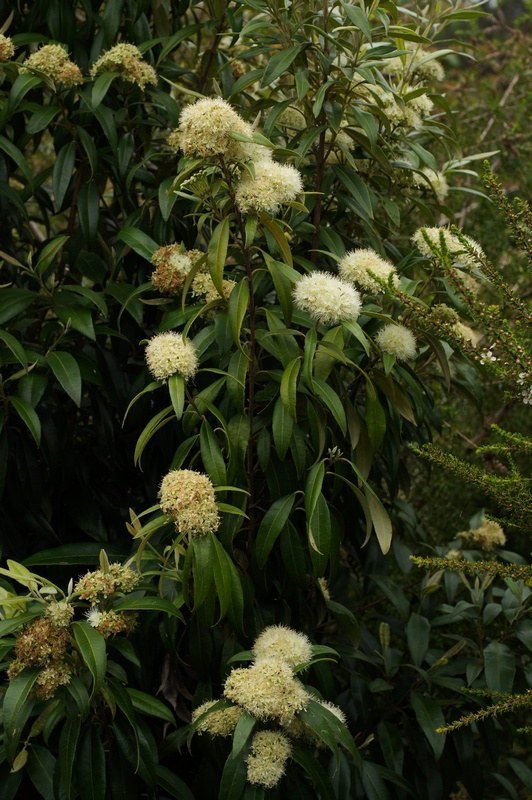
- Leaves: opposite, lance-shaped, glossy deep green, 5-12 cm long; intensely lemon-scented when crushed
- Flowers: clusters of small creamy-white blooms with fluffy stamens, appearing in summer to autumn
- Habit: evergreen tree, typically 3-8 m in cultivation, taller in the wild, with a dense rounded crown
- Bark: finely fissured, grey-brown
- Aroma: the defining feature; far stronger than lemongrass or lemon
Care & growing
Light: Full sun to bright partial shade; more sun encourages dense, fragrant foliage.
Water: Keep soil consistently moist, especially when young; avoid waterlogging.
Soil: Rich, well-drained soil with plenty of organic matter; slightly acidic preferred.
Temperature: Frost-tender; best in subtropical to warm-temperate climates or grown in pots that can be sheltered over winter.
Feeding: Use a low-phosphorus, native-friendly fertilizer in spring and summer.
Propagation: From fresh seed or semi-hardwood cuttings; cuttings preserve the best-scented selections.
Habitat & origin
Lemon myrtle is endemic to the coastal and subtropical rainforests of central and southeastern Queensland, Australia, where it grows as an understory to canopy tree in moist, fertile soils.
It is now cultivated in plantations in Australia and grown as an ornamental in frost-free gardens and in containers in cooler regions worldwide.
Frequently asked questions
Why is lemon myrtle so strongly lemon-scented?
Its leaf oil is dominated by citral, the same compound that gives lemons their scent, but at very high purity (often over 90%), making it one of the most intensely citrus-fragrant plants known.
Will lemon myrtle grow in a cold climate?
It is frost-tender and suited to subtropical or warm-temperate zones. In cooler areas grow it in a container and protect it from frost.
Does lemon myrtle need special fertilizer?
As an Australian native it prefers low-phosphorus fertilizers; standard high-phosphorus feeds can harm it.
Lemon Myrtle guides
In-depth guides for identifying, growing, and caring for Lemon Myrtle.
How to Care for Lemon Myrtle
Grow lush, citrus-scented Backhousia citriodora with full sun, steady moisture, and frost protection for glossy evergreen foliage.
Lemon Myrtle Identification Guide
Identify lemon myrtle (Backhousia citriodora) by its glossy lance-shaped leaves with an intense lemon scent and fluffy creamy-white flower clusters.