
Leyland Cypress Identification Guide
Identify Leyland cypress by its dense, fast-growing columnar form, soft feathery sprays of scale foliage, and sparse small round cones. Includes how to tell this hybrid from arborvitae and true cypress.
Read the full Leyland Cypress encyclopedia entry →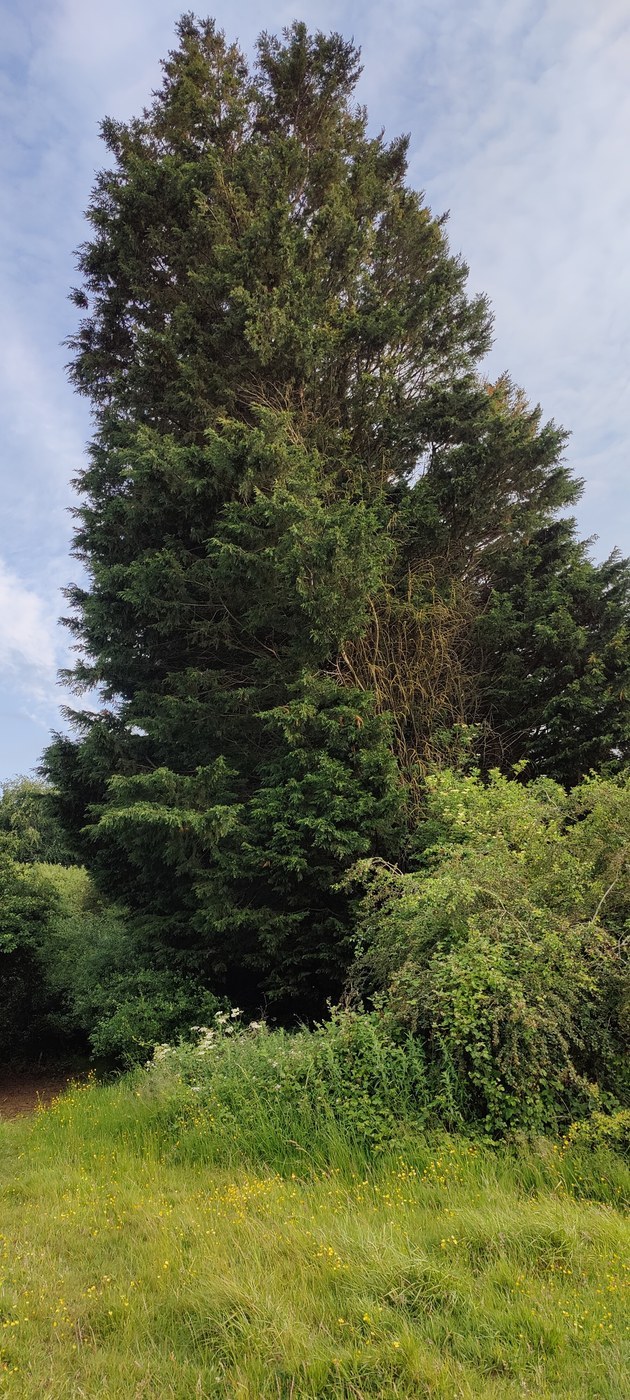
Key Identifying Features
Leyland cypress (x Cuprocyparis leylandii, formerly Cupressocyparis) is a fast-growing hybrid conifer planted almost everywhere as a privacy screen. Recognize it by its dense, narrow, columnar-to-conical shape, soft, feathery, dark grey-green sprays of scale-like foliage, and its tendency to grow in tall uniform hedges. It rarely cones, and when it does the cones are small and round.
- Dense, fast-growing columnar/pyramidal habit, often in hedges
- Soft, flattened-to-irregular sprays of tiny scale leaves
- Dark grey-green to blue-green foliage, not glossy
- Sparse, small (2 cm) round cones when present
Leaves & Stems
Foliage is scale-like, the tiny leaves pressed along the twigs and arranged in soft, flattened or slightly irregular feathery sprays that are not as flat as arborvitae nor as stiff as some true cypresses. Color is a uniform dark grey-green to blue-green, sometimes with a faint resinous smell when crushed (not strongly fruity). Bark is reddish-brown, shallowly furrowed, and stringy on older trunks. The plant grows extremely fast, often a meter per year, into a tall, dense, narrow column that is the main field clue.
Flowers & Fruit
Because Leyland cypress is a sterile or near-sterile hybrid (between Monterey cypress and Nootka cypress), it seldom produces cones, and seed is usually not viable. When cones do form, they are small, round (globose), about 1.5 to 2 cm, with a handful of woody scales, dark brown when mature, scattered sparingly through the foliage. The general lack of abundant cones, combined with rampant growth, is itself a useful identifying trait.
How to Tell It Apart from Look-Alikes
- Arborvitae (Thuja): foliage in distinctly flat sprays with white underside marks and small upturned elongated cones; often bronzes in winter. Leyland sprays are denser and more three-dimensional, with round cones.
- Monterey cypress (Cupressus macrocarpa): a parent; foliage smells lemony when crushed and cones are larger and chunkier.
- Italian cypress (Cupressus sempervirens): much narrower, pencil-like column with rope-like dense foliage and larger oval cones.
- Western red cedar: fruity scent and white butterfly underside marks, which Leyland lacks.
The fast, dense columnar hedge habit plus scarce round cones plus uniform grey-green feathery foliage point to Leyland cypress.
Where You'll Find It
Leyland cypress is one of the most widely planted screening conifers in temperate gardens across Europe, North America, and beyond. You will almost always find it planted in rows as a hedge or windbreak, rarely in the wild. It tolerates a range of soils and grows rapidly, often outgrowing its space and becoming the subject of boundary disputes.
Quick ID Checklist
- Dense, narrow, fast-growing columnar form
- Soft feathery sprays of scale leaves
- Uniform dark grey-green to blue-green color
- Few or no cones; cones small and round when present
- Reddish-brown stringy bark
- Usually planted in hedge rows, not wild
Frequently asked questions
Why does my Leyland cypress have almost no cones?
Leyland cypress is a sterile hybrid of Monterey and Nootka cypress, so it rarely cones and its seed is usually not viable. Sparse coning is itself a clue you are looking at Leyland.
How do I tell Leyland cypress from arborvitae?
Arborvitae has distinctly flat foliage sprays with white marks underneath and small upright elongated cones, and often bronzes in winter. Leyland foliage is denser and more three-dimensional with round cones, staying grey-green.
Why is it growing so fast?
Leyland cypress is prized and infamous for vigorous growth of up to a meter per year. This rapid, dense columnar growth is a primary reason it is planted, and a key identifier.
Is Leyland cypress a true cypress?
It is an intergeneric hybrid between Monterey cypress and Nootka cypress, so it shares cypress ancestry but is its own hybrid taxon and does not occur naturally in the wild.