
Lifesaver Cactus Identification Guide
Recognize the Lifesaver Cactus (Huernia zebrina) by its toothed green stems and striped star flowers with a glossy red, donut-shaped ring in the center.
Read the full Lifesaver Cactus encyclopedia entry →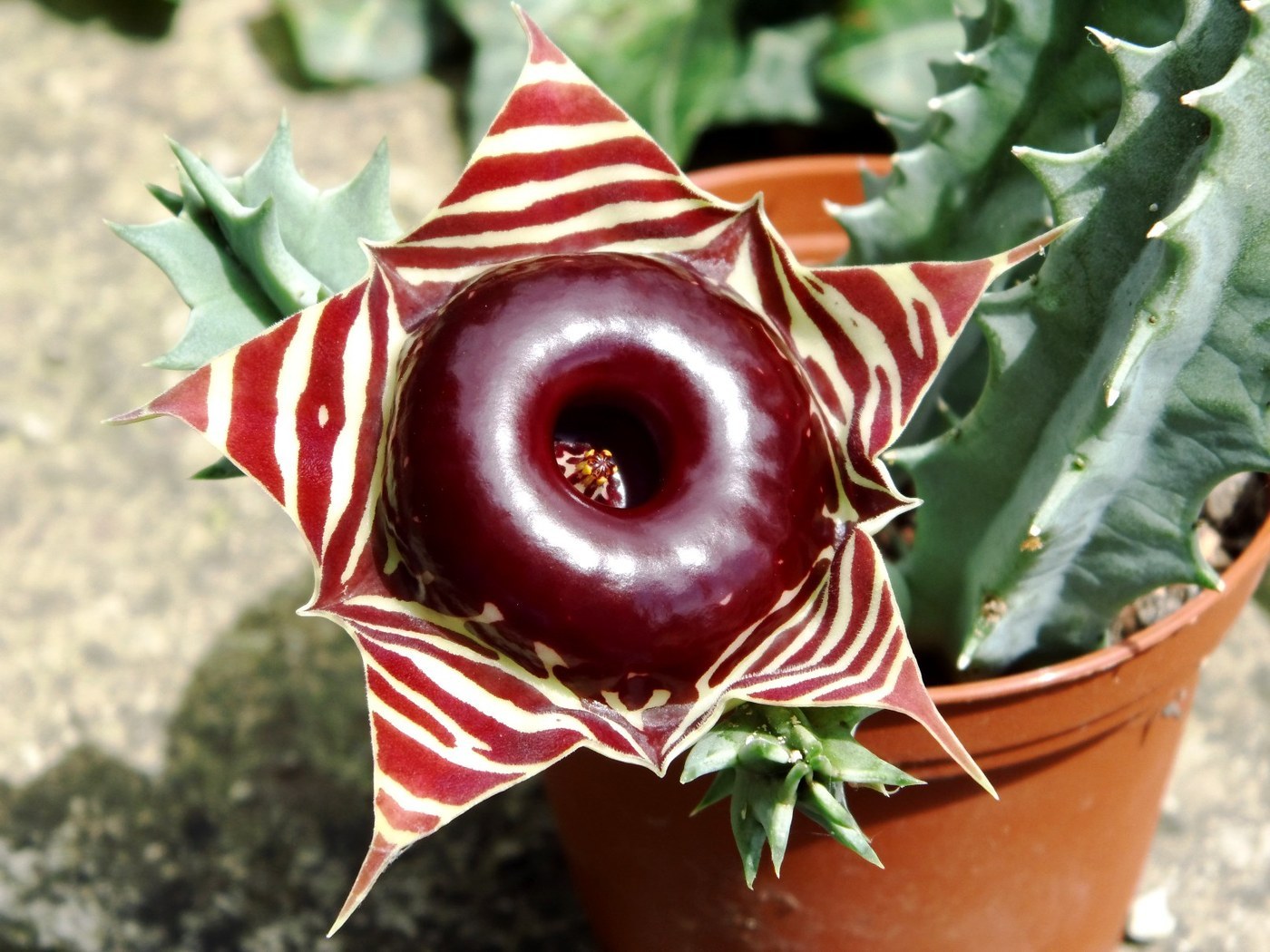
Key Identifying Features
Lifesaver Cactus (Huernia zebrina) is a stem succulent — not a true cactus — famous for flowers that look like candy. Look for:
- Short, fleshy, toothed green stems in low clusters.
- Star-shaped flowers patterned with maroon zebra stripes on a pale yellow background.
- A raised, glossy, deep-red ring (annulus) in the flower's center, exactly like a Life Savers candy.
Stems & Leaves
The stems are erect to sprawling, 1.5-3 in (4-8 cm) tall, 5-angled in cross-section, soft, and green to gray-green, often mottled. Along each angle run rows of soft, tooth-like points (tubercles) rather than true spines — they are not sharp. There are no true leaves. Stems branch at the base and creep to form a small mat or clump.
Flowers & Fruit
The flower is the showstopper and the surest ID. It is a 5-pointed star, about 1-1.5 in (3-4 cm) across, pale cream-yellow boldly marked with fine reddish-brown zebra striping. At its heart sits a thick, shiny, doughnut-like ring of deep glossy red — the 'lifesaver' that names the plant. Unlike the large carrion-flower stapeliads, its scent is faint. Flowers appear near the stem bases in late summer to fall, sometimes followed by paired horn-like seed pods.
How to Tell It Apart from Look-Alikes
- Stapelia grandiflora / Starfish Cactus: much larger, hairy flowers (4-12 in) with a strong carrion smell and no glossy donut ring.
- Orbea variegata (Star Flower): flat star flowers spotted purple-brown, with a raised central rim but not the bright glossy red ring of Huernia zebrina.
- Other Huernia species: similar toothed stems but lack the distinctive shiny red annulus.
- Euphorbia: has milky sap; Huernia sap is clear.
Where You'll Find It
Native to southern Africa, it is a beloved windowsill and collector succulent grown for its bizarre flowers. Hardy in USDA 10-11; elsewhere a potted plant wanting bright light, warmth, and a gritty, very well-drained mix kept dry in winter.
Quick ID Checklist
- Short, soft, 5-angled toothed green stems (no sharp spines)
- Star flowers with maroon zebra stripes
- Glossy deep-red donut ring in the flower center
- Low, clumping, mat-forming habit
- Clear (not milky) sap
Frequently asked questions
Is the Lifesaver Cactus a real cactus?
No. Despite the name, Huernia zebrina is a stem succulent in the milkweed family (Apocynaceae). Its 'teeth' are soft tubercles, not true cactus spines, and it has no areoles.
Why is it called Lifesaver Cactus?
Its star flower has a thick, glossy, deep-red raised ring in the center that looks exactly like a Life Savers candy.
Does it smell bad like other carrion flowers?
Only faintly. Unlike the large Stapelia 'carrion flowers', Huernia zebrina has a mild scent, so it is pleasant to grow indoors.
How do I tell it from a Starfish Cactus?
Starfish Cactus (Stapelia) has much larger, hairy, strongly foul-smelling flowers. Lifesaver Cactus has small striped flowers with a shiny red central ring and little odor.