
Living Stones Identification Guide
Recognize Lithops by their paired, stone-mimicking fleshy leaves with a top fissure and patterned 'window' surface, and the daisy-like flowers that emerge from the slit.
Read the full Living Stones encyclopedia entry →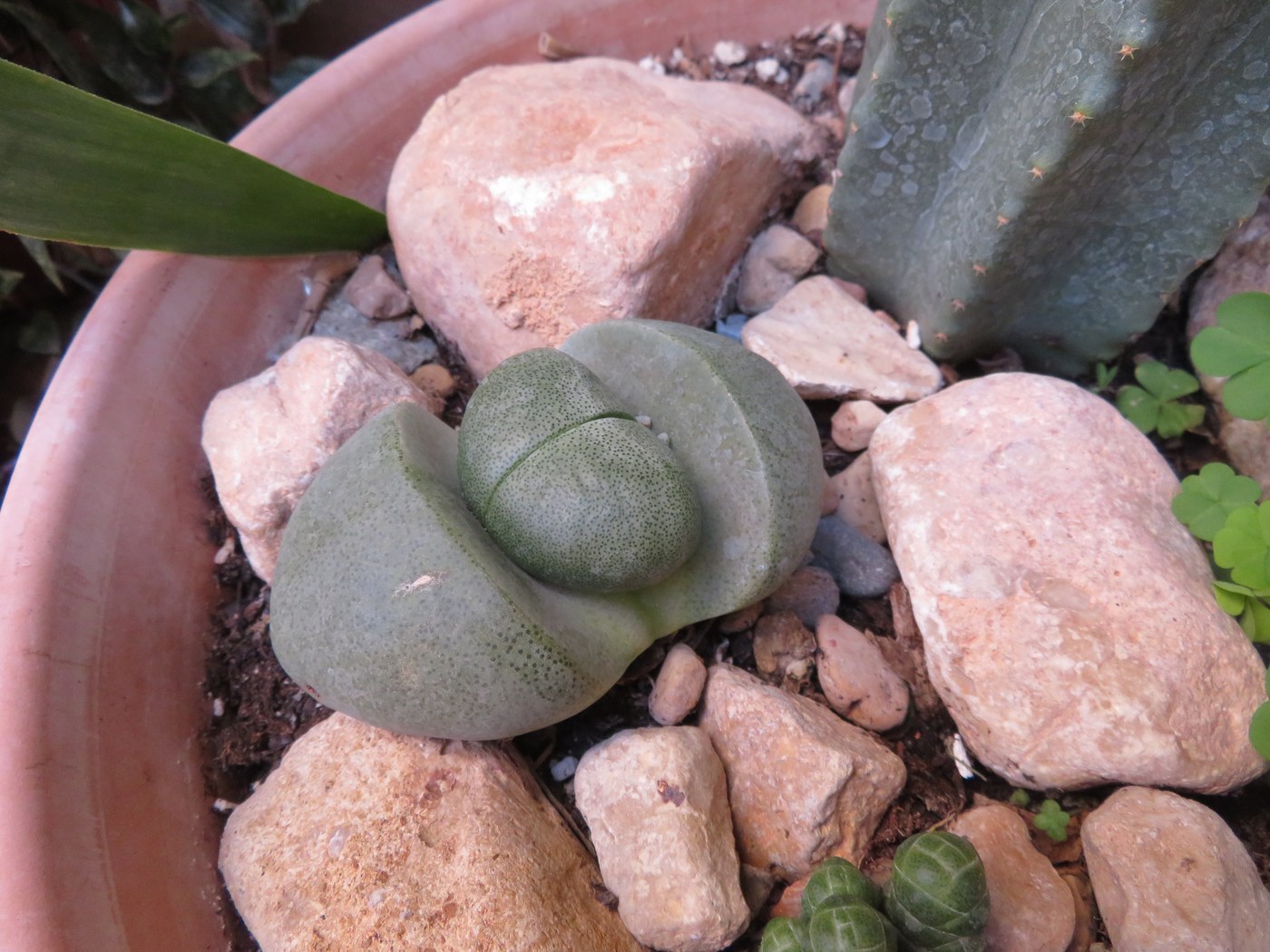
Key Identifying Features
Living Stones (genus Lithops) are tiny, stemless succulents from southern Africa that have evolved to mimic pebbles. Each plant is essentially a pair of fused, swollen leaves with a slit across the top, patterned to blend in with surrounding stones.
- Body looks like a small split pebble, usually 1-4 cm across
- Two fused fleshy leaves with a central fissure (slit) on top
- Flat or domed top surface bears a patterned, translucent "window"
- Colors range from grey, brown, green, rust, to pinkish, mottled to camouflage
Leaves & Stems
The entire visible plant is two thick, fused leaves joined for most of their length, with the slit between them where new growth and flowers emerge. The top face is a flat or slightly domed "window", often translucent and decorated with dots, lines, islands, or marbling that mimic local rock. Below ground the body tapers into a short root system; there is essentially no stem.
A key behavior: each year the plant produces a new pair of leaves from the slit that consumes the old pair, so the old leaves shrivel into a papery sheath as the new body emerges. This molting is diagnostic of Lithops.
Flowers & Fruit
In autumn, a single daisy-like flower pushes out of the central slit, typically yellow or white (some species orange-centered), often nearly as wide as the plant itself and opening in the afternoon. Flowers are many-petaled and showy against the stony body. Fruit is a capsule that opens when wetted by rain to release seeds, a clever desert dispersal trick.
How to Tell It Apart from Look-Alikes
- Split rocks (Pleiospilos) are larger, more angular, grey-green and dotted, and look like chunks of granite rather than smooth pebbles.
- Conophytum also mimics stones but the body is often a single rounded or heart-shaped unit, not a clearly split pebble with a flat window.
- Ordinary pebbles obviously lack the central slit and window pattern.
- The paired fused leaves + top slit + patterned window + annual molting is unique to Lithops.
Where You'll Find It
Native to arid regions of South Africa and Namibia, growing pressed flush into gravelly, rocky ground, often nearly buried with only the window exposed. Grown worldwide as collector windowsill succulents in gritty, fast-draining soil with sparse watering. Overwatering is the main killer.
Quick ID Checklist
- Looks like a small split pebble
- Two fused fleshy leaves with a top slit
- Patterned, translucent 'window' on the top surface
- Daisy-like yellow/white flower from the slit in autumn
- Annual molting: new leaf pair replaces the old
Frequently asked questions
Why does my living stone look like it's splitting into a new plant?
Lithops molt once a year, growing a fresh pair of leaves from the central slit that absorbs the old pair. The old leaves shrivel to a papery shell as the new body emerges. This is normal.
What is the patterned top of the plant?
It is a translucent 'window' that lets light into the buried leaf body. The dots, lines, and marbling help the plant camouflage among real pebbles, which is the easiest way to identify Lithops.
How do I tell Lithops from split rock (Pleiospilos)?
Lithops are small and smooth, mimicking rounded pebbles with a clear top window, while Pleiospilos are larger, angular, grey-green and dotted, resembling chunks of granite.
When and what color are the flowers?
Living stones bloom in autumn, pushing a single daisy-like flower, usually yellow or white, out of the slit between the leaves, often in the afternoon.