
Loblolly Pine Identification Guide
Identify loblolly pine by its needles in bundles of three, spiny-tipped cones, and tall straight trunk with scaly reddish-brown plates. Includes how to tell it from longleaf, shortleaf, and slash pine.
Read the full Loblolly Pine encyclopedia entry →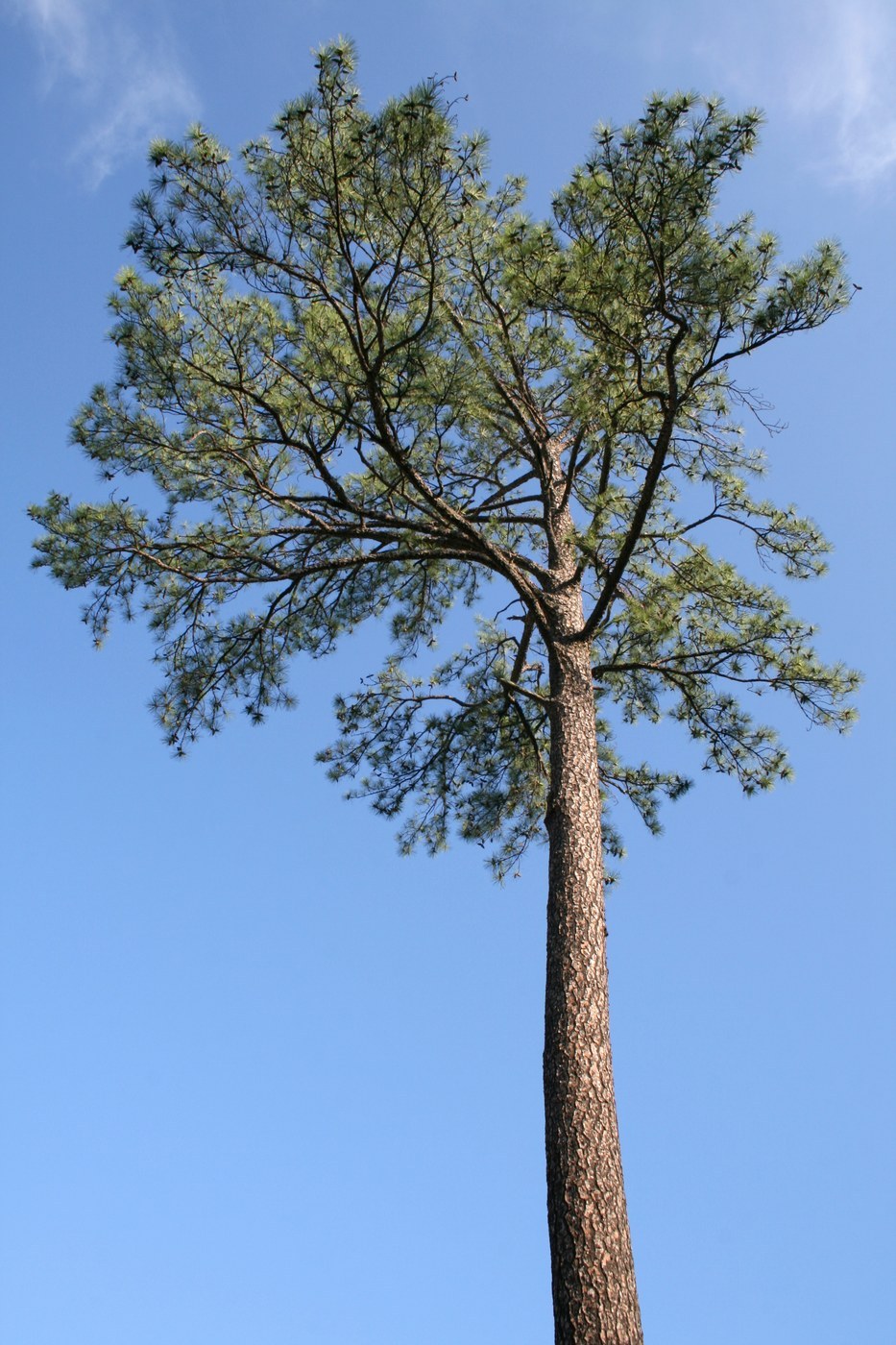
Key Identifying Features
Loblolly pine (Pinus taeda) is the dominant fast-growing pine of the southeastern United States. The key identifiers are needles in bundles of three, 5 to 9 inches (13 to 23 cm) long, slightly twisted and yellow-green, paired with stiff, spiny egg-shaped cones and a tall, straight trunk with reddish-brown scaly bark.
- Three needles per bundle (fascicle), 13 to 23 cm long
- Cones 7 to 13 cm, with a sharp prickle on each scale
- Reddish-brown bark in broad scaly plates
- Tall, straight, fast-growing trunk with a high crown
Leaves & Stems
Loblolly needles are bound in threes, slender, slightly twisted, and stiff, measuring roughly 5 to 9 inches, with a yellow-green to medium-green color. They persist about three years before dropping. Twigs are moderately stout and yellow-brown. The bark is the giveaway on mature trees: thick, reddish-brown to grey, broken into large irregular scaly plates separated by shallow furrows. Young bark is darker and rougher. Mature trees commonly reach 30 to 35 m with a long clear trunk and a rounded crown high up.
Flowers & Fruit
Like all pines, loblolly is a conifer with separate male and female cones. Male (pollen) cones are small, yellowish, and clustered at branch tips in spring, releasing clouds of yellow pollen. Female cones mature over two seasons into ovoid, dull brown woody cones 7 to 13 cm long. Each cone scale bears a stout, sharp spine (prickle), so the cone is uncomfortable to squeeze. Cones often persist on the tree and litter the ground beneath.
How to Tell It Apart from Look-Alikes
- Longleaf pine (P. palustris): needles much longer (up to 45 cm) in bundles of three, cones far larger (15 to 25 cm), and a conspicuous silvery-white terminal bud.
- Shortleaf pine (P. echinata): needles shorter (7 to 13 cm) in bundles of two (sometimes three), smaller cones, and bark with small resin pockets.
- Slash pine (P. elliottii): needles in twos and threes, longer and glossier, cones shinier with a stalk; usually wetter sites.
The three medium needles plus medium spiny cones separate loblolly from the very long longleaf and the shorter-needled shortleaf.
Where You'll Find It
Loblolly is native to the warm, humid southeastern U.S. coastal plain and Piedmont, from Texas to New Jersey. The name "loblolly" refers to low, wet depressions, and the tree tolerates poorly drained soils but grows almost anywhere. It is the backbone of southern timber and pulp plantations and colonizes old fields aggressively.
Quick ID Checklist
- Needles in bundles of three, 13 to 23 cm long
- Needles slightly twisted, yellow-green
- Cones 7 to 13 cm with a sharp prickle on each scale
- Reddish-brown bark in broad scaly plates
- Tall straight trunk, fast-growing
- Southeastern U.S., often old fields and lowlands
Frequently asked questions
How many needles does loblolly pine have per bundle?
Three. Loblolly needles are bound in fascicles of three, each 5 to 9 inches long and slightly twisted, which separates it from two-needled pines like shortleaf and Virginia pine.
How do I tell loblolly from longleaf pine?
Both have three-needle bundles, but longleaf needles are dramatically longer (up to 18 inches), its cones are much bigger, and it has a striking silvery-white terminal bud. Loblolly needles and cones are medium-sized.
Are the cones safe to handle?
Be careful. Each loblolly cone scale ends in a stout, sharp prickle, so squeezing a cone can prick your hand. That spine is itself a useful identifying feature.
Why is it called loblolly?
"Loblolly" is an old term for a mud puddle or wet depression. The tree was named for its tendency to grow in low, moist bottomlands, though it actually thrives on many soil types.