
Longleaf Pine Identification Guide
Identify Longleaf Pine (Pinus palustris) by its very long needles in threes, large cones, big silvery candle buds, and the iconic grass-stage seedling.
Read the full Longleaf Pine encyclopedia entry →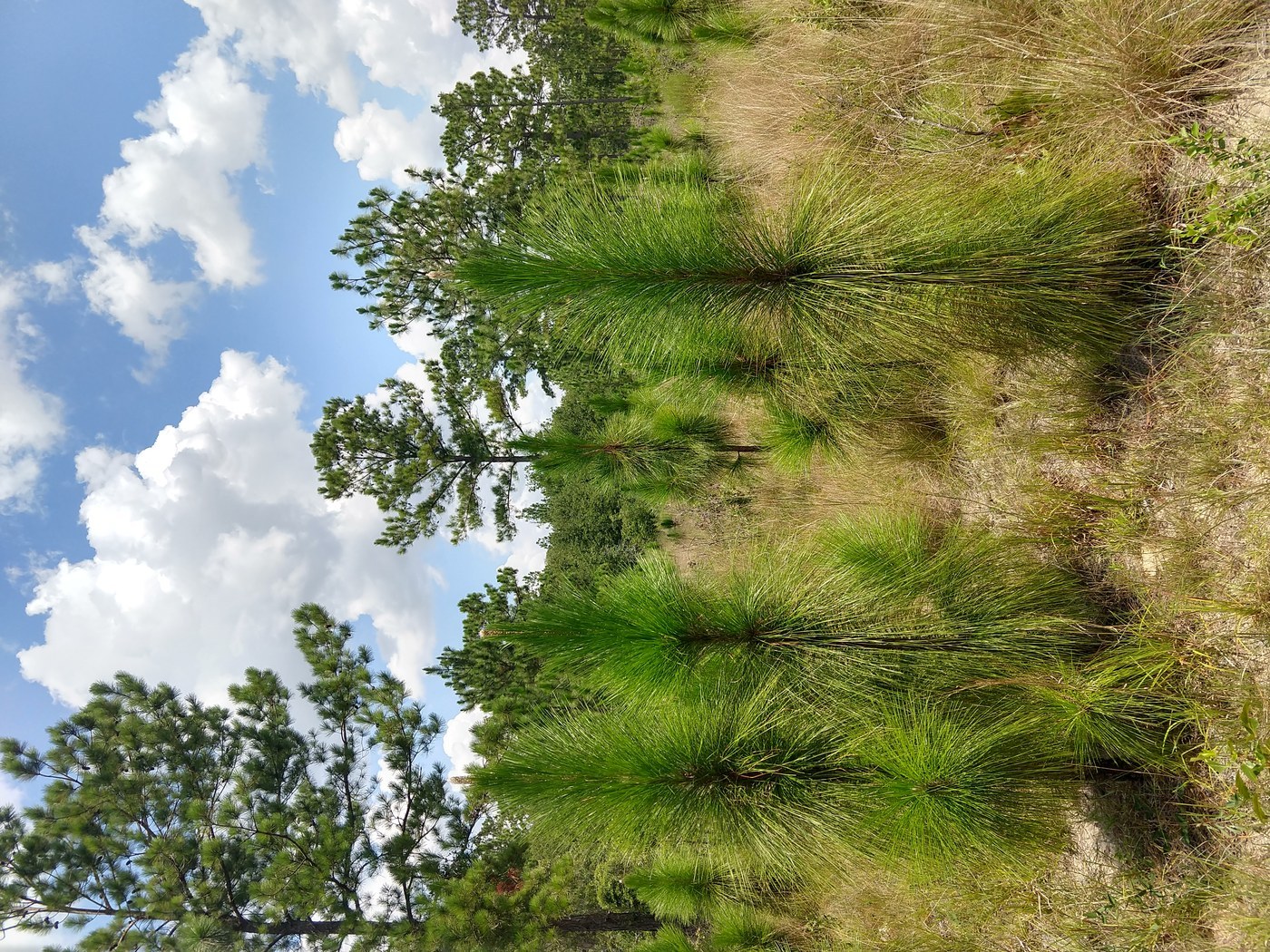
Key Identifying Features
Longleaf Pine (Pinus palustris) is the signature pine of the southeastern U.S. coastal plain. It is identified by its very long needles, large cones, prominent silvery-white terminal buds, and a famous grass-stage seedling that looks like a clump of grass for years before shooting upward.
- Very long needles (8–18 in) in bundles of three, tufted at branch tips
- Large cones (6–10 in) — among the biggest in the eastern U.S.
- Big, silvery-white, scaly terminal buds ("candles")
- Grass-stage seedlings that resemble dense grass tufts
Leaves & Stems
Needles are in fascicles of three, very long (8 to 18 inches), flexible, and bright to dark green, clustered into dense tufts ("pom-poms") at the ends of stout twigs. The conspicuous large, silvery-white terminal buds in winter are a reliable confirming feature. Bark is orange-brown to gray, in thin scaly plates. Young trees spend several years in the grass stage, a low fountain of needles protecting the bud while the root system develops — a key fire adaptation.
Flowers & Fruit
Cones are large, 6–10 inches long, dull brown, conical, with a small prickle on each scale. They are among the largest cones in eastern North America. Pollen cones are purplish and showy in early spring. Seeds are large and winged, dispersing in autumn.
How to Tell It Apart from Look-Alikes
- Slash Pine has needles in twos and threes, shorter (7–11 in), smaller cones, and no grass stage.
- Loblolly Pine has shorter needles (6–9 in) in threes, smaller cones, and slender buds.
- Pond Pine has shorter needles and tufts on the trunk.
- The combination of very long 3-needle tufts + huge cones + big silvery buds + grass-stage juveniles is unique to Longleaf.
Where You'll Find It
Longleaf Pine occupies the southeastern Atlantic and Gulf coastal plains, from southeastern Virginia to eastern Texas. It dominates fire-maintained, well-drained sandy uplands and was historically the keystone of vast longleaf-wiregrass savannas now greatly reduced.
Quick ID Checklist
- Very long needles (8–18 in) in 3s, tufted
- Large cones (6–10 in)
- Silvery-white terminal buds
- Grass-stage seedlings
- Southeastern U.S. coastal-plain sandy uplands
Frequently asked questions
What is the grass stage in Longleaf Pine?
It is a multi-year juvenile phase where the seedling stays low as a dense tuft of long needles, protecting the bud from fire while building roots before rapid height growth begins.
How do I tell Longleaf Pine from Loblolly or Slash Pine?
Longleaf has the longest needles, the largest cones, and distinctive big silvery-white winter buds, plus a grass stage that the others lack.
Why are the silvery buds important for ID?
The large, scaly, silvery-white terminal buds are a dependable year-round feature that, combined with the long tufted needles, confirms Longleaf Pine.
Where can I find Longleaf Pine?
Across the southeastern coastal plain from Virginia to eastern Texas, on fire-maintained, well-drained sandy uplands.