
Loquat Tree Identification Guide
Identify the loquat tree (Eriobotrya japonica) by its large leathery deeply-veined evergreen leaves, fragrant winter flowers, and clusters of orange spring fruit.
Read the full Loquat Tree encyclopedia entry →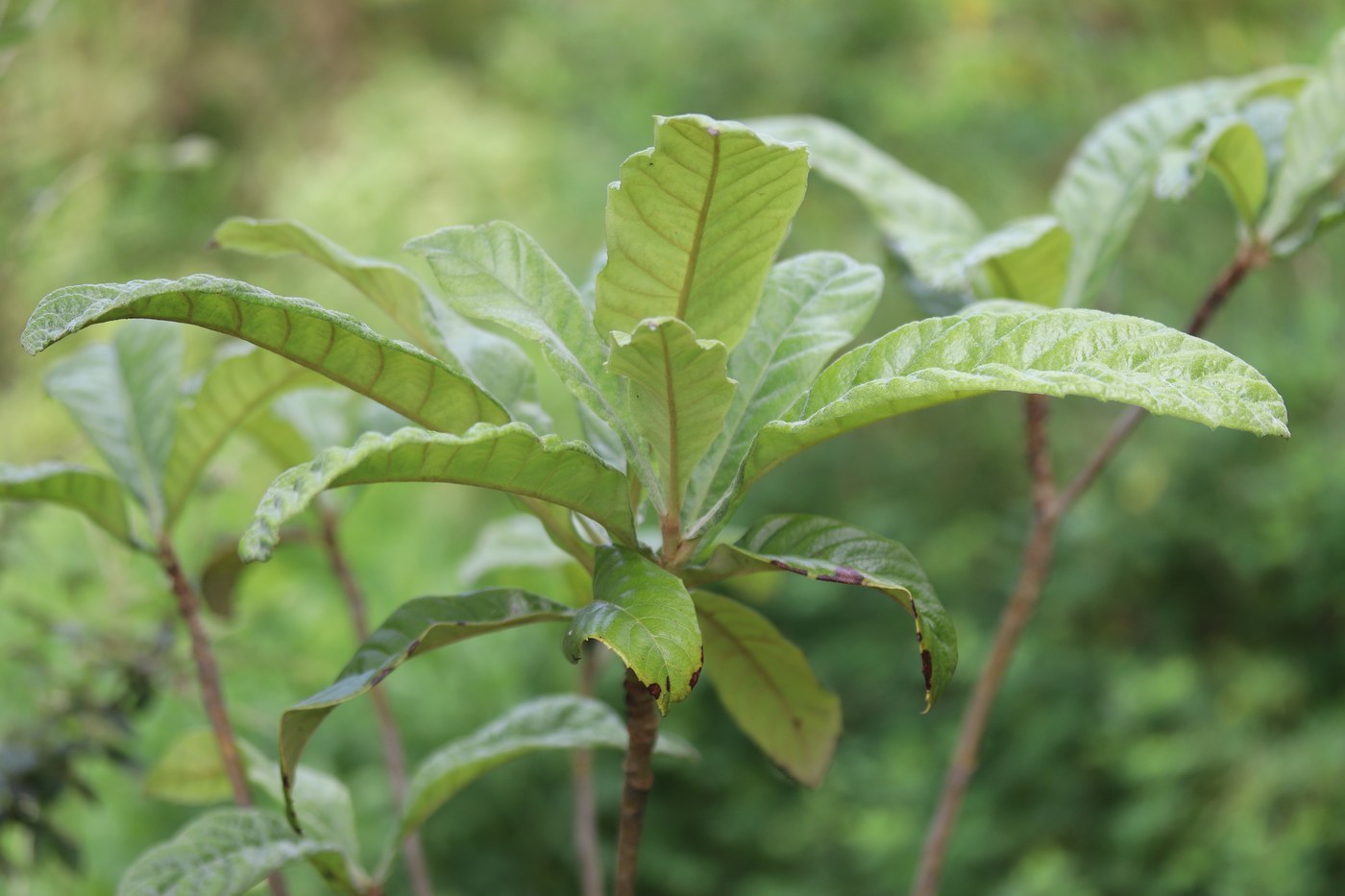
Key Identifying Features
Loquat (Eriobotrya japonica) is an evergreen tree 10-30 ft tall with a rounded crown, grown widely in warm-temperate and subtropical regions. It is easy to recognize by its large, stiff, dark-green leaves with deeply impressed parallel veins and a fuzzy underside, plus its unusual habit of flowering in autumn/winter and fruiting in early spring — opposite the timing of most fruit trees.
- Large (6-12 in.) leathery, coarsely toothed evergreen leaves
- Prominent sunken parallel veins; rusty-woolly leaf undersides
- Fragrant white flowers in fuzzy panicles in autumn/winter
- Clusters of small orange-yellow oval fruit in spring
Leaves & Stems
Leaves are alternate, simple, large (up to a foot long), elliptical to lance-shaped, dark glossy green above and densely rusty- or whitish-woolly beneath. The margins are coarsely toothed, and the veins are strongly parallel and deeply sunken, giving a quilted, corrugated texture — one of the most reliable ID features. New twigs and growing tips are covered in brown wool (tomentum). Bark is grayish and fairly smooth.
Flowers & Fruit
Loquat flowers in fall to winter, producing terminal panicles of small, fragrant, creamy-white five-petaled flowers densely coated in rusty-brown felt. The fruit ripens in late winter to spring as clusters of round-to-oval fruits 1-2 in., yellow to orange, with thin downy skin and juicy flesh surrounding a few large glossy brown seeds. The off-season flowering-and-fruiting cycle makes loquat easy to single out.
How to Tell It Apart from Look-Alikes
- Avocado: Evergreen with large leaves, but leaves are smooth, not corrugated or woolly, and fruit is a large green/black drupe.
- Magnolia (Southern): Glossy evergreen leaves with rusty undersides too, but margins are smooth (untoothed) and flowers are huge solitary white blooms, not small clustered ones.
- Mango: Smooth, narrow, untoothed leaves and reddish new growth; very different fruit.
- Photinia (relative): Smaller, finely toothed leaves and red new growth; far smaller fruit. Loquat's huge corrugated toothed leaves separate it.
Where You'll Find It
Loquat is cultivated and naturalized in warm-temperate, Mediterranean, and subtropical climates worldwide — common in California, the Gulf and Southeast U.S., the Mediterranean basin, China, and Japan. It is planted as an ornamental and fruit tree in gardens, streetscapes, and orchards, and self-seeds into hedges and disturbed ground in mild regions.
Quick ID Checklist
- Evergreen tree, 10-30 ft, rounded crown
- Large leathery leaves with deeply sunken parallel veins
- Rusty-woolly leaf undersides and new growth
- Coarsely toothed leaf margins
- Fragrant white flowers in autumn/winter
- Clusters of orange-yellow oval fruit in spring
Frequently asked questions
What is the easiest way to recognize a loquat?
Look for large, stiff, dark-green leaves with deeply sunken parallel veins and a fuzzy rusty underside, on an evergreen tree that flowers in winter and fruits in spring.
Why does it fruit so early in the year?
Loquat flowers in autumn and winter and ripens its orange fruit in late winter to spring, the opposite cycle of most fruit trees, which helps identify it.
How do I tell loquat from Southern magnolia?
Both have glossy evergreen leaves with rusty undersides, but loquat leaves are coarsely toothed and corrugated, and its flowers are small and clustered rather than large and solitary.
How big are loquat leaves?
Loquat leaves are large, often 6-12 inches long, leathery, coarsely toothed, with deeply sunken parallel veins and a rusty-woolly underside, making them one of the most distinctive features of the tree.