
Lovage Identification Guide
Identify lovage (Levisticum officinale) by its tall hollow stems, glossy celery-scented leaves, and yellow-green umbrella flower clusters.
Read the full Lovage encyclopedia entry →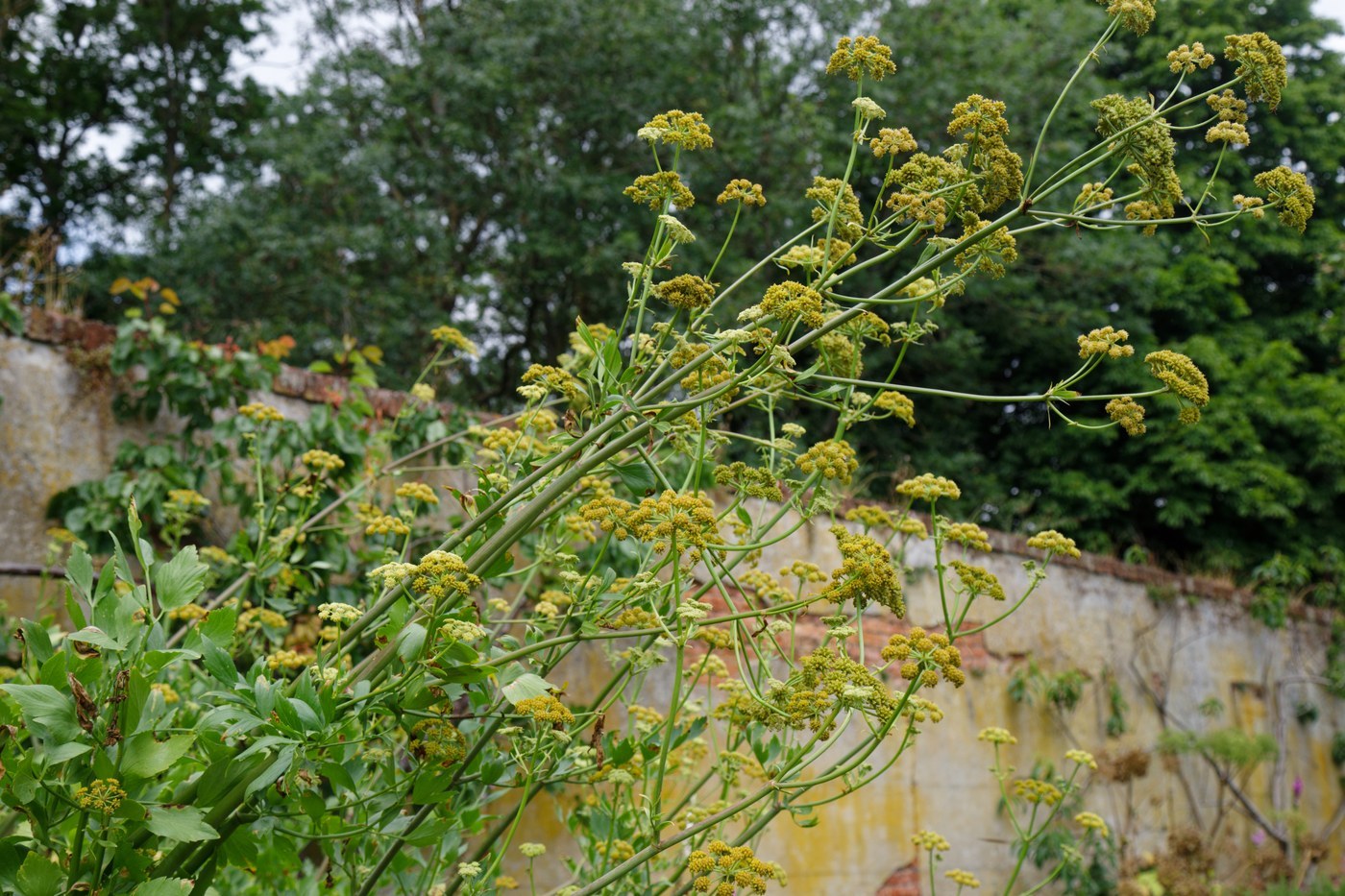
Key Identifying Features
Lovage (Levisticum officinale) is a tall perennial herb in the carrot family (Apiaceae). The standout clue is smell: crushed leaves and stems give off a strong, celery-like aroma (more intense than celery's). Other marks:
- A robust, hollow, ridged stem reaching 1.5-2.5 m at flowering.
- Glossy, dark green, divided leaves resembling overgrown celery foliage.
- Flat-topped yellow-green umbels (umbrella-shaped flower clusters).
Leaves & Stems
Leaves are alternate, large, and 2-3 times divided (pinnate) into broad, wedge-shaped leaflets with toothed or lobed tips, often coarsely cut at the ends. The foliage is shiny dark green and decidedly celery-scented. Leaf stalks are stout and channeled. The main stem is thick, hollow, ribbed, and smooth, branching toward the top. The whole plant is a vigorous clump-former arising from a thick aromatic rootstock.
Flowers & Fruit
Flowers form compound umbels 5-12 cm across of tiny pale yellow to greenish-yellow flowers, blooming in early to mid summer. Each umbel has small bracts at its base. The fruit are oval, ribbed schizocarps about 5-7 mm long that split into two winged halves, ripening yellowish-brown, again strongly aromatic.
How to Tell It Apart from Look-Alikes
The carrot family contains several similar-looking plants, so confirm carefully:
- Poison hemlock (Conium maculatum) has finely lacy, fern-like leaves, purple blotches on the stem, a mousy unpleasant smell, and white flowers — never the bold celery scent or yellow-green flowers of lovage.
- Angelica is also tall but has rounded leaf segments, dome-shaped greenish-white umbels, and a different sweet scent.
- Celery and celeriac are smaller, with the same family look but a milder smell and no towering hollow flowering stem.
When the plant is tall, smells distinctly of celery, has glossy divided leaves and yellow-green umbels, it is lovage. A white-flowered, purple-spotted, foul-smelling plant is a different species such as poison hemlock.
Where You'll Find It
Lovage is native to the Mediterranean region and naturalized in parts of Europe and North America. It is grown mostly in herb gardens, occasionally escaping to roadsides and waste ground. It favors moist, fertile soil in full sun to part shade.
Quick ID Checklist
- Strong celery scent from crushed leaves/stems
- Tall (1.5-2.5 m), hollow ribbed stem
- Glossy, 2-3x divided celery-like leaves
- Flat-topped yellow-green umbels
- No purple stem blotches (rules out poison hemlock)
Frequently asked questions
How do I tell lovage apart from poison hemlock?
Poison hemlock has finely lacy fern-like leaves, purple-blotched stems, white flowers, and a foul mousy smell. Lovage has glossy celery-like leaves, smooth unspotted stems, yellow-green flowers, and a strong celery aroma. The combination of glossy divided leaves, smooth green stems, and yellow-green umbels confirms lovage.
Why does lovage smell like celery?
Lovage and celery are both in the carrot family and share aromatic compounds, but lovage has a more concentrated, distinctly celery-like scent. Crushing a leaf to confirm this aroma is a key identification step.
How tall does lovage get?
At flowering it commonly reaches 1.5 to 2.5 meters on a thick, hollow, ribbed stem, making it one of the tallest herbs in a typical herb garden.
What do the flowers look like?
Lovage produces flat-topped compound umbels, 5-12 cm wide, of many tiny pale yellow to greenish-yellow flowers in early to mid summer, followed by ribbed, winged seeds.