
Lucky Bamboo Identification Guide
Identify Lucky Bamboo (Dracaena sanderiana) and learn why this water-grown 'bamboo' is actually a Dracaena, not a true bamboo.
Read the full Lucky Bamboo encyclopedia entry →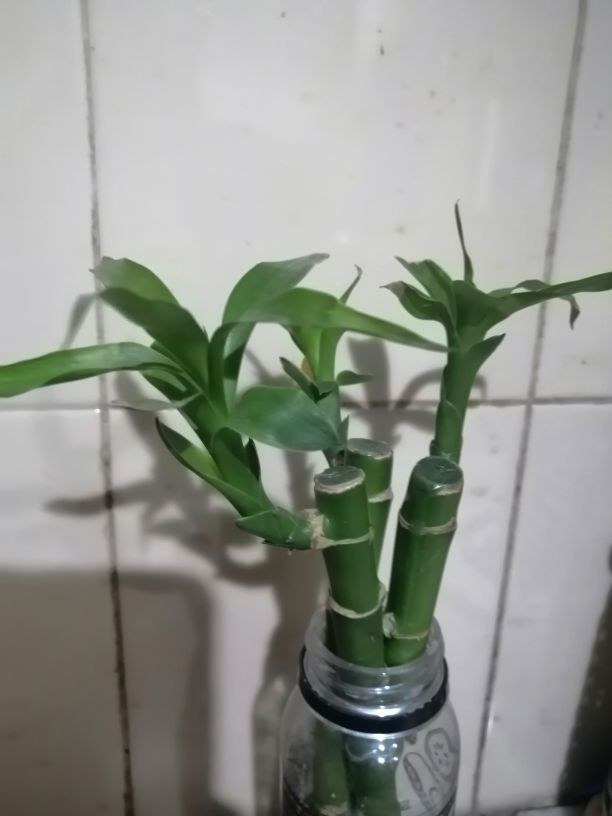
Key Identifying Features
Despite its name, Lucky Bamboo (Dracaena sanderiana) is not a bamboo at all — it is a member of the Dracaena genus. It is recognized by upright green canes that are often curled, braided, or trained into spirals and lattices, commonly sold growing in nothing but water and pebbles.
- Thick, jointed green stalks that superficially resemble bamboo culms
- Strap-like, lance-shaped leaves sprouting from the upper nodes
- Frequently sold rooted in water with decorative stones
- Stems often shaped into spirals, weaves, or "towers"
Leaves & Stems
The canes are solid (not the hollow culms of true bamboo) and segmented by raised rings called nodes, giving the bamboo-like look. Stalks stay green when healthy and yellow when stressed. Leaves are 5–25 cm long, slightly twisted, glossy green, sometimes edged or striped with creamy yellow or gray-green in variegated forms. New shoots emerge from the top nodes. The spiral shapes are not natural — growers create them by rotating the plant toward light over months.
Flowers & Fruit
Lucky Bamboo almost never flowers in cultivation, especially when grown in water. In rare mature outdoor specimens it may send up small, fragrant whitish flower clusters typical of Dracaena, but for identification purposes you should treat the absence of flowers as normal.
How to Tell It Apart from Look-Alikes
- True bamboo (Bambusa, Phyllostachys): has hollow culms, papery sheaths at each node, and feathery branching foliage; it cannot survive grown in a vase of water indefinitely.
- Other Dracaenas (e.g., D. fragrans "Corn Plant"): have wider arching leaves and woody trunks, not slim green segmented canes.
- The giveaway: Lucky Bamboo has solid green segmented stalks, grows happily in plain water, and is sold in twisted ornamental shapes — true bamboo does none of these.
Where You'll Find It
Native to Central Africa, it is now a ubiquitous gift and feng-shui plant sold worldwide. You will find it on desks, in offices, and at florists, usually in shallow dishes of water or low-light potted soil. It tolerates low light but prefers bright, indirect light, and is sensitive to chlorine and fluoride in tap water (leaf tips brown easily).
Quick ID Checklist
- Solid green segmented stalks with raised nodes (not hollow)
- Strap-like, slightly twisted green leaves from upper nodes
- Often grown in water with pebbles
- Stems shaped into spirals, braids, or lattices
- Rarely or never flowers indoors
Frequently asked questions
Is Lucky Bamboo really bamboo?
No. Lucky Bamboo is Dracaena sanderiana, a member of the Dracaena genus. It only resembles bamboo because of its segmented green stalks; true bamboo is a grass with hollow culms.
How can I tell Lucky Bamboo from true bamboo?
Lucky Bamboo has solid green stalks, grows in plain water, and is often sold in spirals. True bamboo has hollow culms, papery node sheaths, feathery leaves, and cannot live indefinitely in a vase of water.
Why is my Lucky Bamboo turning yellow?
Yellowing stalks usually signal stress from chlorinated or fluoridated tap water, too much direct sun, or fertilizer buildup. Healthy Lucky Bamboo keeps firm, uniformly green canes.
How do the stalks get their spiral shape?
Growers rotate the young plant beside a one-directional light source over many months so it curves toward the light. The spirals are trained, not natural.