Meadow Rue Identification Guide
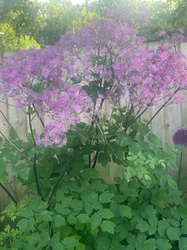
Identify Thalictrum species by their delicate columbine-like foliage and airy clouds of petalless, fluffy flowers.
Read the full Meadow Rue encyclopedia entry →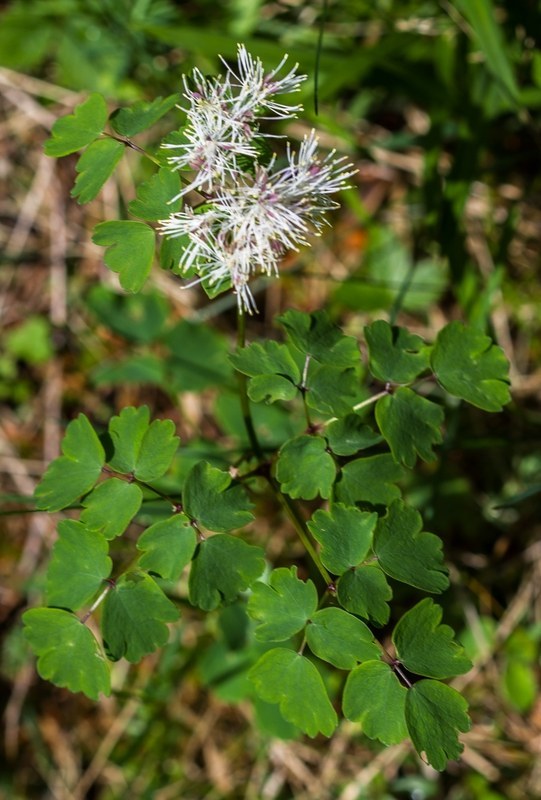
Key Identifying Features
Meadow rue (Thalictrum spp.) is a graceful perennial prized for its fern-like foliage and misty flower clusters. Across the many species, watch for:
- Finely divided, compound leaves that strongly resemble columbine (Aquilegia) foliage
- Airy, branching flower clusters with no true petals — the show comes from showy stamens or colored sepals
- A light, delicate texture throughout, often blue-green foliage
- Heights from 1 ft to over 8 ft depending on species
Leaves & Stems
The leaves are the best clue: they are 2-4 times divided (ternately compound) into small, rounded leaflets with shallow lobes or scalloped tips, much like maidenhair fern or columbine. Foliage is often a soft blue-green or gray-green. Stems are slender, upright, and sometimes purplish, branching airily near the top. The whole plant has a fine, see-through quality rather than dense mass.
Flowers & Fruit
Blooming late spring through summer (varying by species), meadow rue flowers are petalless. Their beauty comes from:
- Dangling tufts of stamens in yellow, cream, or purple (e.g., T. dioicum, T. rochebrunianum)
- Showy sepals in lilac, white, or pink that fall early in some species
Flowers cluster in loose, branching panicles that look like a haze or cloud above the foliage. Many species are dioecious. Fruits are small, ribbed, dry achenes in tight clusters.
How to Tell It Apart from Look-Alikes
- Columbine (Aquilegia) — nearly identical leaves, but columbine has large, spurred, bell-shaped flowers; meadow rue has fluffy petalless tufts.
- Maidenhair fern — similar leaflet shape, but ferns never flower and have spore dots beneath fronds.
- Astilbe — plumes can look similar from afar, but astilbe leaves are sharply toothed and glossy, not rounded and lobed.
- Corydalis / fumitory — ferny leaves too, but those have distinctly tubular, spurred flowers.
The pairing of columbine-style leaves with stamen-puff, petalless flowers confirms meadow rue.
Where You'll Find It
Meadow rues grow in moist meadows, open woods, stream banks, and mountain slopes across temperate North America, Europe, and Asia. They prefer part shade and moist, rich soil, and are popular at the back of perennial borders for their height and airiness.
Quick ID Checklist
- Columbine-like, multiply divided leaves with rounded, lobed leaflets
- Often blue-green foliage
- Airy branching flower clusters
- Flowers without petals — showy stamens or sepals instead
- Moist meadow or woodland habitat
A tall, ferny-leaved plant crowned by a haze of fluffy, petalless blooms is meadow rue.
Frequently asked questions
How is meadow rue different from columbine?
Their leaves look nearly identical, but the flowers differ completely: columbine has large spurred bells, while meadow rue has fluffy, petalless flowers made of showy stamens or sepals.
Do meadow rue flowers have petals?
No. The visual interest comes from colorful stamens or sepals, not true petals — the sepals often drop early.
Why does my meadow rue not set seed?
Many Thalictrum species are dioecious, so only female plants produce the small dry achenes; male plants bloom but bear no seed.
Where does meadow rue grow naturally?
In moist meadows, open woodlands, and along streams in part shade across temperate regions of the Northern Hemisphere.
Meadow Rue identified by the community
Recent Meadow Rue specimens identified with Plant Identifier.