
Mexican Sunflower Identification Guide
How to recognize Mexican sunflower (Tithonia rotundifolia) by its tall coarse growth, velvety leaves, and brilliant red-orange daisy flowers.
Read the full Mexican Sunflower encyclopedia entry →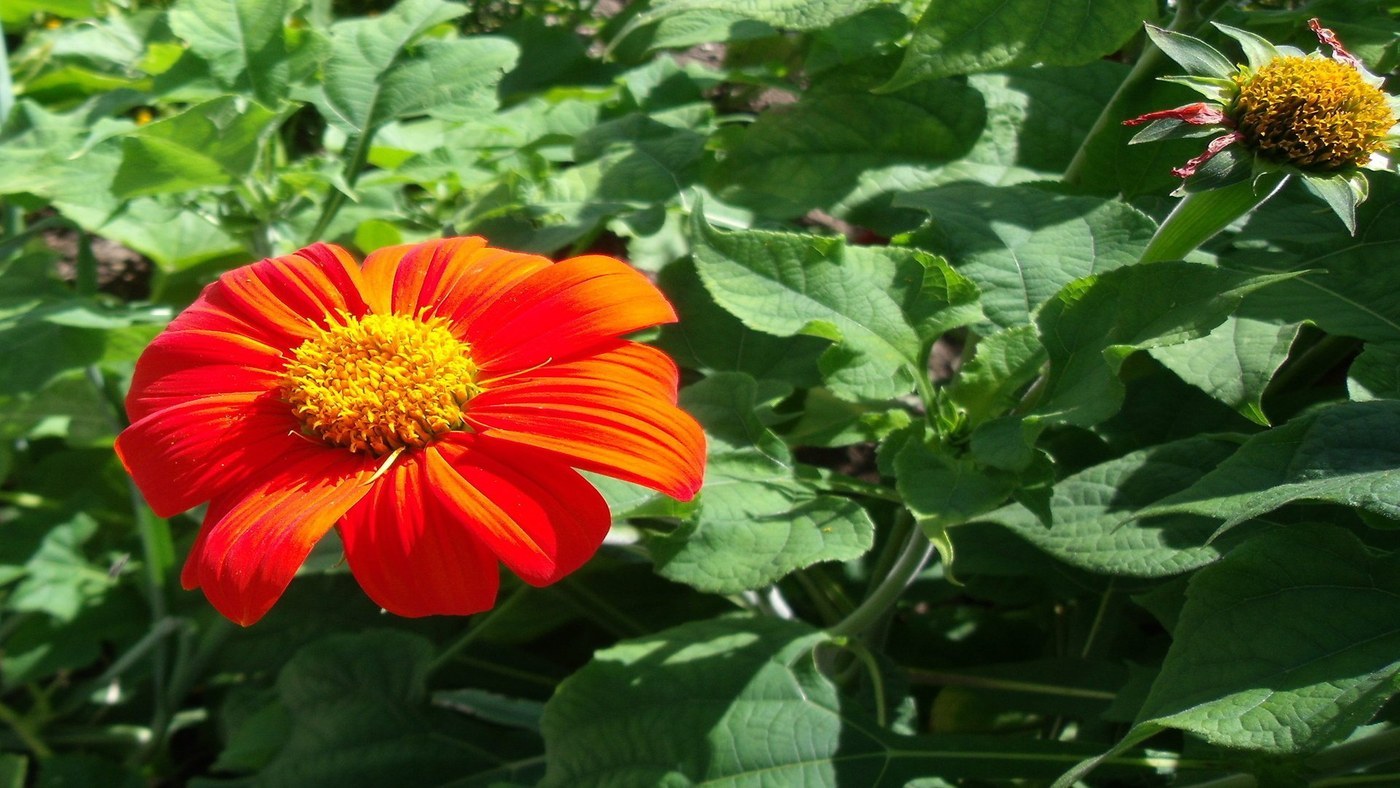
Key Identifying Features
Mexican sunflower (Tithonia rotundifolia) is a robust, fast-growing annual in the aster family (Asteraceae) that reaches 4–6 feet (sometimes 8 feet) in a single season. The standout trait is its vivid red-orange to scarlet daisy flowers, each 2–3 inches across, that glow against coarse green foliage and draw butterflies and bees in droves.
- Tall, bushy, multi-branched annual with a slightly woody base
- Hairy, somewhat rough (sandpapery) stems and leaves
- Brilliant orange-red ray florets around a yellow-orange central disk
- Flower stalks (peduncles) are notably swollen and hollow just below the bloom
Leaves & Stems
Leaves are alternate, large (up to 6–8 inches long), and broadly oval to three-lobed, with toothed margins and a pointed tip. The upper surface is dark green and velvety-hairy; the underside is paler and softly downy. Stems are stout, green to reddish, and covered in short hairs, giving the whole plant a fuzzy, coarse texture. The base becomes semi-woody as the season progresses, helping the plant stand upright despite its height.
Flowers & Fruit
Blooms appear from midsummer to frost. Each flower head has a single row of 8–14 orange-red ray florets surrounding a domed center of yellow disk florets. The cupped, club-shaped peduncle holding each head is a reliable clue. After flowering, heads produce small, dry, four-angled seeds (achenes) tipped with a few scales rather than fluffy bristles.
How to Tell It Apart from Look-Alikes
- Common sunflower (Helianthus annuus) has much larger yellow heads with brown centers and rougher, single-stalked form; Tithonia is brighter orange-red and bushier.
- Torch tithonia (Tithonia diversifolia) is a taller, woodier perennial shrub with deeply lobed leaves and yellow (not orange-red) flowers.
- Zinnias have stiffer, papery petals and opposite leaves; Tithonia's leaves are alternate and its peduncle is swollen.
- The hollow, swollen flower stalk plus velvety leaves quickly separates it from most other daisy-flowered annuals.
Where You'll Find It
Native to Mexico and Central America, it is grown worldwide as a garden annual and frequently self-sows. Look for it in full-sun borders, pollinator gardens, and disturbed warm sites. It thrives in heat and poor, dry soil, often outgrowing nearby plants. In frost-free regions it can escape cultivation along roadsides.
Quick ID Checklist
- Tall (4–6+ ft), bushy, hairy annual
- Velvety, oval to 3-lobed alternate leaves
- Bright orange-red daisy flowers with yellow centers
- Swollen, hollow stalk just below each bloom
- Blooms midsummer to frost, loved by butterflies
If you see a head-high annual blazing orange-red with fuzzy leaves and butterfly traffic, you are almost certainly looking at Mexican sunflower.
Frequently asked questions
How is Mexican sunflower different from a regular sunflower?
Mexican sunflower has smaller, brilliant orange-red flowers (2–3 inches) with yellow centers and a bushy, multi-branched habit, while common sunflowers have large yellow heads with dark brown centers on coarser single stalks.
What does the swollen stalk under the flower tell me?
That cupped, hollow, club-shaped peduncle just below each bloom is a classic Tithonia signature and helps separate it from zinnias and true sunflowers.
Are the leaves hairy or smooth?
They are velvety and slightly rough to the touch, dark green above and paler, softly downy beneath, typically oval to three-lobed with toothed edges.
When does it bloom?
Mexican sunflower flowers from midsummer until the first hard frost, peaking in the heat of late summer.