
Milk Thistle Identification Guide
Identify milk thistle by its glossy, spiny, white-marbled leaves and large solitary purple flower heads surrounded by stout sharp-tipped spiny bracts.
Read the full Milk Thistle encyclopedia entry →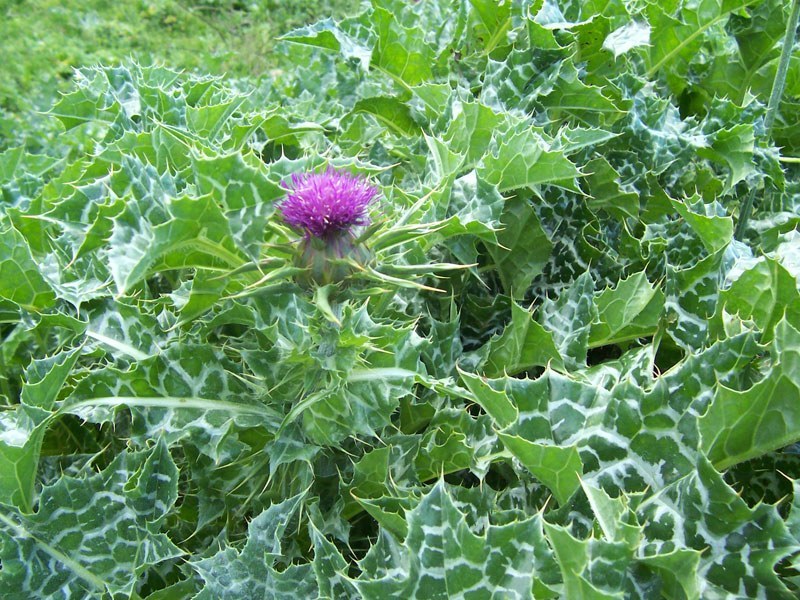
Key Identifying Features
Milk thistle (Silybum marianum) is a stout annual or biennial in the daisy family (Asteraceae). Its single most diagnostic feature is its large, glossy green leaves marbled with distinctive milky-white veins or marbling, as if splashed with milk — the origin of both its common name and the genus association with the Virgin Mary. Combined with fierce yellow spines and big purple flower heads, it is hard to mistake.
- Robust plant 0.5–2 m (1.5–6.5 ft) tall
- Glossy leaves with bold white marbling and spiny margins
- Large solitary purple (red-purple) flower heads
- Flower heads ringed by stout, spine-tipped bracts
Leaves & Stems
Leaves are large, glossy deep green, with conspicuous white veins/marbling, and deeply lobed margins armed with sharp yellow spines. Basal leaves form a rosette up to 50 cm long; upper stem leaves are smaller and clasp the stem. Stems are stout, grooved, branching, and often slightly woolly. The bold white-on-green leaf pattern is unmistakable even before flowering.
Flowers & Fruit
In summer, single large flower heads (4–8 cm across) of red-purple to pink disc florets appear at the branch tips. Each head is surrounded by broad green bracts that taper into long, stiff, spreading yellow spines — a key ID feature. After flowering, the heads produce shiny brown-black seeds topped with a white pappus (down) for wind dispersal.
How to Tell It Apart from Look-Alikes
- Other thistles (Cirsium, Carduus): lack the bold white-marbled leaves; their foliage is plain green and often hairier, and flower heads are usually smaller and clustered, not large and solitary with such stout spiny bracts.
- Blessed thistle (Cnicus benedictus): has yellow flowers and less marbling.
The glossy white-marbled spiny leaves plus large solitary purple heads with spine-tipped bracts confirm milk thistle.
Where You'll Find It
Native to the Mediterranean and southern Europe, milk thistle is naturalized widely (including much of North America and Australia, where it is often a noxious weed). It grows in dry, sunny, disturbed ground: roadsides, pastures, fields, and waste areas, thriving in poor soils and full sun.
Quick ID Checklist
- Glossy green leaves with bold white marbling
- Spiny, lobed leaf margins
- Large solitary red-purple flower heads
- Stout spine-tipped bracts around each head
- Tall, robust plant in dry, sunny waste ground
A tall thistle with milk-splashed white-veined glossy leaves and big purple flower heads guarded by sharp spiny bracts is milk thistle.
Frequently asked questions
What makes milk thistle's leaves so distinctive?
The glossy green leaves are boldly marbled with milky-white veins, looking as though milk was splashed across them. This white marbling, combined with sharp spiny margins, is the easiest way to identify the plant even before it flowers.
How is it different from other thistles?
Most thistles have plain green, often hairy leaves and smaller clustered flower heads. Milk thistle has uniquely white-marbled leaves and large, solitary purple heads ringed by stout, spreading, spine-tipped bracts.
What do the flowers look like?
Large (4–8 cm) solitary heads of red-purple to pink florets, each surrounded by broad green bracts that taper into long, stiff yellow spines.
Where does milk thistle grow?
In dry, sunny, disturbed places like roadsides, pastures, fields, and waste ground. Native to the Mediterranean, it has naturalized widely and is considered a weed in many regions.