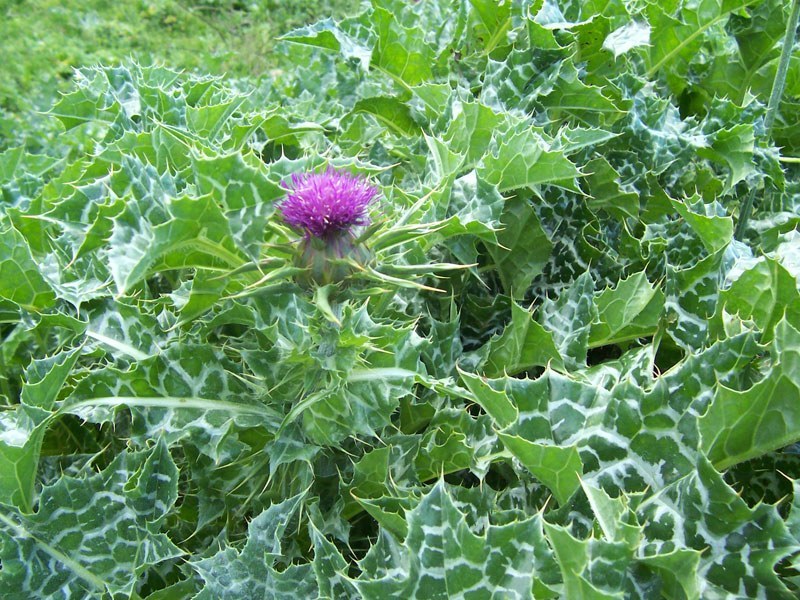
Milk Thistle
Silybum marianum
Milk thistle is a striking, spiny thistle with glossy white-marbled leaves and large purple flower heads. Robust and self-seeding, it can become a weed in warm climates.
- Light
- Full sun
- Water
- Low; drought-tolerant
- Difficulty
- Easy
Got a plant like this?
Identify any plant from a photo, free.
Overview
Milk thistle is a tall annual or biennial in the daisy family (Asteraceae), instantly recognizable by its glossy green leaves boldly marbled with white veining and its large, spiny purple flower heads. The white marbling gave rise to the legend that it came from the Virgin Mary's milk, hence the names 'Mary thistle' and 'holy thistle'.
Robust and self-seeding, it can become a weed in warm climates.
How to identify it
- Leaves: Large, glossy green with distinctive white marbled veins, deeply lobed and edged with sharp spines
- Flowers: Large, solitary, purple-pink thistle heads surrounded by stout spiny bracts
- Habit: Bold, erect plant typically 1-2 m tall
- Seeds: Shiny brown-black seeds (achenes) topped with a tuft of white hairs (pappus)
- Stems: Thick, grooved, branching
Care & growing
- Light: Full sun
- Water: Low; very drought-tolerant once established
- Soil: Tolerant of poor, dry, well-drained soils
- Temperature: Hardy, roughly zones 5-9; grown as an annual or biennial
- Feeding: Not needed; thrives on lean ground
- Propagation: From seed sown in spring; it self-seeds readily, so deadhead before seeds disperse if you want to prevent spreading
Habitat & origin
Milk thistle is native to the Mediterranean region, southern Europe and the Middle East, growing in dry, sunny, disturbed ground, roadsides and overgrazed pastures. It has naturalized widely in North and South America, Australia and elsewhere.
In many warm regions it is regarded as an invasive weed of rangeland.
Frequently asked questions
Why is it called milk thistle?
Because of the milky-white marbling on its leaves, which legend attributes to the Virgin Mary's milk falling on the plant.
Is milk thistle invasive?
It can be. It self-seeds prolifically and is a noxious weed in some warm regions, so deadhead it before the seeds disperse if you grow it in a garden.
How do you identify milk thistle?
Look for large glossy green leaves with striking white marbled veins, sharp spines along lobed edges, and solitary purple-pink thistle flower heads on a stout plant 1-2 m tall.
How big does milk thistle get?
It is a bold, erect annual or biennial typically 1 to 2 m tall, with thick, grooved, branching stems.
Milk Thistle guides
In-depth guides for identifying, growing, and caring for Milk Thistle.
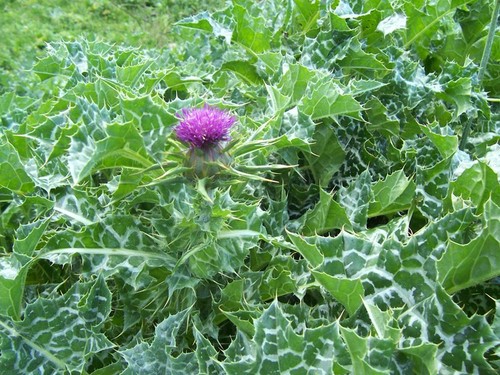
How to Care for Milk Thistle
Grow bold, marble-veined milk thistle for dramatic foliage and purple blooms. An easy, sun-loving, drought-tolerant plant for lean soils.
Milk Thistle Identification Guide
Identify milk thistle by its glossy, spiny, white-marbled leaves and large solitary purple flower heads surrounded by stout sharp-tipped spiny bracts.