
Mock Orange Identification Guide
How to identify mock orange by its opposite leaves and intensely citrus-fragrant four-petaled white flowers in early summer.
Read the full Mock Orange encyclopedia entry →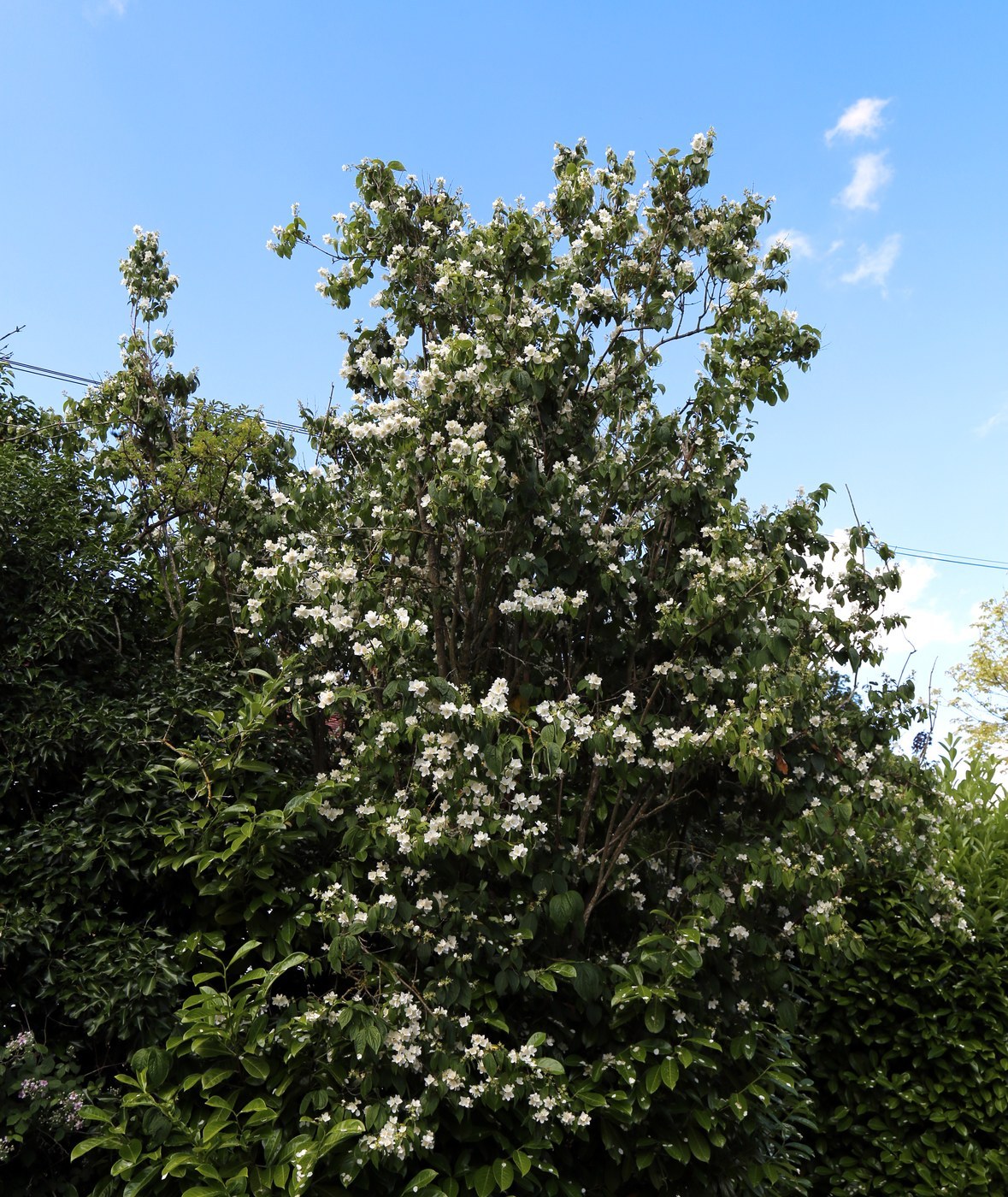
Key Identifying Features
Mock orange (Philadelphus spp.) is a deciduous shrub grown almost entirely for its showy white flowers with a powerful, citrus-orange-blossom fragrance in early summer—the source of its common name. Identify it by its opposite leaves, arching stems, and clusters of four-petaled white flowers with a tuft of yellow stamens. Out of bloom it can be plain, so the opposite leaves and peeling older bark are useful clues.
- Opposite, simple, oval leaves with a few teeth
- Pure white, four-petaled, fragrant flowers (citrus scent)
- Arching, upright shrub, 4-10 ft, often suckering
- Peeling/shredding gray-brown bark on older stems
Leaves & Stems
Leaves are opposite, simple, oval to lance-shaped, 1.5-4 inches long, with a pointed tip and scattered small teeth along the margin (sometimes nearly smooth). Veins are usually three-to-five prominent ones from the base. Foliage is medium green with little fall color. Stems arch outward; older bark is gray-brown and peels or shreds in thin strips, while young stems may be reddish-brown. The opposite leaves plus exfoliating bark help separate it from look-alikes when not in flower.
Flowers & Fruit
Flowers are the signature feature: borne in late spring to early summer in clusters at branch tips, each is 1-2 inches across with four broad, rounded white petals (some cultivars semi-double) surrounding a cluster of yellow stamens. The fragrance is strong and sweet, like orange blossoms or jasmine—the single most diagnostic trait. After bloom, small, dry, woody seed capsules form. There are no showy berries.
How to Tell It Apart from Look-Alikes
- Deutzia: related and similar arching shrub with white flowers, but blooms are smaller, often star-shaped, only lightly scented, with toothed leaves; mock orange flowers are larger and powerfully fragrant.
- Hydrangea: opposite leaves but flowers in big domed/flat clusters, not single four-petaled blooms.
- Single white roses / Rosa: five petals and thorns; mock orange has four petals and no thorns.
- Tree mock-orange (Pittosporum) / other 'mock oranges': evergreen with different leaves—check that it's deciduous with four-petaled flowers.
The four white petals + strong citrus fragrance + opposite peeling-bark stems confirm Philadelphus.
Where You'll Find It
Various mock oranges are native to North America, Europe, and Asia, growing on wooded slopes, stream banks, and rocky hillsides; Philadelphus lewisii is the state flower of Idaho. In gardens it's a classic old-fashioned fragrant flowering shrub for sun to part shade and average, well-drained soil.
Quick ID Checklist
- Deciduous arching shrub, 4-10 ft
- Opposite oval leaves, lightly toothed
- Four-petaled pure white flowers in early summer
- Strong orange-blossom/citrus fragrance
- Peeling gray-brown bark on old stems; dry seed capsules (no berries)
Frequently asked questions
Why is it called mock orange?
The white flowers smell strongly of orange blossoms even though the plant is unrelated to citrus, so it 'mocks' the scent of orange. This intense citrus-sweet fragrance is the best way to confirm it.
How do I tell mock orange from deutzia?
Both are arching white-flowered shrubs, but mock orange has larger four-petaled flowers with a powerful orange-blossom scent, while deutzia has smaller, often star-shaped flowers with little to no fragrance.
Does mock orange produce fruit?
It forms small, dry, woody seed capsules rather than fleshy berries. The plant is grown for flowers and fragrance, not fruit.
My mock orange isn't flowering, how can I still ID it?
Look for opposite, lightly toothed oval leaves on arching stems with gray-brown bark that peels in thin strips. Pruning at the wrong time (after midsummer) removes next year's flower buds, which often explains a non-blooming plant.