
Monkey Puzzle Tree Identification Guide
How to identify the Monkey Puzzle Tree (Araucaria araucana) by its unmistakable spiky, reptilian branches, rigid leathery scale-leaves, and umbrella-shaped silhouette.
Read the full Monkey Puzzle Tree encyclopedia entry →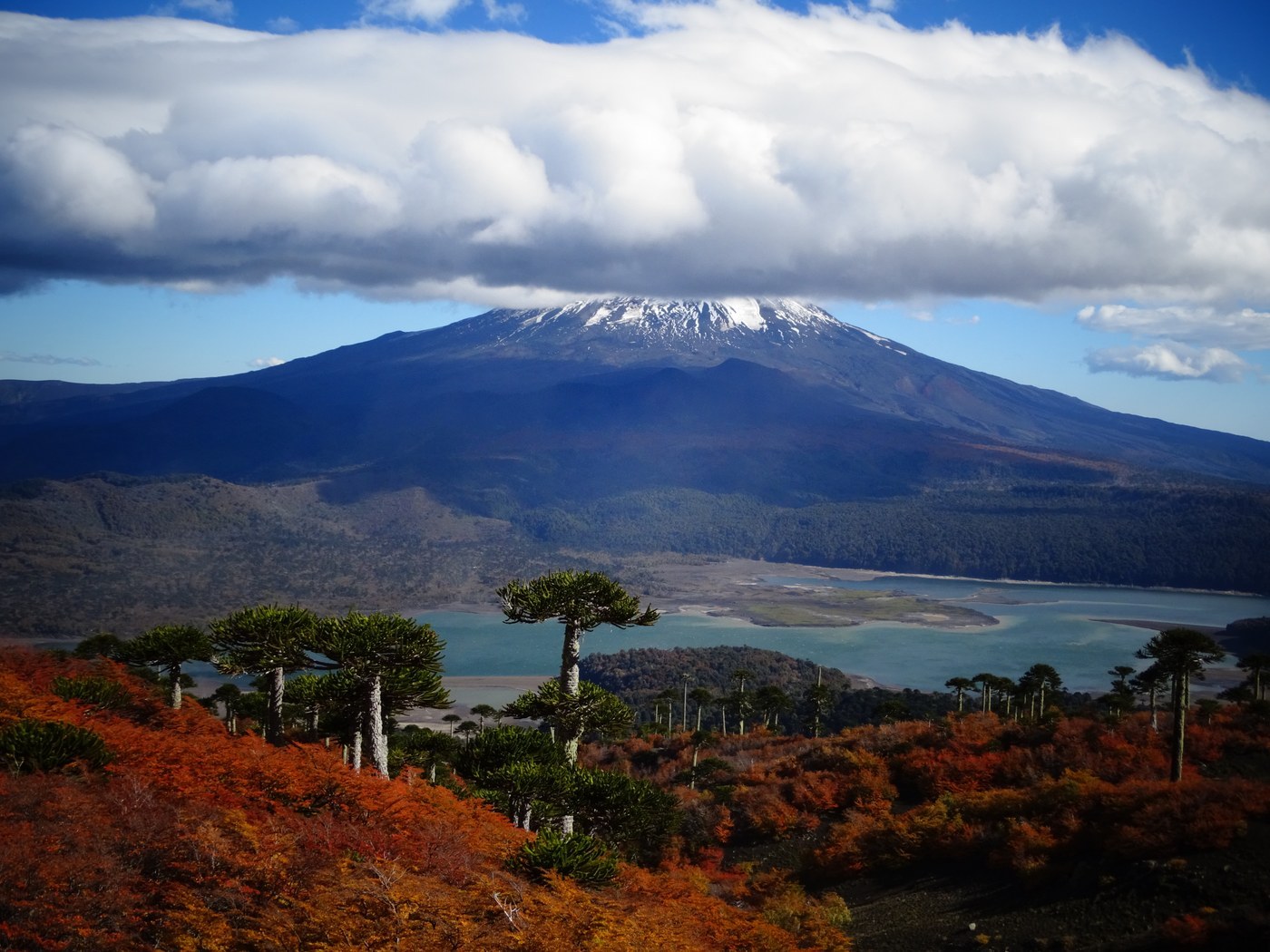
Key Identifying Features
The Monkey Puzzle Tree (Araucaria araucana) is one of the most instantly recognizable conifers on Earth. Look for:
- Stiff, dark green, triangular leaves that completely cover the branches like overlapping scales
- A dome-like or umbrella-shaped crown that becomes flat-topped with age
- Thick, ropy branches that look like a reptile's tail or a green pipe-cleaner
- A tall, straight trunk with wrinkled, gray, elephant-hide bark
Mature trees reach 20-40 m (65-130 ft) and have a stark, prehistoric outline visible from a distance.
Leaves & Stems
The leaves are the dead giveaway. Each is a thick, leathery, sharply pointed scale about 3-4 cm long and 1-3 cm wide, dark glossy green, and extremely rigid and spine-tipped. They are arranged spirally and densely overlap, so the branch looks armored. Leaves persist on the tree for 10-15 years or more, even staying green on the older inner branches.
Branches are produced in whorls (rings) around the trunk, sweeping upward at the tips. Lower branches are often shed as the tree ages, leaving a clean trunk topped by an umbrella of foliage. The bark is gray-brown, thick, and marked with horizontal wrinkles resembling skin.
Cones & Seeds
Monkey Puzzles are usually dioecious (separate male and female trees).
- Male cones are oblong, cucumber-like, 8-12 cm long, brown, and clustered at branch tips
- Female cones are large, rounded, 15-20 cm across, green ripening to brown, and break apart when mature
- Each female cone holds 120-200 large seeds (piñones)
How to Tell It Apart from Look-Alikes
- Bunya Pine (Araucaria bidwillii) and Norfolk Island Pine (A. heterophylla) are relatives, but their leaves are softer, smaller, and far less spiny; the Norfolk Island Pine has a feathery, soft look rather than the armored Monkey Puzzle branch.
- Cook Pine (A. columnaris) is narrowly columnar with juvenile needle-like foliage, not broad spiny scales.
- No true pine, spruce or fir has the broad, overlapping, dagger-pointed scale-leaves of the Monkey Puzzle — if the foliage hurts to grip, it's almost certainly A. araucana.
Where You'll Find It
Native to the slopes of the Andes in central Chile and western Argentina, where it forms ancient forests. It is the national tree of Chile. Widely planted as an ornamental and curiosity in cool temperate gardens across the UK, the Pacific Northwest, New Zealand, and parts of Europe, where its strange silhouette stands out in parks and large lawns.
Quick ID Checklist
- Rigid, sharp, dark-green triangular scale-leaves densely covering the branches
- Reptilian, rope-like branches in whorls around the trunk
- Umbrella or dome-shaped crown, often with a bare lower trunk
- Gray, wrinkled elephant-skin bark
- Large rounded female cones or cucumber-shaped male cones
- Foliage too prickly to grip comfortably — the classic field test
Frequently asked questions
Why is it called the Monkey Puzzle Tree?
The name comes from a 19th-century remark in England that climbing the spine-covered branches would puzzle even a monkey. The tree has no native monkeys in its Chilean range; the name is purely a Victorian nickname.
How can I be sure it's a Monkey Puzzle and not a Norfolk Island Pine?
Touch the foliage (carefully). Monkey Puzzle leaves are hard, broad, overlapping scales that are genuinely sharp and difficult to grip. Norfolk Island Pine foliage is soft, fine, and feathery, with a tiered, layered look.
How big does it get and how fast does it grow?
It is slow-growing but long-lived, often surpassing 1,000 years. Mature trees commonly reach 20-40 m tall, developing the characteristic tall bare trunk and umbrella crown over many decades.